Revolutionary Fintech Web Design That Drives Customer Acquisition
Transform your financial technology platform with Bay Area websites engineered for conversion, compliance, and competitive advantage in today’s digital finance landscape
Best Fintech Company Websites: California Examples That Make Complex Finance Feel Simple
Fintech company websites face a communication paradox: they must explain fundamentally new ways of managing money to audiences ranging from individual consumers making a single purchase decision to enterprise CFOs evaluating multi-year software contracts, all while projecting the security, trust, and regulatory compliance that financial products demand by default. The best fintech websites in California solve this paradox through precision positioning, confident visual design, and content architecture that makes complexity disappear. The companies below represent the benchmark for how California’s fintech category leaders build digital presence that converts across every buyer type they serve.
Blend
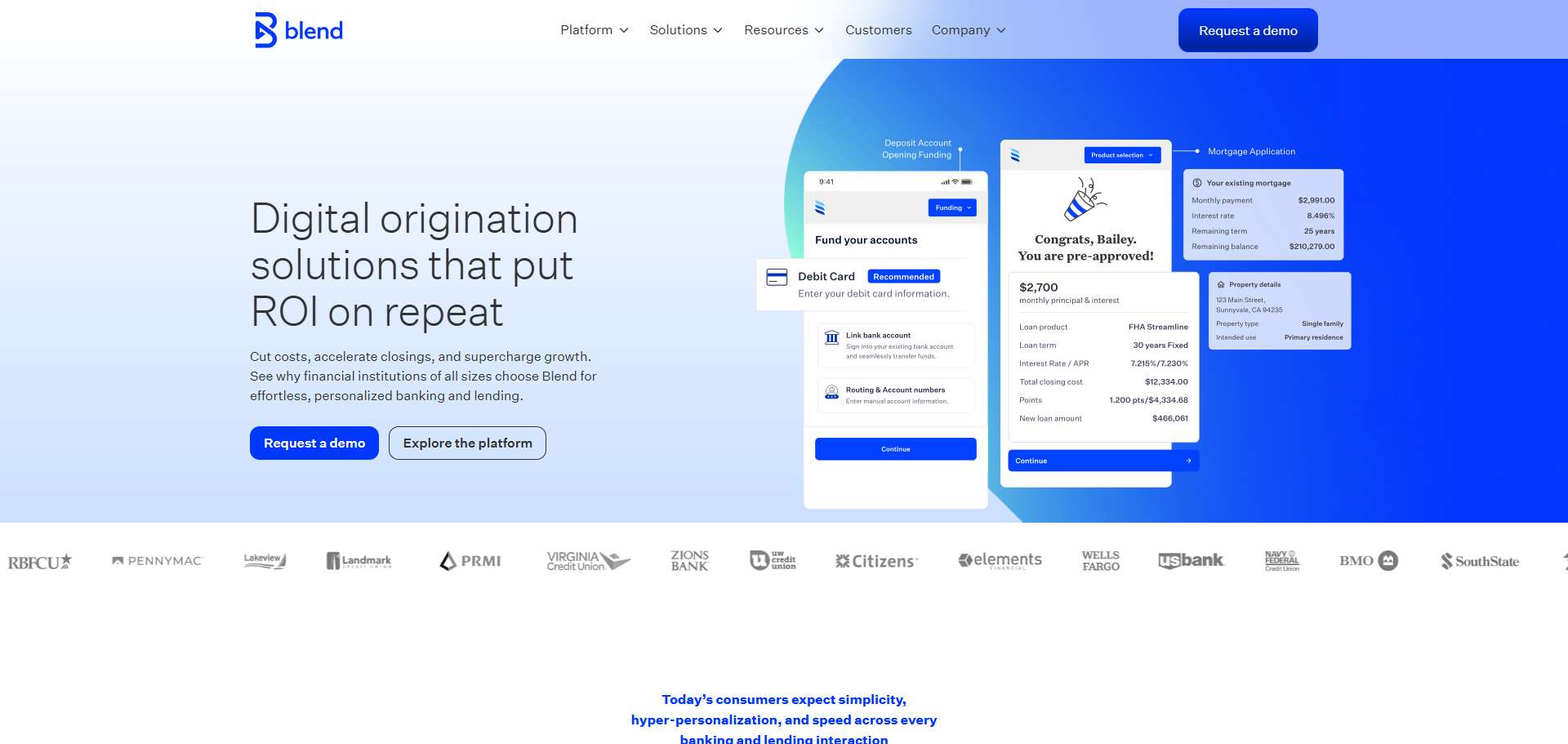
Blend — the San Francisco digital lending platform powering mortgage originations and consumer banking for banks, credit unions, and independent mortgage bankers — demonstrates one of the most sophisticated B2B fintech product architectures of any company in this group. The platform navigation reveals the full scope of the Blend offering across two distinct product suites: the Home Lending Suite (Mortgage Originations, Verifications, Lender Tools, Close, Rapid Home Refi, and Rapid Home Equity) and the Consumer Banking Suite (Deposit Accounts and Consumer Loans) — with a dedicated Platform layer covering Intelligent Origination, Blend Autopilot, and Partners and Integrations. This three-tier architecture communicates the full lifecycle of a digital lending operation in a single navigation structure, immediately telling lender prospects that Blend covers not just origination but the entire journey from application to close. The Solutions track — organized by institution type: Credit Unions, Banks, and IMBs (Independent Mortgage Bankers) — ensures that each visitor type finds a tailored entry point with messaging specific to their regulatory environment and operational priorities. Blend Autopilot, highlighted as a dedicated AI product within the platform section, positions the company at the intersection of mortgage technology and artificial intelligence at a moment when the lending industry is actively evaluating which AI capabilities will deliver measurable efficiency gains. The client roster — U.S. Bank, BMO Harris, Navy Federal Credit Union, Lennar Mortgage, and Movement Mortgage — provides enterprise-grade social proof that directly answers the due diligence question every community bank and credit union evaluator asks: do institutions our size already trust this platform?
Brex
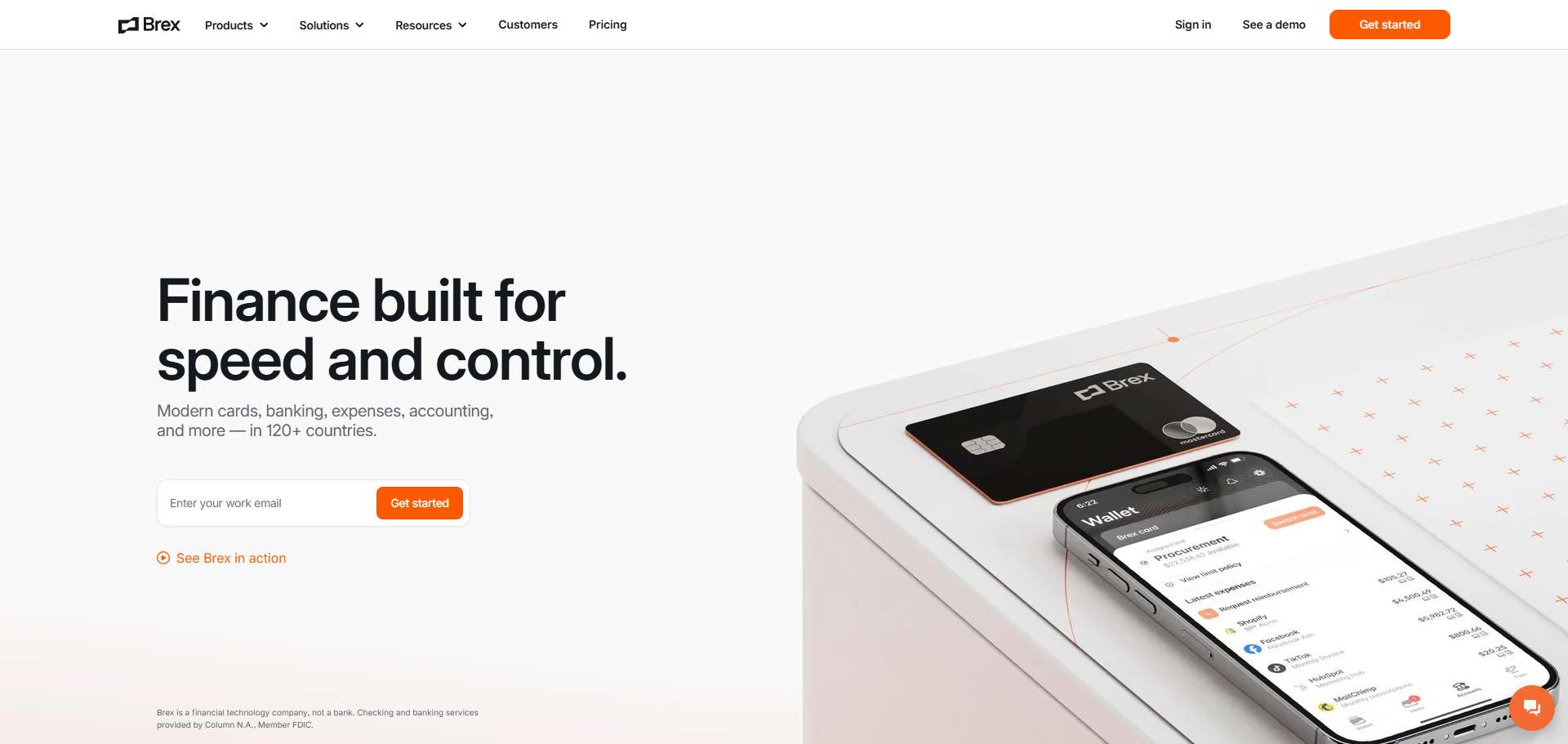
Brex — the San Francisco corporate finance platform serving startups, growth companies, and enterprises across 120+ countries — leads with a homepage headline that is bold, direct, and precisely targeted at the CFO and finance team audience it serves: “Finance built for speed and control.” This six-word value proposition communicates both the operational outcome (speed) and the governance outcome (control) that define the two most pressing priorities of a modern corporate finance team, without requiring the visitor to navigate through product features to understand what Brex actually delivers. The product breadth communicated below the fold — modern cards, banking, expenses, accounting, and more — signals that Brex has evolved from its startup corporate card origins into a full-stack finance operating system, a positioning shift that the website communicates with the confidence of a company that has $1.2B in annual revenue and over $1.1B in total funding validating its trajectory. The three-CTA navigation bar — Sign in, See a demo, Get started — serves three distinct buyer stages simultaneously: existing customers, enterprise prospects requiring a guided evaluation, and self-serve users ready to onboard immediately. The “Finance built for speed and control” headline paired with the global scale message (120+ countries) positions Brex as the solution for both the Bay Area hypergrowth startup and the multinational enterprise, a dual-market appeal that few fintech competitors can credibly claim. The Customers page — with case studies organized by company stage and industry — converts abstract platform claims into documented outcomes for the specific types of companies evaluating Brex.
BlackLine
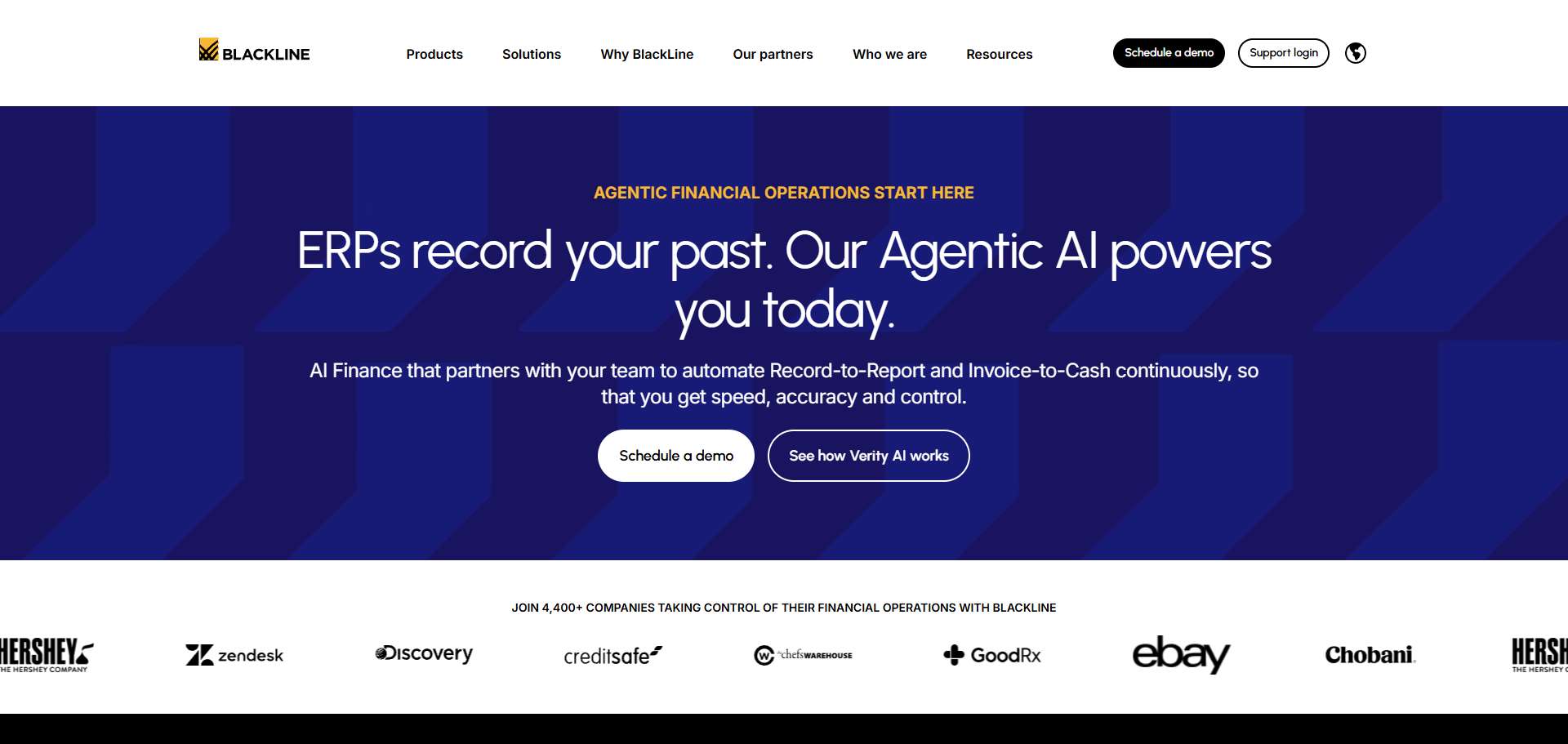
BlackLine — the California-based publicly traded SaaS platform serving 4,400+ companies with AI-powered financial close, intercompany, and invoice-to-cash automation — opens with one of the most confident category positioning statements in enterprise fintech: “ERPs record your past. Our Agentic AI powers you today.” This headline directly confronts the incumbent technology — ERP systems like SAP and Oracle — that BlackLine’s platform is designed to augment and automate, positioning the company not as a competitor to enterprise resource planning systems but as the intelligent automation layer that transforms ERP data into real-time financial intelligence. The Verity AI product, featured in the hero as the engine of the company’s Agentic Financial Operations positioning, communicates that BlackLine has moved beyond rule-based automation into AI systems that can take autonomous action within the Record-to-Report and Invoice-to-Cash workflows — a claim that directly addresses the AI transformation priorities of the enterprise CFOs and Controllers who make BlackLine’s procurement decisions. The customer metric — 4,400+ companies taking control of their financial operations — is placed directly below the hero with a logo carousel that functions as an instant credibility check for any new enterprise prospect evaluating the platform. The recognition from Gartner Peer Insights, G2, and TrustRadius — cited prominently throughout the site — provides the analyst and peer validation that enterprise software buyers use as primary input in their evaluation process. The dual CTA architecture — Schedule a demo alongside Support login — simultaneously serves prospects and existing clients from the same header, reflecting the operational reality that a company with thousands of enterprise clients needs its website to function as both a sales tool and a customer success portal.
Afterpay
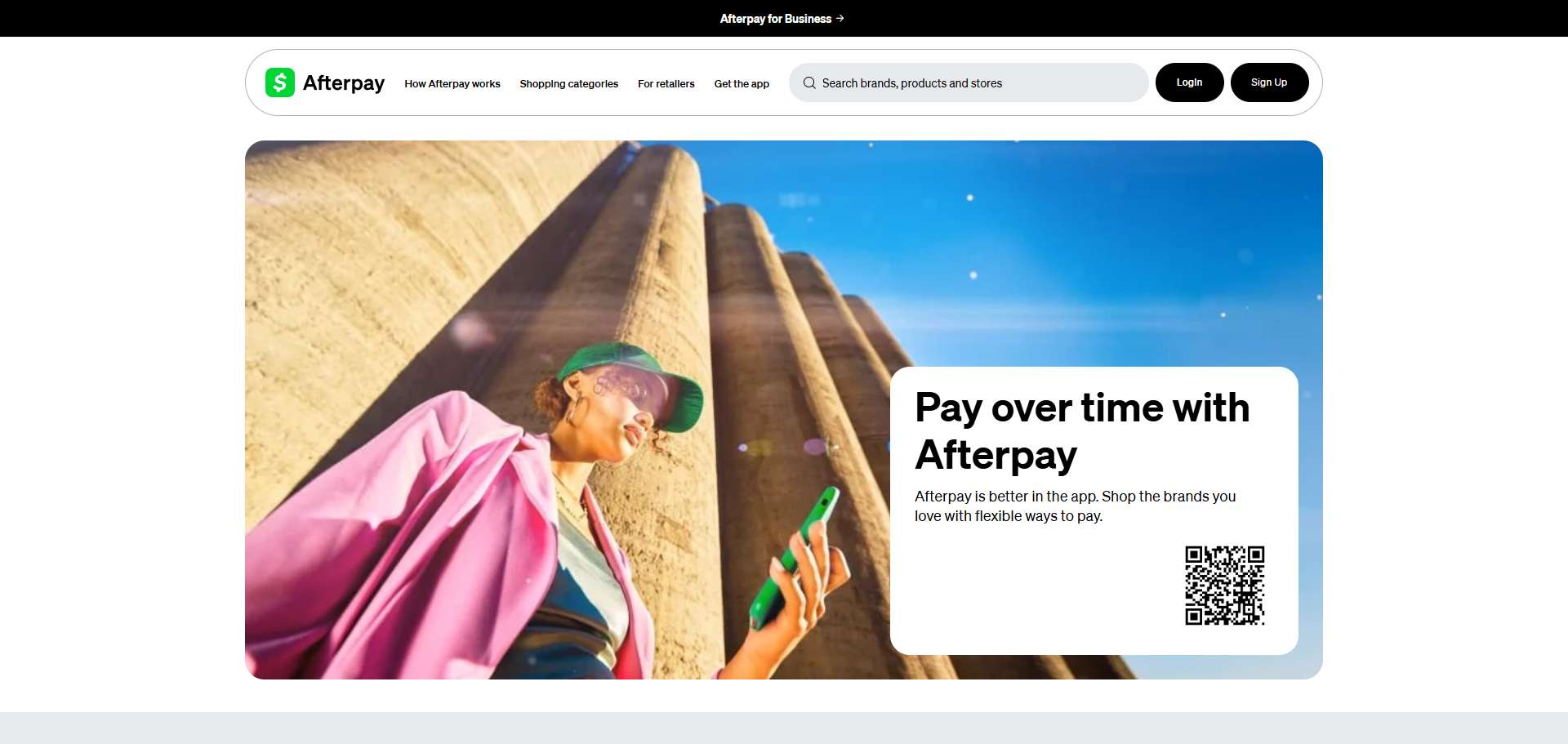
Afterpay — the buy now, pay later platform with its US operations headquartered in San Francisco — operates a consumer fintech website that has mastered the art of making a financial product feel like a retail experience rather than a lending transaction. The navigation architecture serves its two fundamentally different audiences — shoppers and retailers — with clean separation, while the mobile-first design philosophy reflects the reality that the overwhelming majority of Afterpay’s purchase decisions happen on a smartphone in the fraction of a second at checkout. The categories browsing experience transforms the financial product into a shopping discovery platform, allowing consumers to find Afterpay-enabled merchants before they’ve even decided what they want to buy — a smart acquisition strategy that embeds the product into the consumer’s shopping journey rather than presenting it as a payment method to consider at checkout. The app download CTA is placed above every other conversion action, reflecting a product strategy that recognizes the mobile app as the primary engagement surface for Afterpay’s relationship with its consumer base. The For Retailers section creates a clear B2B pathway for merchant partners to explore integration, with the implicit value proposition — access to Afterpay’s consumer base — embedded in every element of the consumer-facing site’s browsing behavior. The brand aesthetic — clean, modern, and lifestyle-forward rather than financial — deliberately distances Afterpay from the visual language of traditional lending products, making the installment payment model feel as accessible and friendly as any other retail purchase tool.
Affirm
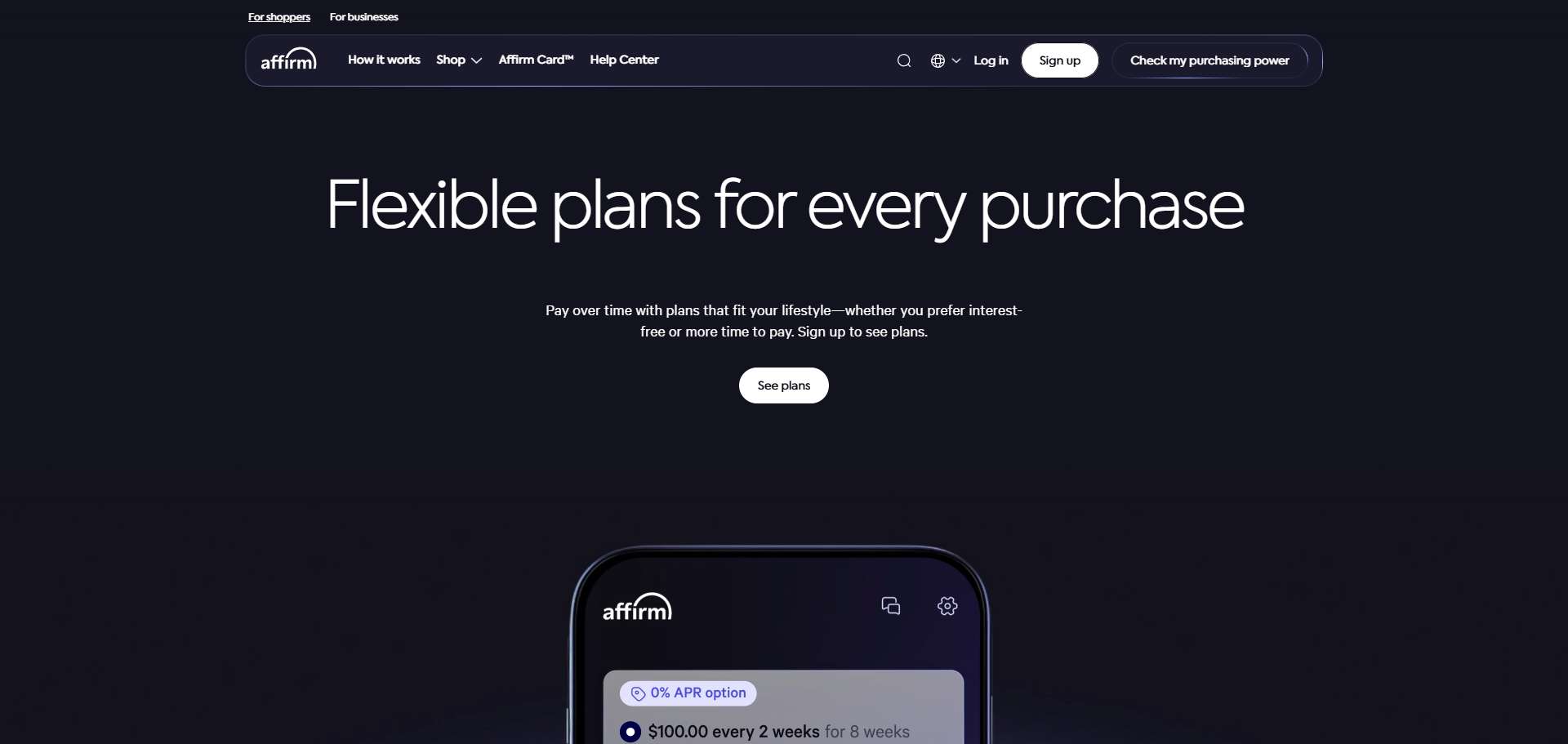
Affirm — the San Francisco BNPL fintech traded on NASDAQ and powering flexible payment plans for consumers and merchants across the US, Canada, and the UK — has built a website that positions the company’s core value proposition around transparency and consumer empowerment rather than credit product features. In a category where competitors compete primarily on merchant availability and approval speed, Affirm differentiates on trust: the “no fees” promise — no late fees, no hidden fees, no compounding interest surprises — is embedded in the brand tagline and reinforced throughout the site’s consumer-facing messaging. The dual-audience architecture serves both the consumer evaluating Affirm for personal purchases and the merchant evaluating Affirm for checkout integration, with clean navigation pathways that allow each audience to self-select without interference. The expanding partnerships strategy — recently integrating with AI shopping experiences and tax services — is reflected in the site’s merchant integration messaging, which signals to prospective retail partners that Affirm is actively growing the contexts in which consumers encounter the payment option. The Affirm Card and savings account features, visible in the product navigation, communicate that Affirm has evolved from a point-of-sale installment product into a broader consumer financial services platform — expanding the total addressable relationship with each user beyond a single purchase decision into an ongoing financial identity. The site’s clean, high-contrast design and straightforward typography reflect the brand’s commitment to simplicity and transparency, communicating in visual language the same promise that Affirm makes in its financial products: what you see is what you get.
Stripe
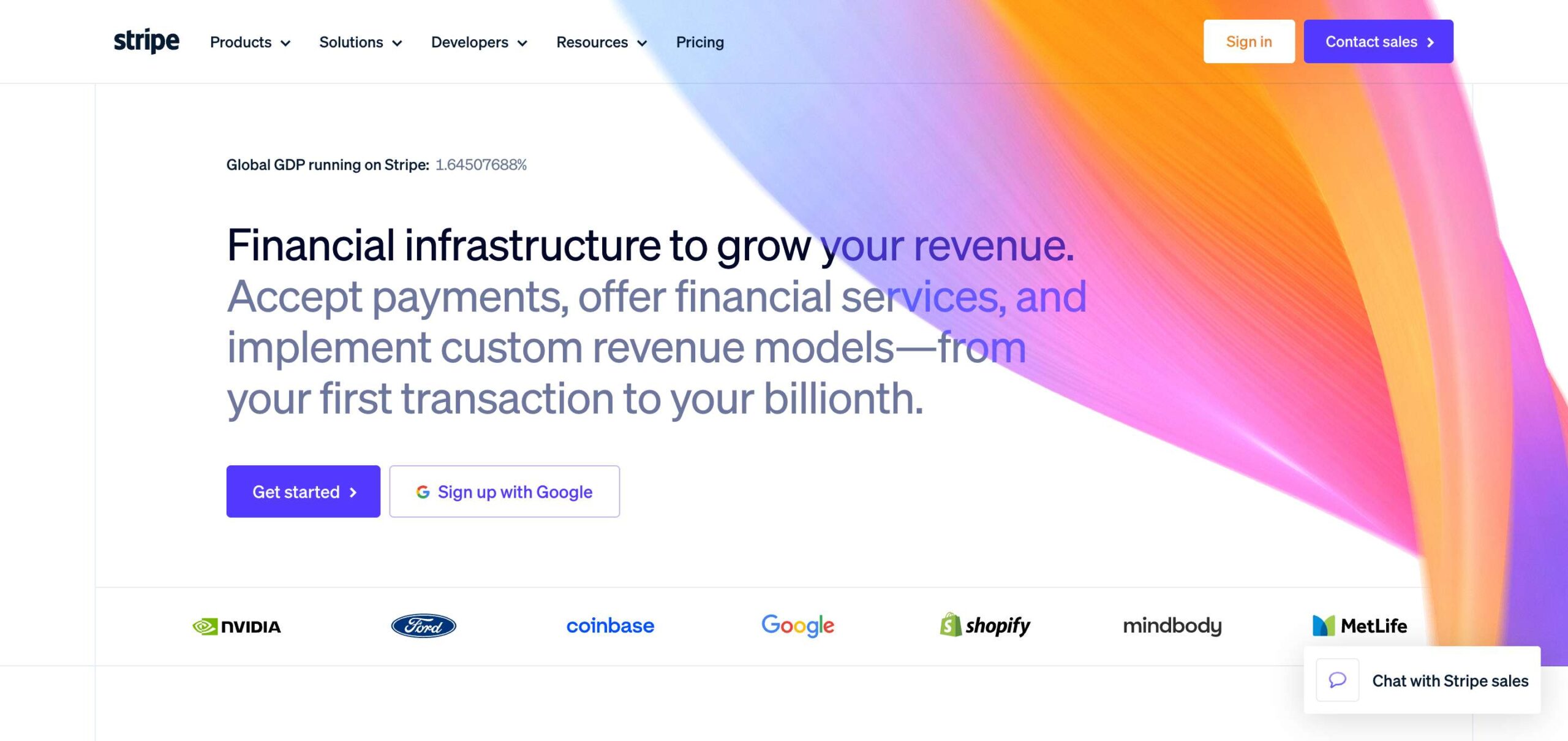
Stripe — the South San Francisco payments and financial infrastructure company valued at $159 billion in 2026 with over $1.9 trillion in payment volume processed in 2025, dual-headquartered in South San Francisco and Dublin — operates the gold standard for developer-first fintech website design. The site’s defining achievement is its documentation-as-product architecture: stripe.com functions simultaneously as a marketing website, a developer reference, a product catalog, and a customer success portal — all unified by a visual identity so precise and distinctive that “looks like Stripe” has become a benchmark phrase in B2B SaaS web design. The product navigation — Payments, Terminal, Billing, Connect, Revenue Recognition, Atlas, Radar, and over a dozen more — communicates a financial infrastructure platform of category-defining breadth, while the dual-audience targeting of “millions of businesses” and “the most ambitious startups” positions Stripe as the payments partner for every company from launch to IPO. The Stripe Sessions conference brand and the Stripe Dev publication — both maintained as dedicated content platforms alongside the main site — create a developer community and thought leadership presence that no payment processor competitor has matched. The September 2025 announcement of Stripe powering Instant Checkout in ChatGPT, and the Agentic Commerce Protocol co-developed with OpenAI, is reflected in the site’s forward-looking product messaging, which positions Stripe not just as a payments infrastructure layer but as the financial rails for the next era of autonomous AI commerce. For Bay Area fintech and technology companies building their digital presence, Stripe’s site represents the pinnacle of what developer-first, conversion-optimized B2B product marketing looks like when executed with complete conviction.
Chime
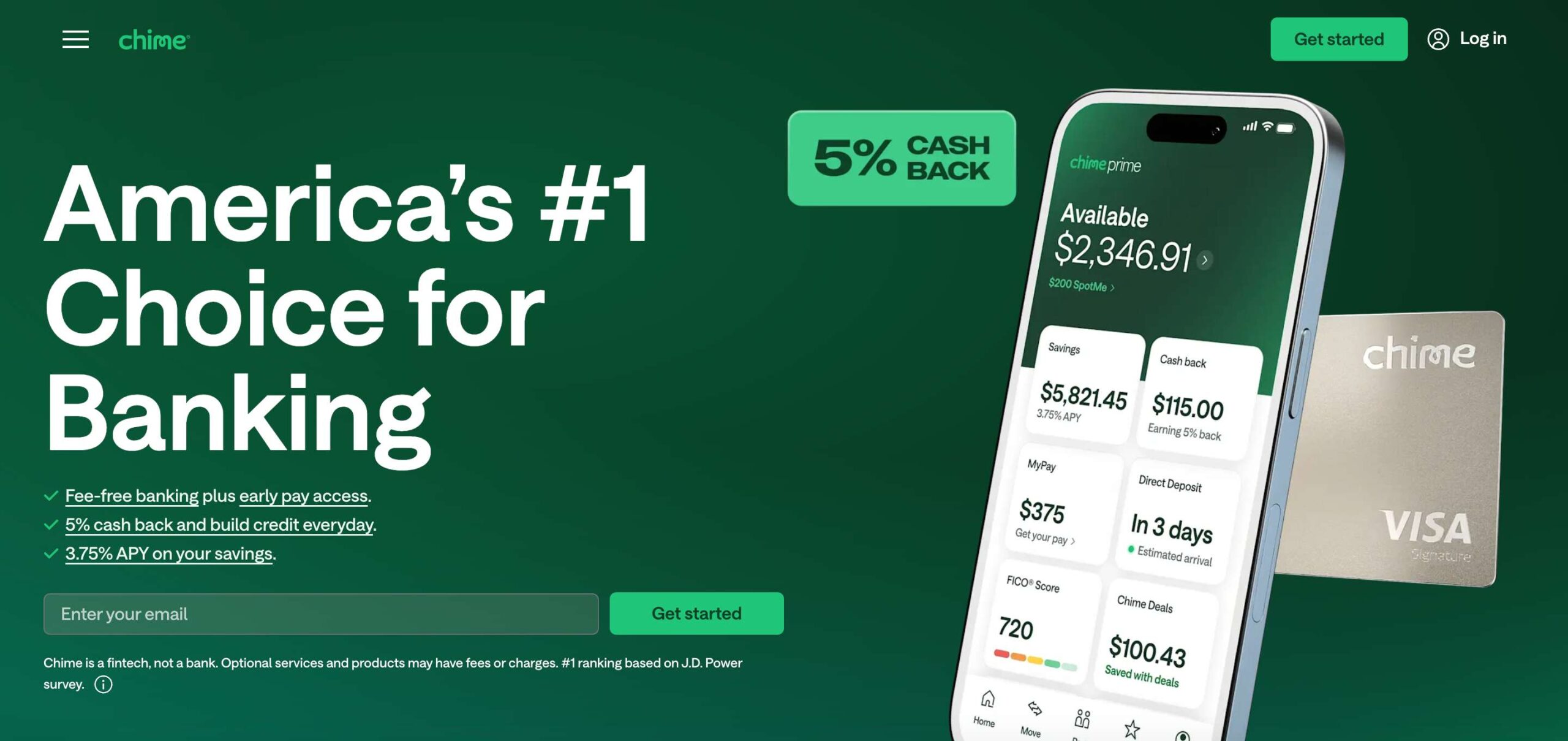
Chime — the San Francisco neobank that generated $1.67 billion in revenue in 2024, went public in 2025 with an IPO that opened at $18.2 billion, and serves over 8.7 million active users who on average make 54 transactions per month — has built a consumer fintech website whose emotional intelligence is its primary conversion mechanism. In a product category where every competitor promises fee-free banking and early direct deposit, Chime differentiates at the website level through radical simplicity and hyper-accessible language that communicates genuine financial empathy rather than marketing positioning. The SpotMe, Credit Builder, and MyPay features are presented not as product specifications but as solutions to specific, named financial stress situations — the person who needs $100 before payday, the person rebuilding credit after a setback, the employee who wants their paycheck on their own timeline. The mobile app download CTA dominates the hero and is reinforced throughout the page, reflecting the reality that Chime’s primary relationship with its members is through the app, not the browser. The clean, bright color palette and illustration-forward design aesthetic communicate accessibility and friendliness rather than financial authority — a deliberate choice for a product that serves the “motivated middle” of American banking customers who have grown up distrusting the fee structures and complexity of traditional banks. For Bay Area fintech companies serving consumer markets, Chime’s mobile-first, empathy-first website architecture demonstrates that the highest-converting consumer fintech product pages are built not around features but around feelings.
Ripple
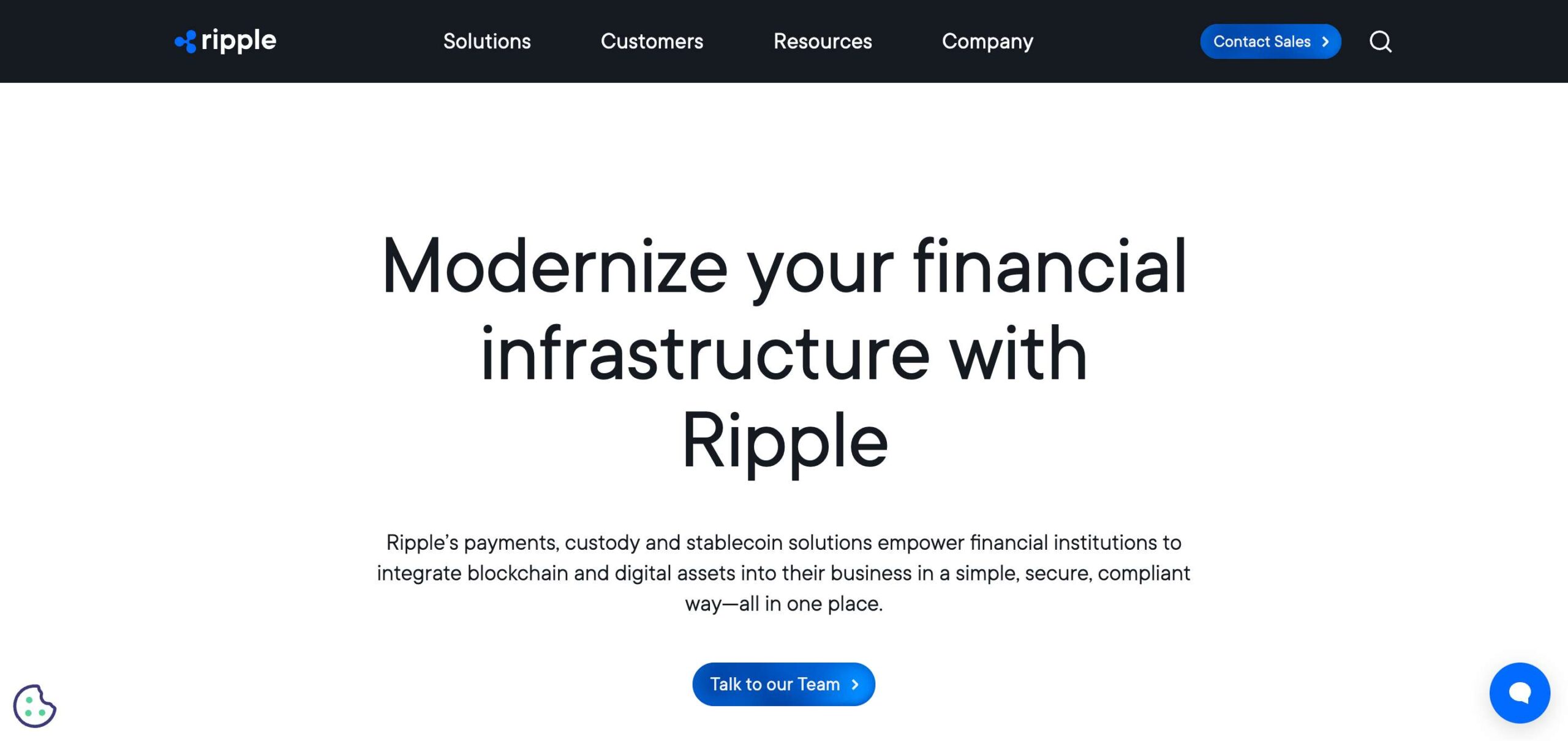
Ripple — the San Francisco blockchain and crypto solutions company founded in 2012, serving hundreds of customers in over 55 countries with cross-border payments processing over $100 billion in volume, and the first company to receive OCC conditional approval for a national trust bank charter under the 2025 GENIUS Act — has built an enterprise fintech website whose institutional credibility architecture is its most sophisticated design achievement. The site leads with Ripple’s positioning as the provider of “internet of value” infrastructure — making money move globally the way the internet made information move — and communicates this mission through a product suite that has evolved far beyond its XRP origins: Ripple Payments for cross-border stablecoin and fiat flows, RLUSD for institutional stablecoin infrastructure, digital asset custody integrated directly into bank core systems, and a prime brokerage capability acquired through Hidden Road. The client roster — BBVA Switzerland, Tranglo, Corpay, MassPay, and over 300 financial institutions across 55+ countries — provides enterprise-grade validation that positions Ripple as a regulated infrastructure provider rather than a speculative crypto company, a distinction that matters enormously to the compliance-driven financial institution procurement process. The site’s dark, authoritative visual design with blue-green blockchain-themed imagery communicates technical depth and institutional seriousness that distinguishes Ripple from consumer crypto platforms. The Ripple National Trust Bank charter announcement, prominently featured in the news section, signals regulatory maturity that gives risk-averse financial institution prospects the regulatory clarity they need to evaluate Ripple as a long-term infrastructure partner.
Coinbase
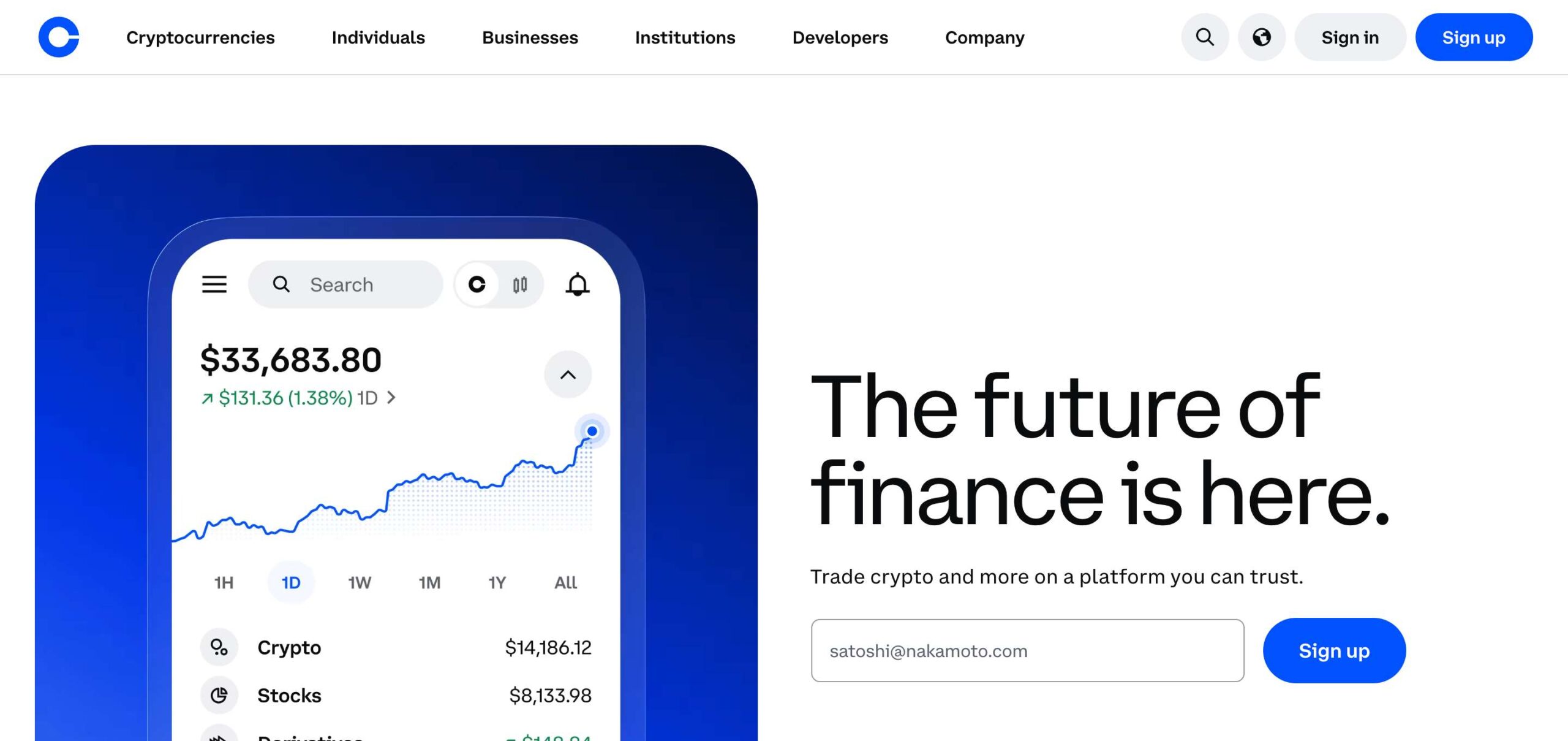
Coinbase — the San Francisco publicly traded crypto and financial services company with $7.18 billion in annual revenue, 110+ million verified users, and a 2025 strategic pivot to becoming the “Everything Exchange” — operates a website that is in the midst of communicating one of the most ambitious platform expansion narratives in fintech history. The December 2025 System Upgrade announcements — stock trading, prediction markets, Solana DEX integration, expanded perpetual futures, Coinbase Business for startups, and a custom stablecoin infrastructure for brands — are reflected in a homepage and product navigation that no longer describes a cryptocurrency exchange but an all-in-one financial operating system that competes simultaneously with Robinhood, Stripe, traditional brokerages, and prediction market platforms. The “economic freedom for more than 1 billion people” mission statement — placed prominently in both the product and careers sections — functions as a values alignment signal for the ideologically committed crypto-native user base while positioning the company’s commercial ambitions within a narrative of global financial inclusion. The Base blockchain, the USDC stablecoin, the developer API ecosystem, and the institutional custody and prime brokerage services each have their own dedicated product pages, creating a multi-audience website that serves retail traders, enterprise CFOs, startup founders, blockchain developers, and institutional asset managers from the same navigation structure. The Coinbase Advisor AI wealth management tool and the Agentic Commerce Protocol, co-developed with Stripe and OpenAI, reflect a forward-looking product messaging strategy that positions Coinbase as infrastructure for the AI financial future rather than a legacy crypto exchange. For Bay Area fintech companies navigating a platform expansion story, Coinbase’s website demonstrates how to communicate radical scope expansion without losing the core brand identity that built the original audience’s trust.
LendingClub
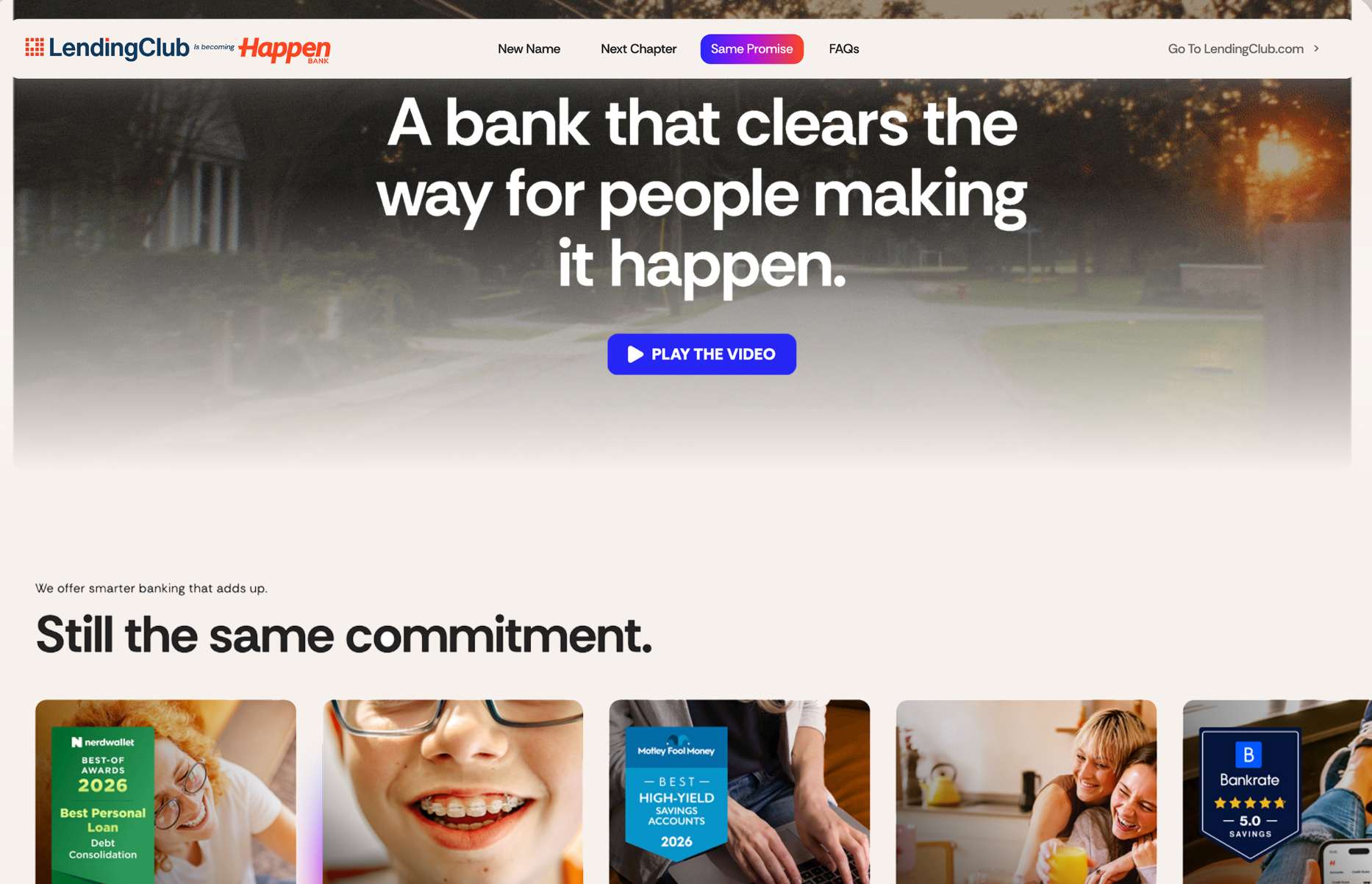
LendingClub — the San Francisco digital marketplace bank at 88 Kearny Street with $11.6 billion in assets, 5 million members, $2.6 billion in Q4 2025 loan originations (up 40% year-over-year), and a pending rebrand to Happen Bank in summer 2026 — has built a website that documents one of the most consequential transformation stories in Bay Area fintech: a company that began in 2006 as a peer-to-peer lending marketplace, acquired a bank charter in 2021 through the purchase of Radius Bank, and has since evolved into a full-spectrum digital bank serving the “motivated middle” — high-FICO, above-average income, digitally savvy consumers who are getting more value than traditional banks are offering them. The LevelUp Checking and LevelUp Savings product architecture — which pays 2% cashback when borrowers make on-time loan payments from their LevelUp Checking account — reflects a loyalty design philosophy built around rewarding positive financial behavior rather than extracting fees, a positioning that the website communicates with the moral clarity of a company that has chosen sides in the debate between consumer-aligned and bank-aligned financial services. The “Check your rate in minutes without impacting your credit score” CTA, placed prominently throughout the site, communicates product confidence and consumer respect simultaneously — a design choice that converts visitors who have been burned by hard credit inquiries at traditional lenders. The DebtIQ personal finance app, the upcoming Happen Bank rebrand, and the home improvement financing expansion all signal a company that is actively communicating momentum and transformation to both existing members and the prospects evaluating it for the first time. For Bay Area fintech companies managing a brand evolution story, LendingClub’s website demonstrates how to honor an established identity while building the narrative infrastructure for what comes next.
From a San Francisco digital lending platform powering mortgages at the nation’s largest banks, to an AI-first corporate finance OS trusted by 4,400+ enterprises, to two consumer BNPL platforms that have redefined how Americans pay at checkout — every fintech website above succeeds because it makes its specific financial innovation feel inevitable, trustworthy, and immediately accessible to the exact buyer it is designed to convert. If your fintech, financial technology, or financial services company is based in the Bay Area or Silicon Valley, KO Websites builds financial technology websites that communicate regulatory credibility, scale trust signals for your target buyer, and convert high-intent financial searches into demos, signups, and long-term client relationships. Contact us today for a free consultation.
What Sets Our Fintech Digital Solutions Apart
Regulatory Compliance Expertise
Navigating SEC regulations, PCI DSS requirements, and state-level financial compliance demands specialized knowledge that generic web developers lack entirely. Our team understands the intricate balance between user experience optimization and SEC regulatory standards, ensuring your platform meets all legal requirements while maintaining conversion-focused design principles.
Security-First Architecture
Financial data protection isn’t optional—it’s foundational to user trust and business viability in today’s threat landscape. We implement enterprise-grade security protocols, encrypted data transmission, and multi-layered authentication systems that protect sensitive information while optimizing search visibility through technical SEO excellence.
Conversion-Optimized User Journeys
Fintech users demand intuitive interfaces that simplify complex financial processes without sacrificing functionality or transparency. Our behavioral analysis and A/B testing methodologies create seamless user experiences that guide prospects from initial awareness through targeted PPC campaigns to successful platform adoption and long-term engagement.
Proven Track Record
Bay Area fintech leaders trust our expertise because we deliver measurable results that directly impact user acquisition metrics and investor confidence. Our client testimonials showcase consistent success stories across payment processing platforms, investment management tools, and blockchain applications throughout the region.
Advanced Features for Fintech Excellence
API Integration Frameworks
Seamless connectivity with banking institutions, payment processors, and third-party financial services through robust API architectures that scale with your platform’s growth trajectory and managed hosting solutions.
Real-Time Data Visualization
Interactive dashboards and dynamic charts that transform complex financial data into comprehensible insights, enhancing user engagement while supporting informed decision-making processes across all device types and screen sizes.
Multi-Platform Compatibility
Responsive design architectures optimized for desktop trading platforms, mobile banking applications, and tablet-based portfolio management tools, ensuring consistent functionality across San Francisco’s diverse user base.
Compliance Documentation Systems
Automated reporting mechanisms and audit trail generation that streamline regulatory submissions while maintaining user privacy standards and supporting transparency requirements essential for fintech operations.
Complete Fintech Digital Solutions
Payment Platform Development
Custom websites showcasing digital payment solutions, mobile wallet integrations, and cryptocurrency exchange platforms with conversion-focused landing pages that communicate security benefits and ease-of-use advantages effectively.
Investment Technology Portals
Sophisticated web platforms highlighting robo-advisory services, portfolio management tools, and algorithmic trading capabilities through user-friendly interfaces that build investor confidence and encourage platform adoption.
Lending Software Showcases
Professional websites demonstrating peer-to-peer lending platforms, automated underwriting systems, and alternative credit scoring methodologies with clear value propositions that attract both borrowers and institutional partners.
Blockchain Application Presentation
Innovative web designs explaining decentralized finance protocols, smart contract platforms, and cryptocurrency mining operations through accessible content that educates users while driving engagement and adoption.
RegTech Solutions Display
Compliance-focused websites highlighting regulatory technology tools, risk management platforms, and automated reporting systems with professional presentations that appeal to enterprise clients and regulatory bodies.
InsurTech Platform Marketing
Dynamic websites promoting insurance technology innovations, claims processing automation, and actuarial analytics tools through compelling storytelling that demonstrates tangible benefits and competitive advantages.
Wealth Management Integration
Comprehensive digital platforms connecting financial advisors with clients through secure portals, performance tracking dashboards, and communication tools that enhance relationship management and service delivery.
Banking Technology Solutions
Modern websites showcasing core banking platforms, mobile banking applications, and customer onboarding systems with emphasis on security features and user experience improvements that differentiate your solutions.
Explore our fintech portfolio showcase to see how we transform complex financial technologies into compelling digital experiences that drive user acquisition and investor interest.
Serving Bay Area Fintech Innovation Centers
From Silicon Valley’s venture capital corridors to San Francisco’s fintech startup ecosystem, we support financial technology companies across the region’s most dynamic markets. Our Silicon Valley expertise extends throughout Peninsula innovation hubs, while our Oakland web design services serve East Bay fintech entrepreneurs. Whether your headquarters operates in San Jose’s technology district or emerging markets like Pleasanton and San Ramon, we understand the unique competitive dynamics and regulatory environment shaping Bay Area financial technology innovation.
Integrated Digital Marketing for Fintech Growth
Beyond exceptional web design, fintech companies require comprehensive digital strategies that address complex sales cycles and regulatory constraints effectively. Our social media marketing expertise navigates financial advertising restrictions while building thought leadership and community engagement. Strategic local search optimization ensures qualified prospects discover your innovative solutions, while professional video production services explain complex financial concepts through engaging visual content that builds trust and demonstrates platform capabilities across Livermore, Castro Valley, and San Leandro markets.
Your Fintech Web Design Questions Answered
How do you ensure websites meet financial industry compliance requirements?
We implement comprehensive compliance frameworks aligned with CFA Institute standards and SEC regulations, including data encryption protocols, privacy policy integration, and accessibility requirements mandated for financial service providers.
What makes fintech web design different from standard business websites?
Fintech platforms require specialized security measures, regulatory compliance integration, complex data visualization capabilities, and user authentication systems that standard business websites simply don’t need or understand.
How long does fintech website development typically require?
Timeline varies based on platform complexity, but most fintech websites require 8-16 weeks for complete development, including compliance review, security implementation, and thorough testing phases essential for financial applications.
Can you integrate our existing financial APIs and third-party services?
Absolutely—we specialize in seamless API integrations with banking institutions, payment processors, data providers, and compliance monitoring systems while maintaining optimal performance and security standards throughout.
What ongoing maintenance do fintech websites require?
Financial technology platforms need continuous security updates, compliance monitoring, performance optimization, and regulatory change adaptations that our maintenance packages address comprehensively and proactively.
How do you measure fintech website success and user engagement?
We track user acquisition metrics, conversion funnel performance, platform adoption rates, and investor engagement analytics while monitoring security incident reports and compliance audit results. Our satisfied fintech clients consistently report improved user onboarding and increased platform utilization following our optimization implementations.
Launch Your Fintech Platform’s Digital Transformation
Revolutionary financial technology deserves equally innovative digital presence that communicates your platform’s unique value proposition while converting visitors into engaged users and potential investors. Our specialized fintech web design expertise transforms complex financial concepts into compelling user experiences that drive adoption, build trust, and accelerate growth in today’s competitive marketplace.