Professional Fire Department Website Design That Informs, Protects, and Recruits
Custom websites for Bay Area fire departments and fire districts that put emergency information first, simplify permits and inspections, support wildfire preparedness, and help you recruit the firefighters your community needs
Fire agencies in the Bay Area also come in many shapes: city departments, county departments, independent special districts, and joint powers authorities that serve several communities at once. Each has its own board, budget, and public-information responsibilities, and each needs a website that explains who it serves and how to reach it. Our approach adapts to that structure, whether you are a single-station district or a county-wide department.
Best Fire Department Websites: Bay Area Examples That Prepare Communities and Make Services Easy to Find
Fire department websites carry an unusual mix of responsibilities. They must make 911 and non-emergency guidance unmistakable, support fire prevention bureaus that handle permits, plan reviews, and inspections, publish wildfire and disaster preparedness information, recruit career and volunteer firefighters, and, for special districts, share board agendas and financial documents with the public. The ten agencies below, all of which run their own dedicated websites, show how different Bay Area departments and districts handle that range, from a large city department and county-wide agencies to community fire districts and consolidated joint powers authorities.
1. San Francisco Fire Department (SFFD)

The San Francisco Fire Department’s website shows how a large urban agency can keep emergency information, everyday services, and a deep document library organized on one site. A banner across the top of every page separates the three situations that matter most: call or text 911 for emergencies, text your ZIP code to 888-777 for alerts, and call 311 or use the “report a safety concern” link for non-emergencies. The main navigation is short and plain — About, Calendar, Fire Commission, NERT, News, Programs, Safety, and Services — with Find Your Station and Search available from the header. A language selector offers seven options, including Spanish, Chinese, Filipino, Vietnamese, and Russian. The homepage then surfaces what residents and stakeholders need most: health and safety alerts, career opportunities, the Fire Commission, ways to support or thank the department, and FAQs, followed by tiles for NERT (the Neighborhood Emergency Response Team), public records and subpoena requests, fire prevention and investigation, emergency medical services, community programs, and budget, data, and reports. Behind those tiles sits a large library of safety resources and fire code materials, including home fire safety checklists, lithium-ion battery and fire extinguisher safety, tenant and building owner fire safety information, smoke alarm notices, and administrative bulletins. For large departments with many audiences, SFFD is a strong model of clear triage and organized depth.
2. Santa Clara County Fire Department (SCCFD)
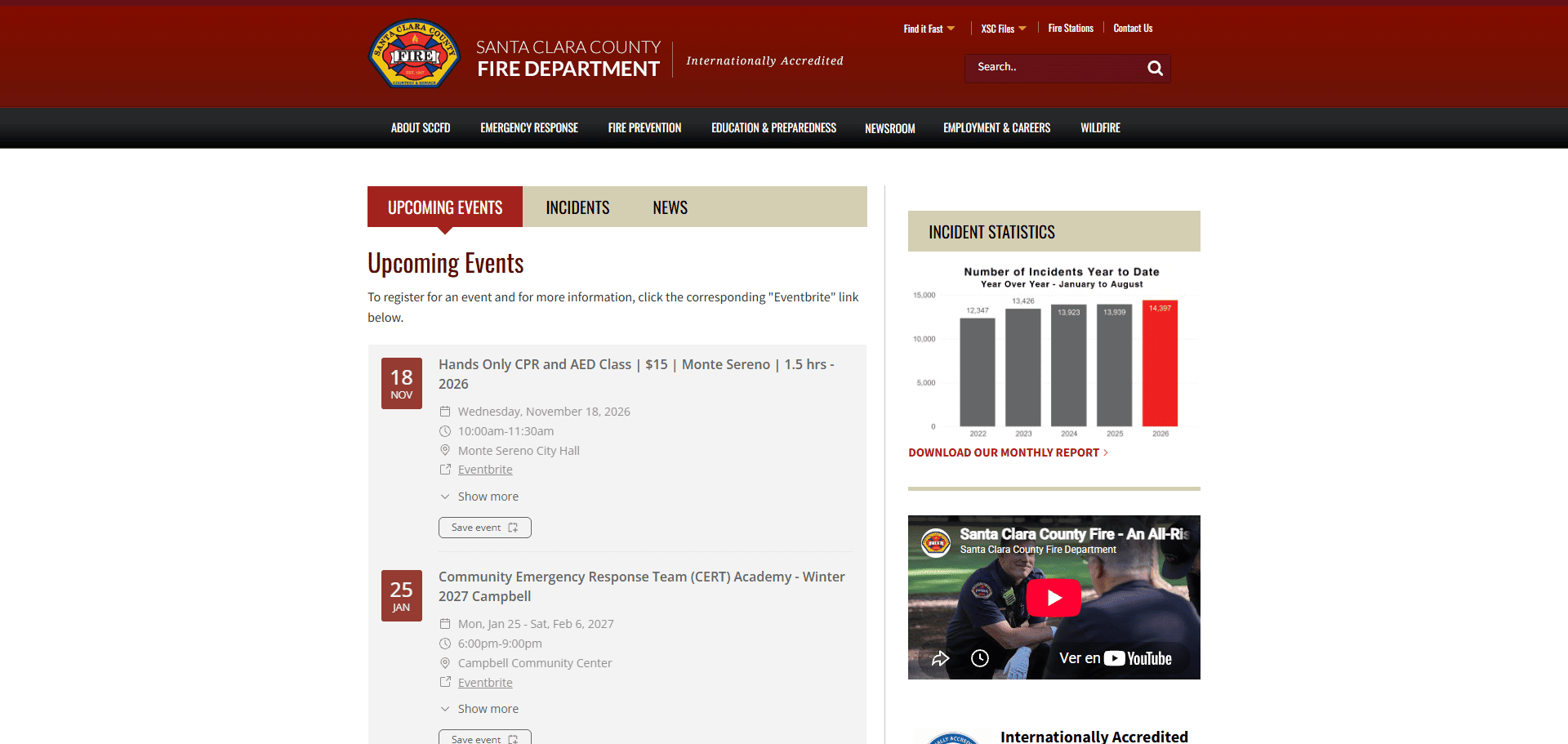
The Santa Clara County Fire Department serves Campbell, Cupertino, Los Altos, Los Altos Hills, Los Gatos, Monte Sereno, Saratoga, and surrounding unincorporated areas, and its website is a clear example of putting the most requested tasks in one fast lane. A “Find it Fast” bar sits at the top of the site with direct links to request an inspection, fire permits, incident reports, CPR and AED training, request a program, the arson tip line, emergency preparedness, and a satisfaction survey. Below that, the main navigation separates the department’s major audiences: About SCCFD, Emergency Response, Fire Prevention, Education and Preparedness, Newsroom, Employment and Careers, and Wildfire. The Fire Prevention section is practical and complete, with applications and forms, plan submittals, municipal codes and fees, standards and specifications, hazardous materials, information sheets, and a way to report a fire safety concern. The Education and Preparedness section includes programs for adults and seniors, schools, scouts, babysitters, and youth firesetter intervention, along with emergency alert registration, CERT, workplace emergency planning, and a long list of safety topics from helmet safety and car seats to pedestrian safety and water safety. A dedicated Wildfire section covers living with wildfire, pre-fire management, local fire hazard severity maps, and a Get Set and Go preparedness guide. For county-wide departments that serve many cities, SCCFD shows how a thorough site map can still feel easy to use.
3. Alameda County Fire Department (ACFD)
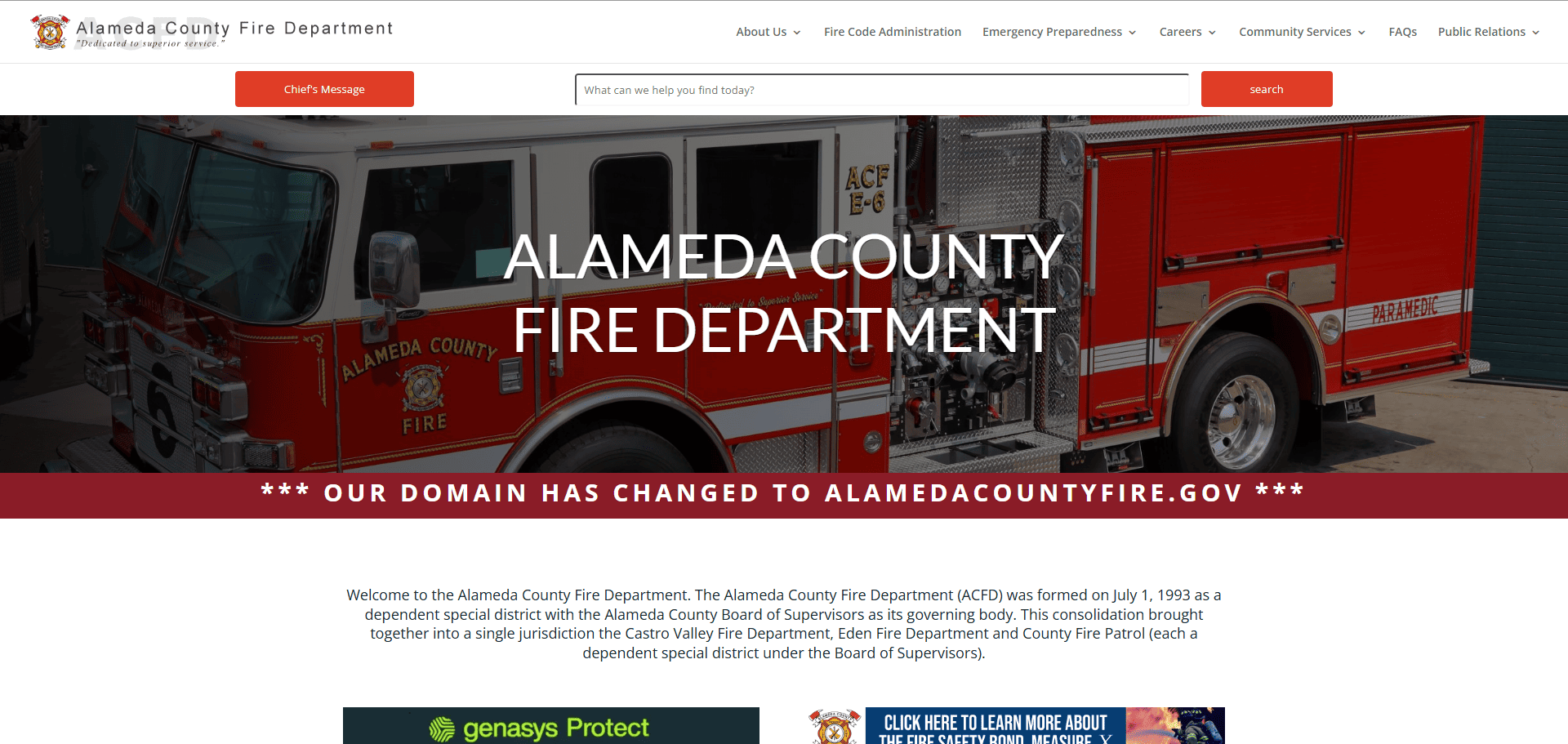
The Alameda County Fire Department has moved to a .gov domain, alamedacountyfire.gov, and its homepage opens with a banner telling returning visitors about the change, a small but important detail for a site that residents bookmark. The homepage then uses large image banners to promote the department’s current priorities: a link to the Genasys Protect evacuation zone tool, information about the Measure X Fire Safety Bond, the Alternative Response Unit, local responsibility area fire hazard severity maps, and the County Assessor’s parcel viewer. The navigation is organized by what residents want to do: About Us, Fire Code Administration, Emergency Preparedness, Careers, Community Services, FAQs, and Public Relations. Emergency Preparedness covers CPR and AED training, defensible space, fire hazard severity zones, fire weather, and a hazard locator. Community Services includes the Chipper Program, ride-alongs, station tours, Vial of Life, Safe Surrender, and PulsePoint. The Careers section is broken into job openings, reserves, education requirements, physical requirements, and a recruitment webinar, which answers questions candidates usually have before applying. A Public Relations section houses events, media, newsletters, a community report, the Fire Advisory Commission, and a public records request link, and an AC Alert sign-up is available from the homepage. For county departments with a mix of urban and wildland areas, ACFD shows how a homepage can double as a preparedness dashboard.
4. Contra Costa County Fire Protection District (Con Fire)
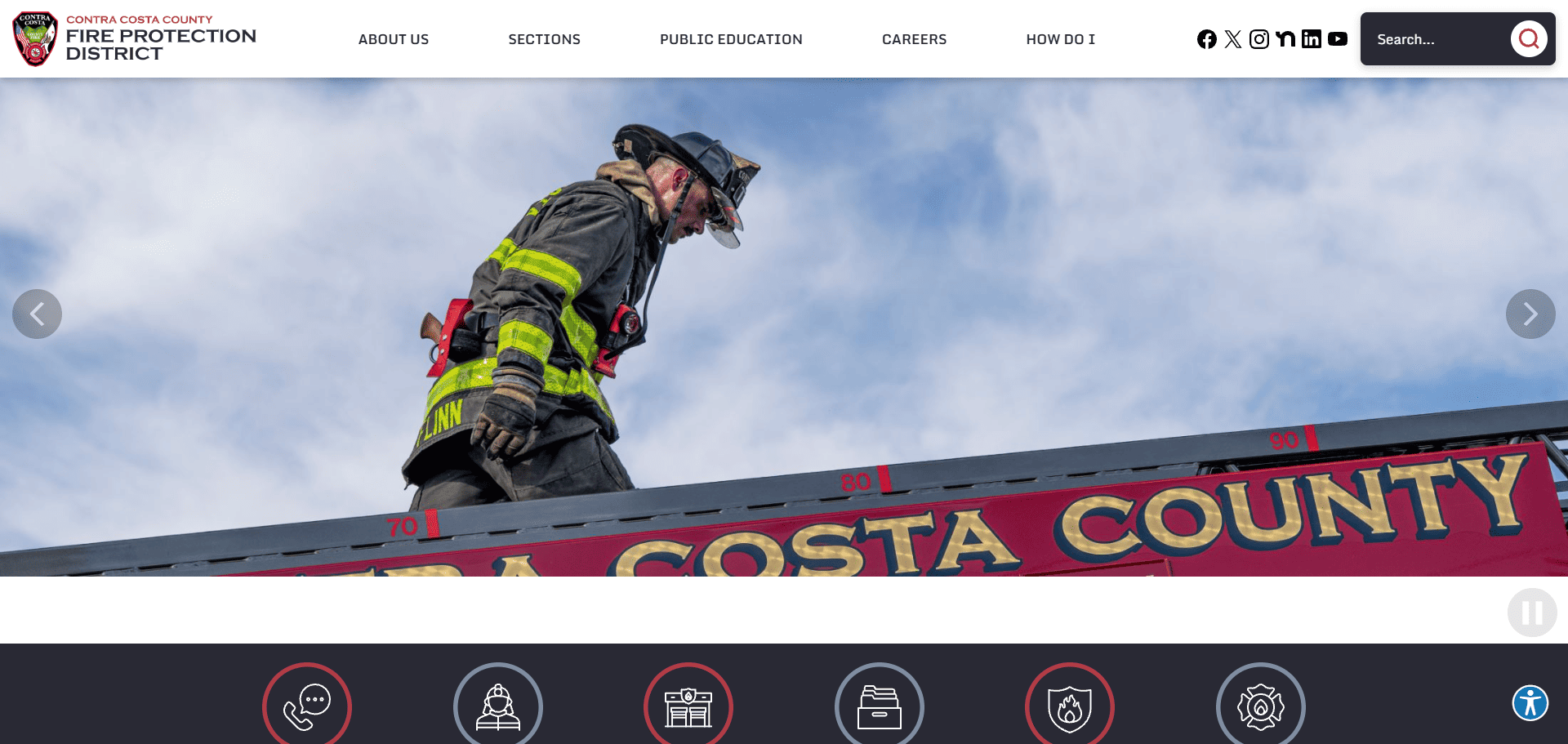
The Contra Costa County Fire Protection District covers a large part of the county after decades of consolidations, and its website keeps a complicated organization simple with five main menu items: About Us, Sections, Public Education, Careers, and How Do I. Large tiles on the homepage then put the most common requests one click away: Contact Us, Recruitment, Station Locations, Records Requests, Fire Prevention, and the Measure O Senior Exemption, a good example of giving a specialized financial program its own clear entry point. A News and Events section uses the site’s news module to share more than routine announcements, including the grand opening of the Regional Fire Communications Center, the center’s reaccreditation for dispatch excellence, leadership appointments, and an annual toy drive, which gives residents a sense of the organization behind the engines. A calendar, FAQs, notification sign-ups, and a facilities directory are available from the footer, along with a site map and accessibility link. The About pages explain the district’s history, including how neighboring districts joined over time, which matters for residents who still use old names for their local fire station. The site is built on a government CMS with built-in news, calendar, and notification tools. For districts that have grown through annexations, Con Fire shows how to present a large service area without losing the local feel.
5. San Ramon Valley Fire Protection District
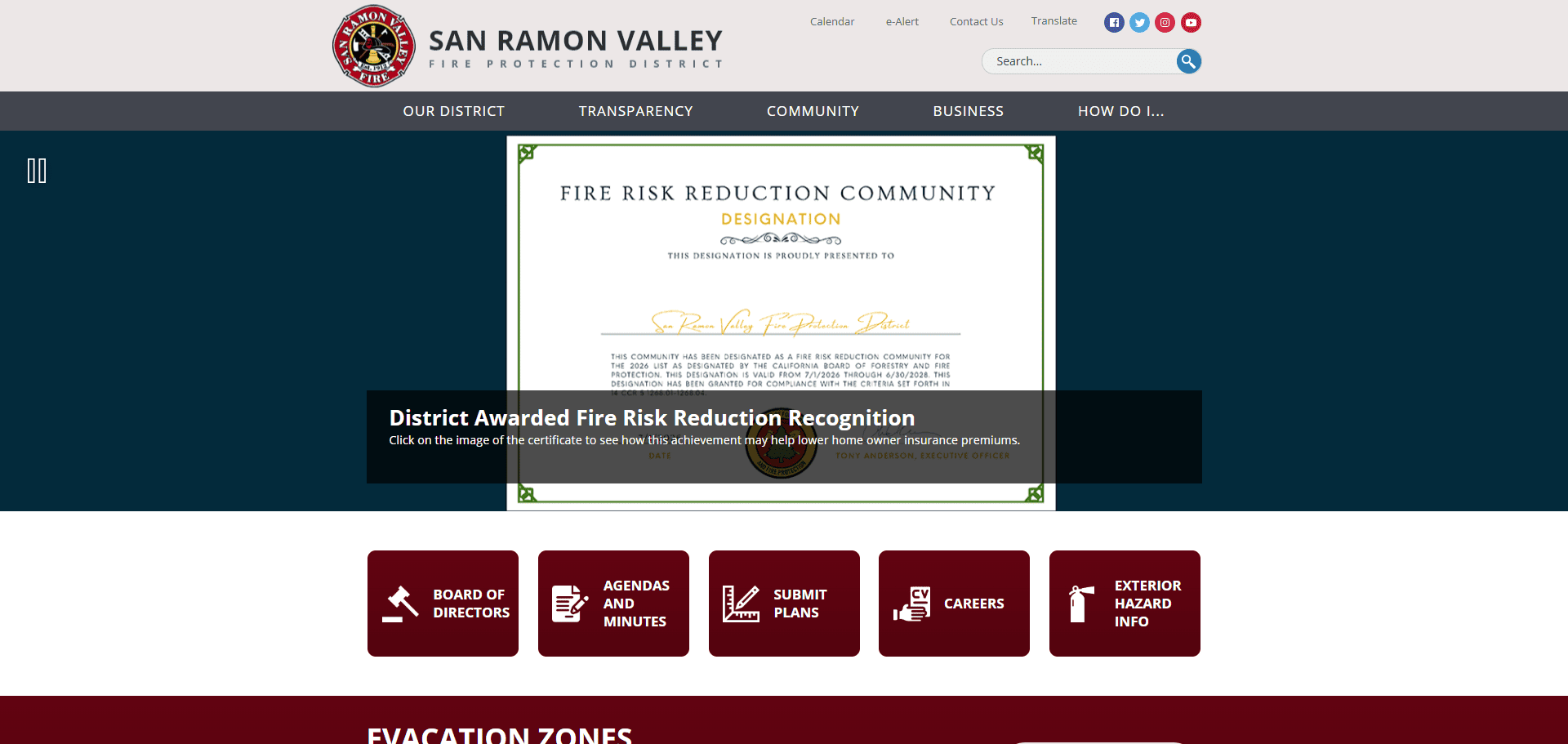
The San Ramon Valley Fire Protection District runs its site at firedepartment.org, a web address that the district said at launch it chose to be as easy to remember as the site is to use, which is a smart branding decision for an agency residents search for by function rather than by name. The Our District section explains who the district serves — Alamo, Blackhawk, Danville, Diablo, San Ramon, and parts of Morgan Territory and Tassajara Valley — in plain language, with its service area, population, station count, staffed companies, and its own nationally accredited 911 communications center. The Community Risk Reduction Division is described in terms residents understand: vegetation and hazard abatement programs, plan review and engineering services, code enforcement and fire investigation, and programs that teach fire safety, CPR and AED skills, and emergency preparedness. A Stations and Facilities page lists each station with its street address and photograph, which helps residents find the nearest station. A Training Division page and a Regional Resources section show the operational side of the organization, and recent news about the district’s wildfire mitigation initiative demonstrates how the site communicates current projects. For independent districts that want to explain their governance and services in one place, San Ramon Valley is a clear and practical example.
6. Moraga-Orinda Fire District (MOFD)
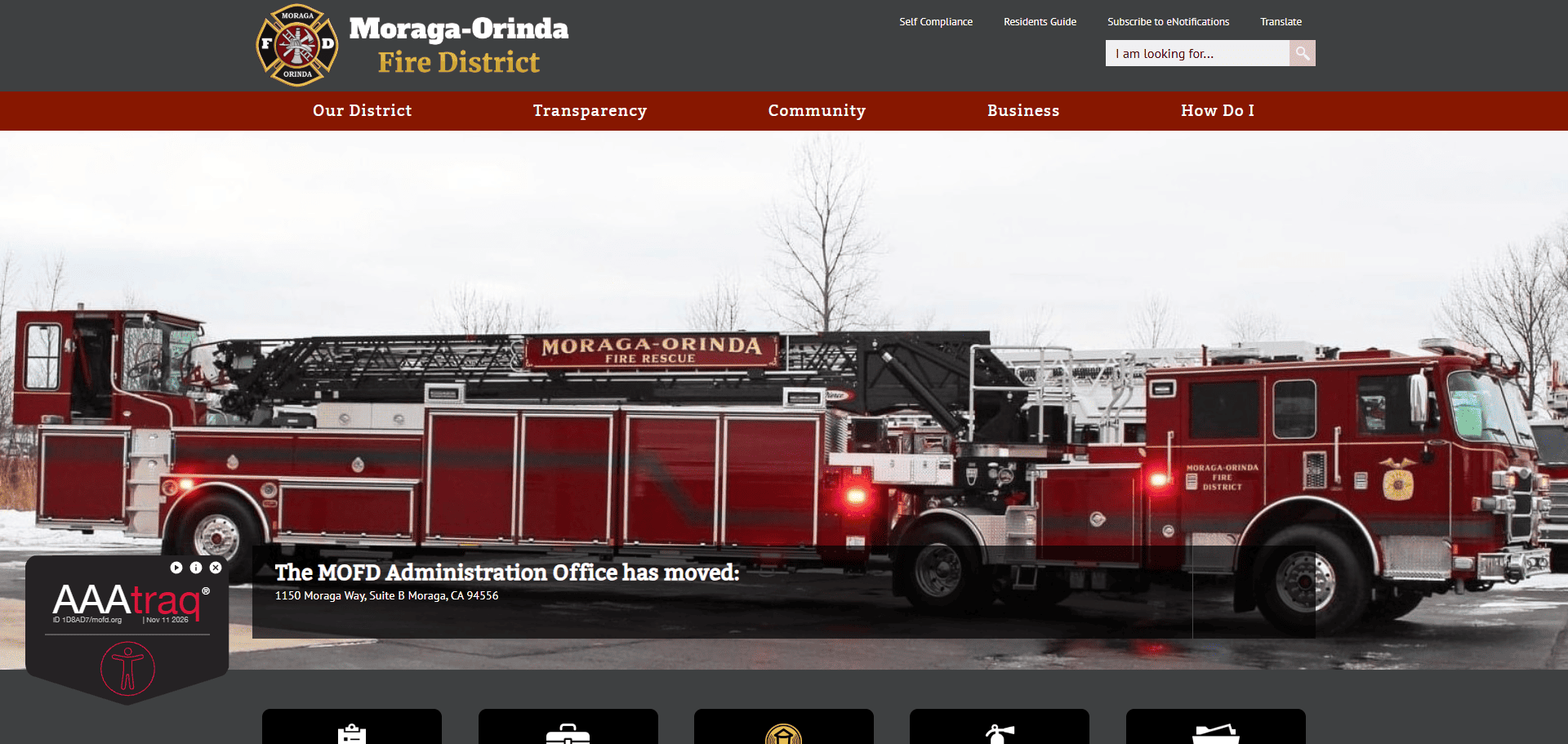
The Moraga-Orinda Fire District redesigned its website in 2020 with accessibility as a core goal, and the result remains one of the most complete small-district sites in the Bay Area. Local reporting at launch noted that the site uses contrast checkers for visitors with color impairments and allows all information to be accessed by keyboard, and the district publishes an accessibility statement that targets WCAG 2.1 Level AA. A header toolbar puts the most useful tools on every page: FAQs, Self Compliance, Residents Guide, eNotification sign-up, Translate, and Search. The Fuels Mitigation and Fire Prevention section is especially strong for a wildfire-prone community, with abatement requirements in English and Spanish, a certificate of compliance for property sales, the Chipper Program, a Community Wildfire Protection Plan, a Home Hardening Grant Program, fire hazard severity zone maps, Zone Zero information, permit applications, and a weed abatement contractor list. A “How Do I” menu groups services by task: submit a hazard concern, report self-compliance, request a wildfire safety home assessment, request an incident report or medical report, and drop off fire extinguishers, medication, or needles. A full Transparency section includes board agendas, budgets, financial audits, board policies, and a board handbook. For fire districts in wildfire country, MOFD shows how to turn regulatory requirements into resident-friendly tasks.
7. Livermore-Pleasanton Fire Department (LPFD)
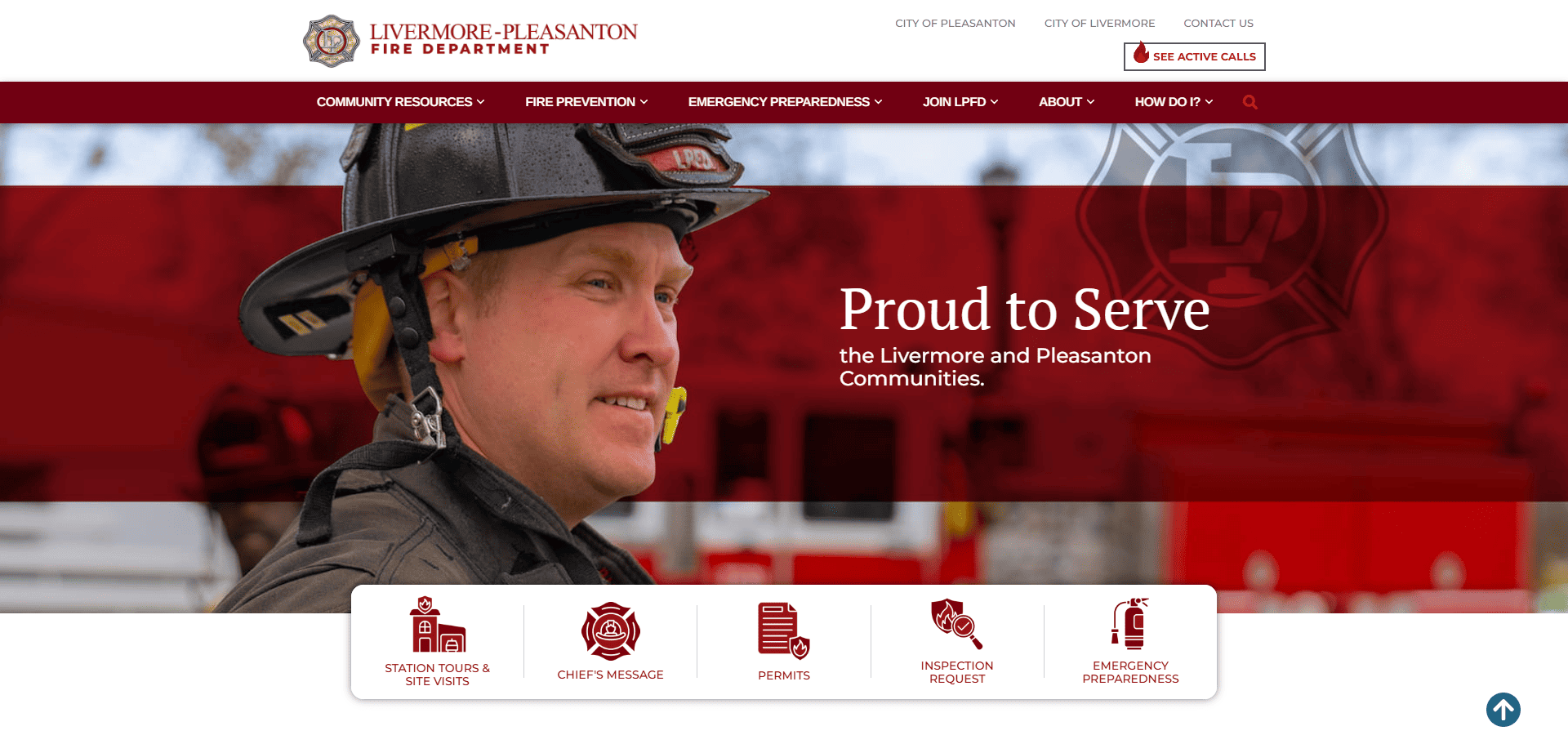
The Livermore-Pleasanton Fire Department jointly serves two cities, and its newly redesigned website at lpfire.org is a recent example of a department rethinking its site around usability, accessibility, and transparency. Phase I launched in April 2026, and local reporting describes the new homepage as a central hub for safety information, department programs, and important updates. According to that coverage, the homepage includes a live incident map, the day’s current fire danger level, featured events, popular services with thumbnail links to tasks such as public records requests and reporting a hazard online, and a recap of annual report statistics. That combination of live information and everyday services is exactly what residents expect from a modern fire department site. The redesign also introduced the department’s updated mission, vision, and core values, and the department says it is part of a broader communication effort that includes annual reports, a twice-yearly community newsletter, and a more consistent social media presence. The site was built with a local Pleasanton design firm, a good reminder that a joint powers authority can work with local creative partners. The phased rollout also shows a practical approach for departments with limited staff: launch the core experience first, then expand content over time. For multi-city departments, LPFD shows how to bring two communities together under one clear, current website.
8. San Mateo Consolidated Fire Department
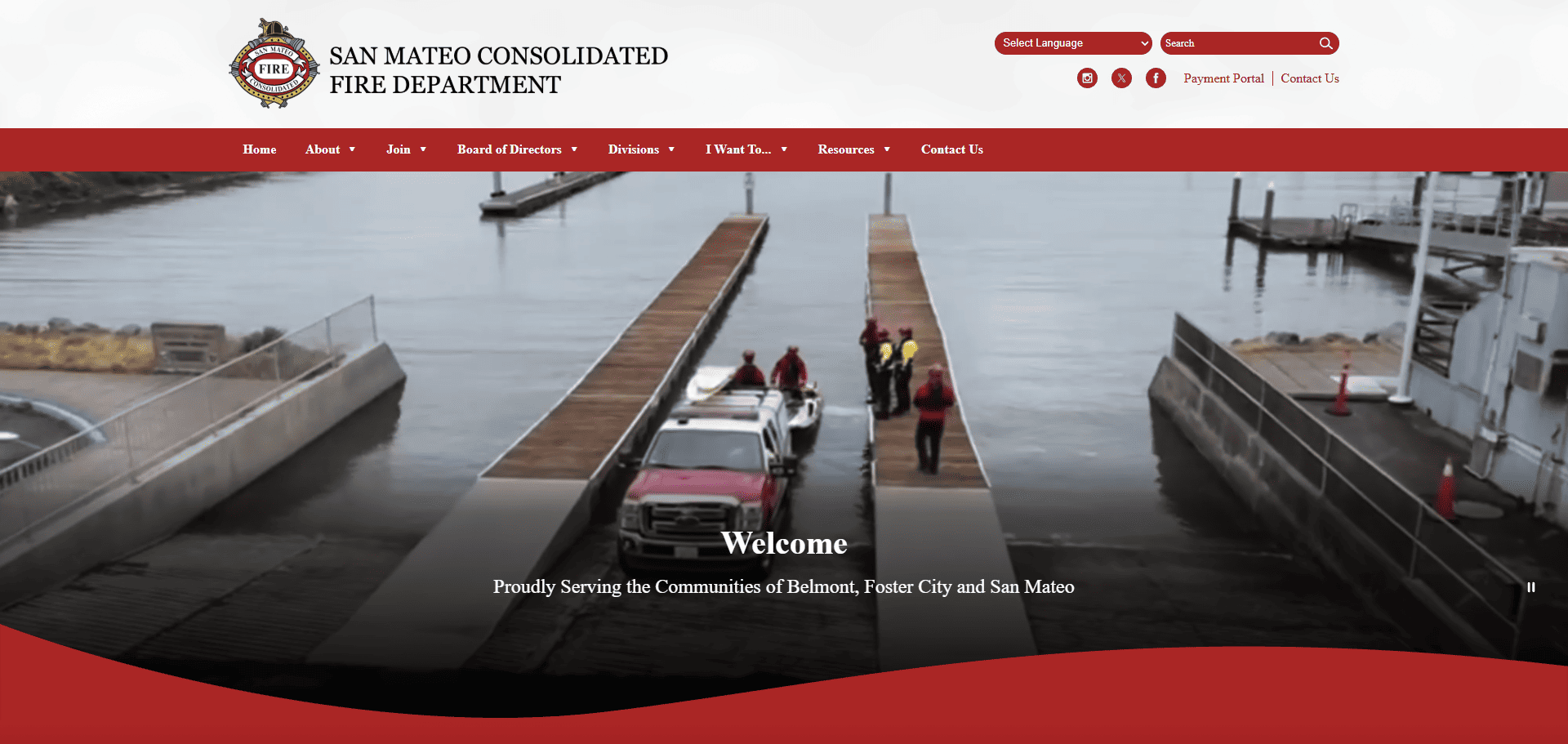
The San Mateo Consolidated Fire Department serves Belmont, Foster City, and San Mateo as a joint powers authority, and its website is built to make three cities feel like one clear organization. The main navigation covers About, Join, Board of Directors, Divisions, I Want To, and Resources, with a payment portal and contact link in a top utility bar. The “I Want To” menu is the standout feature: prepare for emergencies, do business with the department, join the fire service, make a report or request, make a payment, and request a fire inspection. The Divisions menu explains how the agency is organized, with Administration, Community Risk Reduction (including Fire Prevention and Life Safety, the Office of Emergency Services, and CERT), Field Operations (EMS, special operations, and mutual aid deployments), and Training. Quick links on the homepage go straight to plan submittals, the fee schedule, board meetings, press releases, and FAQs, which are the items contractors, developers, and residents look for most. The Join section separates becoming a firefighter, a cadet program, and job openings, and a Board of Directors section includes meetings, members, and transparency materials. The homepage also features an interactive map of the department’s nine stations, a wildfire preparedness section, and a list of upcoming board meetings with the most recent agenda packet. For consolidated departments, San Mateo Consolidated Fire shows how one site can serve several communities and a governing board.
9. Menlo Park Fire Protection District
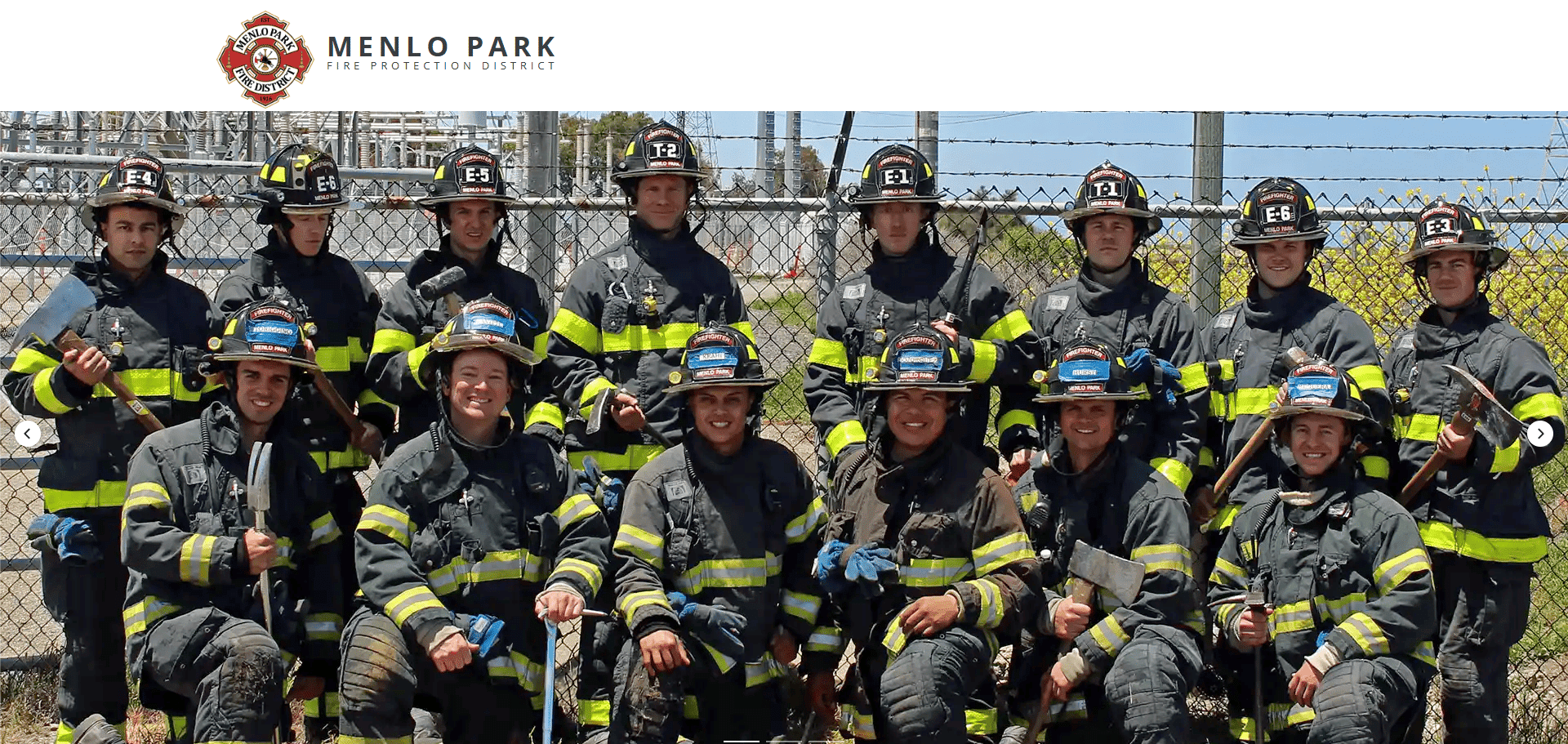
The Menlo Park Fire Protection District’s website is a lean, content-forward site that shows how a district can organize public education resources clearly. The homepage opens with the district’s mission statement — to protect and preserve life and property from the impact of fire, disaster, injury, and illness — followed by the latest news, an events calendar, and an upcoming meetings calendar, so residents and board watchers can find what is happening without searching. The Fire Prevention section includes a Community Risk Reduction area, and its Educational Resources page is a good model of curated, topic-based content. It groups resources under clear headings: Fire Safety in Your Home, Road Safety, Wildfire Prevention, Smoke and Carbon Monoxide Alarms, Injury Prevention and Control, and Other. Each group pairs the district’s own guides, such as a disaster preparedness checklist, apartment fire safety requirements, smoke alarm requirements, and food truck guidelines, with trusted outside sources such as FEMA, the Red Cross, NFPA, CAL FIRE, Fire Safe San Mateo County, and the CDC. Small icons make each group easy to scan. A district directory and accessibility link appear in the footer, and the site runs on a municipal content management system built for local government. For smaller districts that want to be a trusted local source for safety information without building everything from scratch, Menlo Park shows how to curate effectively.
10. Ross Valley Fire Department
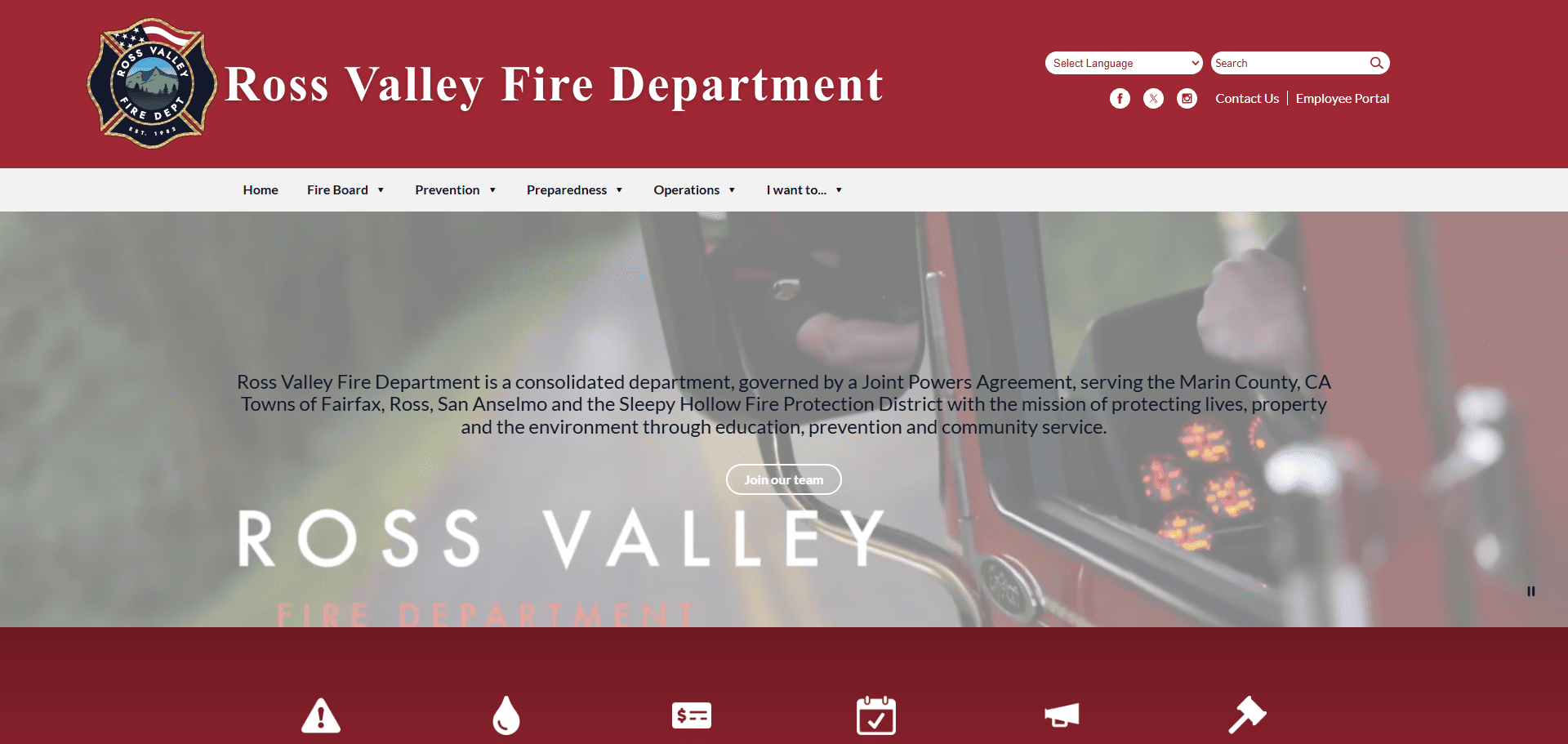
The Ross Valley Fire Department serves Fairfax, Ross, San Anselmo, and the Sleepy Hollow Fire Protection District through a joint powers agreement, and its website reflects the specific risks of a narrow Marin County valley. Beyond the standard wildfire topics, the Preparedness menu includes pages most departments do not have: creek flood gauges and cameras, storm preparedness, and neighborhood-specific FAQs, alongside defensible space, vegetation management, and evacuation information. The Prevention menu is clear and complete, with permit and plan submittals, inspections, resale inspections, a way to report a fire hazard, fire code and wildland urban interface code pages, hazard severity zone maps, Knox box entry systems, smoke and carbon monoxide alarm information, a fee schedule, and forms. An “I want to” menu turns those pages into tasks: apply for a job, become an explorer, order a resale inspection, report a non-emergency hazard, request an incident report or public record, request an engine at a community event, request a station tour, schedule an inspection, sign up for emergency alerts, and view a creek flood gauge and camera. Quick links on the homepage repeat the most used actions, station cards describe each station’s staffing and apparatus, and a Fire Board section includes members, meetings, transparency, and a board handbook. For departments with distinctive local hazards, Ross Valley shows how to give them dedicated pages instead of burying them.
Whether the strongest feature is a “Find it Fast” bar, a wildfire preparedness center, an “I Want To” menu, a transparent board section, or a dedicated recruitment path, each fire department above succeeds because it starts with what residents, contractors, and candidates actually need to do. If your fire department or fire district serves San Francisco, the East Bay, the Peninsula, Silicon Valley, the Tri-Valley, Marin, or anywhere in the Bay Area, KO Websites builds websites that put emergency information first, make services easy to find, and support your community through wildfire season and beyond. Contact us today for a free consultation.
What Sets Our Fire Department Website Design Apart
Designed for Emergencies and Everyday Tasks
Fire department sites carry two kinds of traffic: urgent visits during incidents and routine visits for permits, inspections, records, and programs. We design both. Emergency and non-emergency guidance is always visible, alert sign-ups and evacuation tools are one click away, and everyday services are organized into task-based menus so residents, contractors, and developers reach the right page quickly. Our web design process starts with your most requested services.
Wildfire and Preparedness Content That Stays Current
Defensible space, home hardening, fire hazard severity maps, evacuation zones, chipper programs, and preparedness checklists change from season to season. We build a preparedness center that your staff can update easily, with clear links to official resources such as CAL FIRE’s defensible space guidance and your county’s alert and evacuation tools, so residents always find current information.
Accessibility and Language Access Built In
Public agency websites need to work for every resident. We build to WCAG 2.1 Level AA, including keyboard navigation, color contrast, accessible forms, and accessible documents, and we design for translation tools and multilingual content. The federal ADA Title II web accessibility rule sets compliance dates in 2027 for larger entities and 2028 for smaller ones, so building accessibly now avoids a costly rebuild later.
Recruitment and Volunteer Pipelines
Fire agencies compete for firefighters, paramedics, dispatchers, reserves, cadets, and volunteers. We create recruitment pages with clear role descriptions, requirements, testing steps, events, and ways to reach a recruiter, plus pathways for explorers, CERT volunteers, and community programs. See how we approach government and agency web design across the Bay Area.
Complete Fire Department Website Package
Permits, Inspections, and Plan Submittals Hub
A dedicated area for fire prevention bureau services: permit applications, plan submittal checklists, fee schedules, inspection scheduling, resale inspections, hazard reporting, and code information. We link or embed your existing permit and payment systems and design the pages around the questions contractors and property owners ask most.
Wildfire and Emergency Preparedness Center
Defensible space and home hardening guidance, fire hazard severity maps, evacuation zone tools, alert sign-ups, CERT and community education, and seasonal safety content, organized so residents can act before an emergency and find answers during one.
Recruitment and Volunteer Pages
Career, reserve, cadet, explorer, and volunteer paths with requirements, process timelines, salary and benefits information, and links to your application platform. Candidate-friendly design and authentic photography help your department stand out.
Board Transparency and Public Records
For districts and joint powers authorities: board members, meeting calendars, agendas and minutes, budgets, audits, policies, and public records and incident report request pages. These features connect to your ongoing website management so documents stay organized and current.
Specialized Fire Department Digital Solutions
Fire Department Websites
Standalone sites for city and county fire departments, with clear emergency messaging, station information, services, programs, news, and careers, designed for the full range of audiences from residents to contractors to candidates.
Fire Protection District Websites
Websites for independent special districts and joint powers authorities that explain who you serve, how you are governed, and how residents can reach you, with transparency sections for board materials and financial documents.
Fire Prevention Bureau Pages
Organized pages for plan review, permits, inspections, fire code and ordinance information, standards, fee schedules, and forms, written for the developers, contractors, and property owners who use them every day.
Community Risk Reduction and Education
Pages for CPR and AED training, school and senior programs, station tours, smoke alarm and carbon monoxide safety, fire extinguisher guidance, youth programs, and seasonal safety campaigns that help your department reach residents before an emergency.
Emergency Alerts and Evacuation Information
Prominent alert banners, links to your county’s emergency notification and evacuation zone tools, incident information pages, and seasonal alerts that authorized staff can update quickly when the community needs information.
EMS Information and Records Requests
Clear pages for ambulance and EMS services, fee schedules, incident report and medical report requests, and public records requests, with instructions that reduce phone calls and misdirected requests.
Website Redesign and Migration
Content audits and structured migrations for agencies moving from outdated platforms or changing domains, including redirects and document organization so important links and records are not lost. Ready to see how this works in practice? Explore our portfolio.
Serving Bay Area Fire Departments and Districts
From the dense neighborhoods of San Francisco and Oakland to the technology corridors of San Jose and Silicon Valley, Bay Area fire agencies protect communities with very different risks. We work with departments and districts across the East Bay and Tri-Valley, including San Leandro, Castro Valley, Pleasanton, Livermore, and San Ramon. Each area has its own wildfire exposure, languages, and priorities, and we shape content and navigation to match.
Beyond Web Design: Complete Digital Communication
A strong fire department website works best when it is supported by consistent communication. Our SEO strategies help residents find your services when they search for things like fire inspections, burn rules, defensible space, or firefighter jobs in your area. Local search optimization keeps your station addresses, hours, and phone numbers accurate across Google Maps and other directories. Social media marketing supports community engagement and safety messaging, while video production creates recruitment, safety education, and station tour content that shows your department as it really is. Ongoing website management and hosting keeps your site secure, updated, and reliable.
Your Questions About Fire Department Web Design Answered
What should a fire department website include?
At minimum: clear 911 and non-emergency guidance, station locations and service area, fire prevention services such as permits, plan submittals, and inspections, emergency preparedness and wildfire resources, community programs and education, recruitment and volunteer information, news and events, and contact details. Fire districts and joint powers authorities should also include board information, agendas, budgets, and public records request pages.
How do you handle permits, inspections, and payments online?
We link to or embed the permit, scheduling, and payment systems your agency already uses and design the pages around them: plain-language instructions, submittal checklists, fee schedules, and forms. If your agency is changing systems, we can plan the website so those links can be updated without a redesign.
Can you help with wildfire preparedness and evacuation information?
Yes. We build preparedness sections covering defensible space, home hardening, fire hazard severity zone maps, evacuation zone tools, alert sign-ups, chipper and vegetation programs, and seasonal safety guidance, with links to official resources such as CAL FIRE and your county’s emergency tools. Your agency remains responsible for the accuracy of its content and for coordinating with county emergency management.
Does the website replace our emergency alert system?
No. A website supports your alert system but does not replace it. We make alert sign-ups, evacuation tools, and current incident information easy to find, and we recommend a short list of official channels so residents know where to look during an emergency.
Can the website help us recruit firefighters, paramedics, and volunteers?
Yes. We create recruitment pages with role descriptions, requirements, testing and academy steps, salary and benefits information, events, and recruiter contact options, plus separate paths for reserves, cadets, explorers, and community volunteers. We link to your application platform so candidates can apply without friction.
Will the website be accessible and available in multiple languages?
We design and build to WCAG 2.1 Level AA and plan for translation tools and multilingual content from the beginning. The federal ADA Title II rule on web accessibility sets compliance dates in 2027 for larger public entities and 2028 for smaller ones, so we recommend building accessibly now. Final compliance decisions should be reviewed with your legal counsel.
What ongoing support do you provide after launch?
We provide hosting, security updates, backups, and content support so your site stays current, including help with seasonal wildfire content, new permits and fee schedules, board documents, and recruitment updates. See what our clients say in our testimonials section.
Build a Fire Department Website Your Community Can Count On
Your website is where residents turn for safety information, where contractors go to keep projects moving, and where future firefighters decide whether to apply. When it is clear, current, and accessible, it saves staff time, helps your community prepare, and strengthens trust in your department. KO Websites designs fire department and fire district websites that put emergency information first, make services easy to find, and present your agency as the professional, community-focused organization it is.