Professional Law Enforcement Website Design That Builds Trust and Serves Your Community
Custom websites for Bay Area police departments and sheriff’s offices that make services easy to find, meet California transparency requirements, and help you recruit the people your community needs
California agencies also work with a legal baseline. Since January 1, 2020, SB 978 (Penal Code section 13650) requires local law enforcement agencies to conspicuously post their current standards, policies, practices, operating procedures, and training materials on their websites. We treat that requirement as an opportunity. A well-organized transparency section helps answer common questions, can reduce the volume of individual records requests, and shows your community how your department operates.
Best Law Enforcement Websites: Bay Area Examples That Build Trust and Make Services Easy to Find
A law enforcement website serves several audiences at once: residents reporting a crime, families looking for records, journalists and advocates reviewing policies, and candidates deciding whether to apply. The best police and sheriff websites in the Bay Area handle all of them by organizing content around tasks, explaining clearly what can be done online, and treating transparency as part of the structure instead of an afterthought. The ten agencies below, all of which run their own dedicated websites, show how different departments approach that challenge, from large city departments and a mid-sized city agency to four county sheriff’s offices and a university police department.
1. San Francisco Police Department (SFPD)
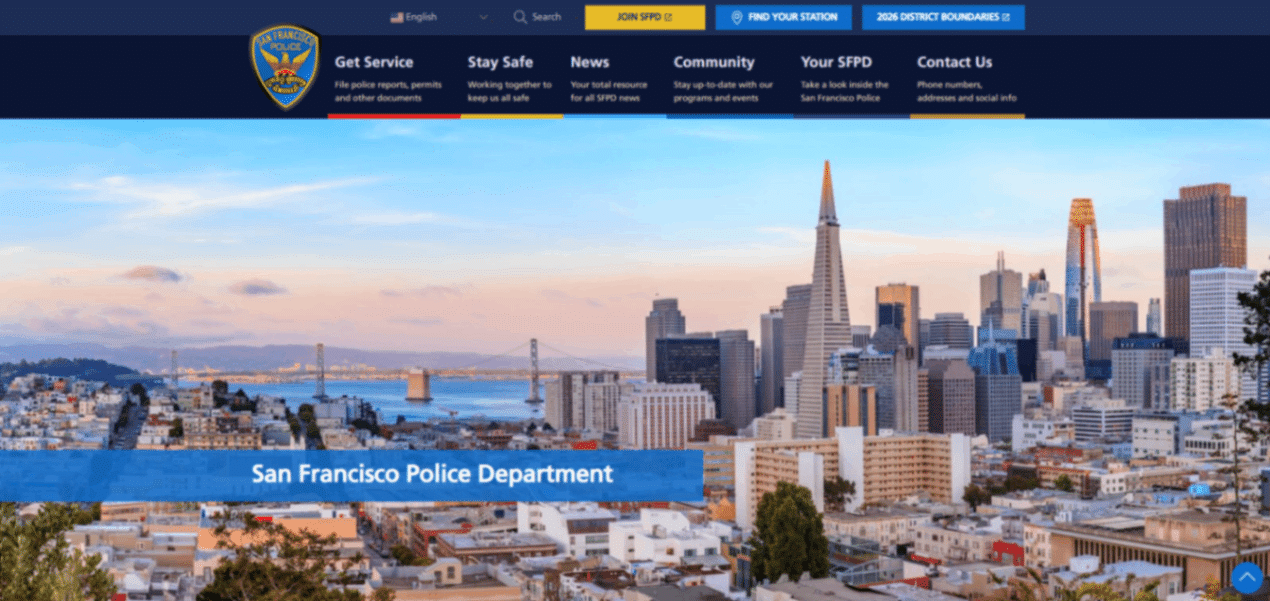
The San Francisco Police Department’s website shows how a large agency can organize a huge amount of content around what residents actually need. The main navigation is built around tasks and audiences — Get Service, Stay Safe, News, Community, Your SFPD, and Contact Us — while a utility bar keeps Search, Join SFPD, and Find Your Station within reach on every page. Popular search terms under the search box, such as police or supplemental report, jobs, policy, crime stats, and use of force, put the most requested topics one click away. The Police Reports page is a strong model of honest user experience: it lists exactly which crimes can and cannot be filed online, offers the online form in English, Spanish, and Chinese, and points residents to 3-1-1 for phone assistance in more than 175 languages. Transparency is built into the structure rather than buried: crime and clearance-rate dashboards sit under Stay Safe, while Policies, Published Reports, and Police Reform live under Your SFPD, alongside links to the Police Commission and the Department of Police Accountability. Dedicated pages for language assistance, deaf and hard-of-hearing services, and an accessibility statement complete the inclusive design. For large departments serving many audiences, SFPD’s task-first architecture is the clearest benchmark in the Bay Area.
2. San Jose Police Department (SJPD)
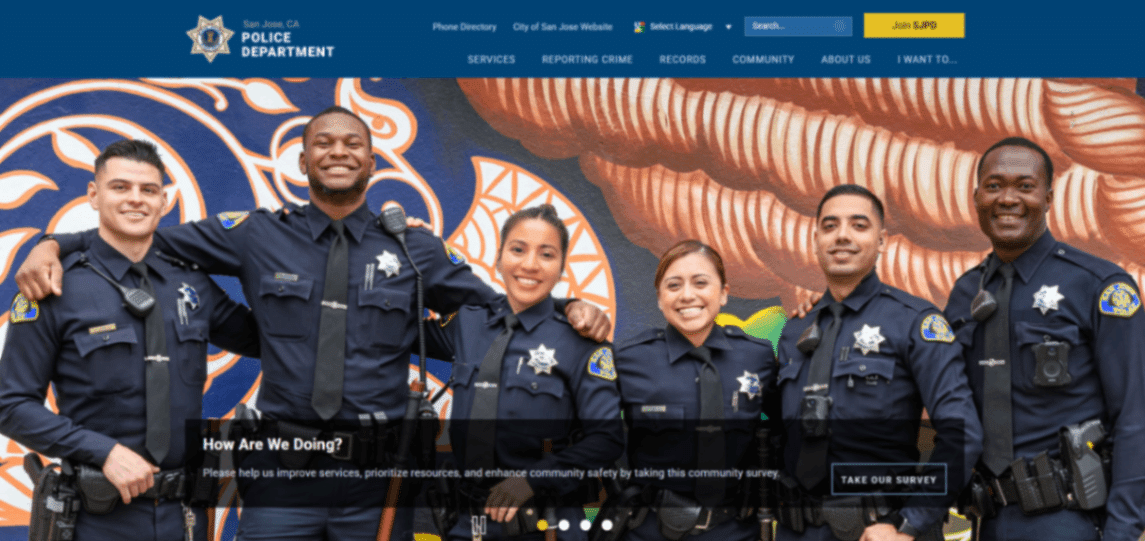
The San Jose Police Department’s crime-reporting section is a practical example of explaining options in plain language. Instead of sending every visitor to a single form, the page walks residents through each way to report: calling the non-emergency line, dialing 3-1-1 for City services, texting to 9-1-1 for people who are deaf, hard of hearing, speech impaired, or unsafe speaking aloud, visiting police headquarters, or filing online. The page opens by explaining why reporting matters, including practical reasons such as getting a report number for an insurance claim, which frames the process as helpful rather than bureaucratic. Online reporting is clearly limited to a defined list of incident types, including fraud, identity theft, theft, vandalism, lost property, and non-injury traffic accidents, and is labeled as intended for insurance purposes, which sets expectations before a resident starts a form. Lobby hours are spelled out with a phone number to confirm availability, and a separate section explains how to leave an anonymous tip through Silicon Valley Crime Stoppers, with a bold reminder not to use that channel for official police reports. For departments serving a large and diverse city, SJPD shows how one well-structured page can route different situations to the right channel.
3. Fremont Police Department
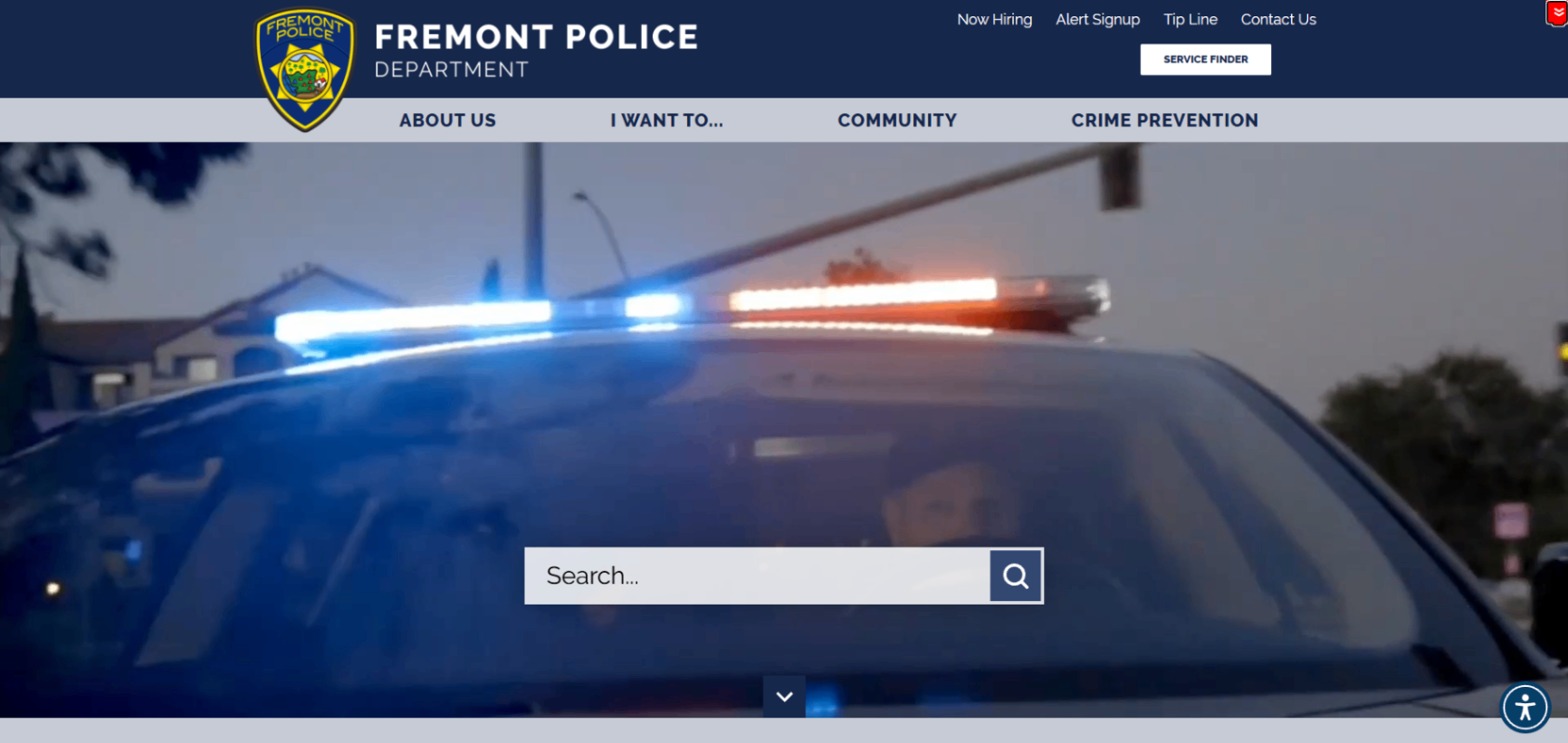
The Fremont Police Department operates its own dedicated government domain, fremontpolice.gov, and its website is one of the best-documented redesigns among Bay Area agencies. The department rebuilt its site after more than a decade on an aging platform, selecting Granicus through a competitive bid process and launching a mobile-friendly site with improved search and menu navigation, designed with accessibility in mind and with the SB 978 deadline in view. Granicus’ case study reports that nearly half of the department’s visitors use mobile devices, which is exactly why the redesign prioritized the most requested information. The result is a site with a dedicated Transparency Portal under About Us, an Office of Professional Standards and Accountability page, and an Accountability FAQ that answers difficult public questions directly, covering budget allocation, calls for service, use of force and training, hiring standards, school resource officers, and equipment. That approach to public questions is rare and valuable: it shows residents that the department is willing to explain itself in plain language. The About Us section adds mission, vision, and values, and a history timeline that humanizes the agency. At launch, the department also introduced a separate hiring microsite to give candidates a dedicated experience. For departments that want to own their brand and domain, Fremont is a strong model of a standalone police website built around public trust.
4. Vallejo Police Department
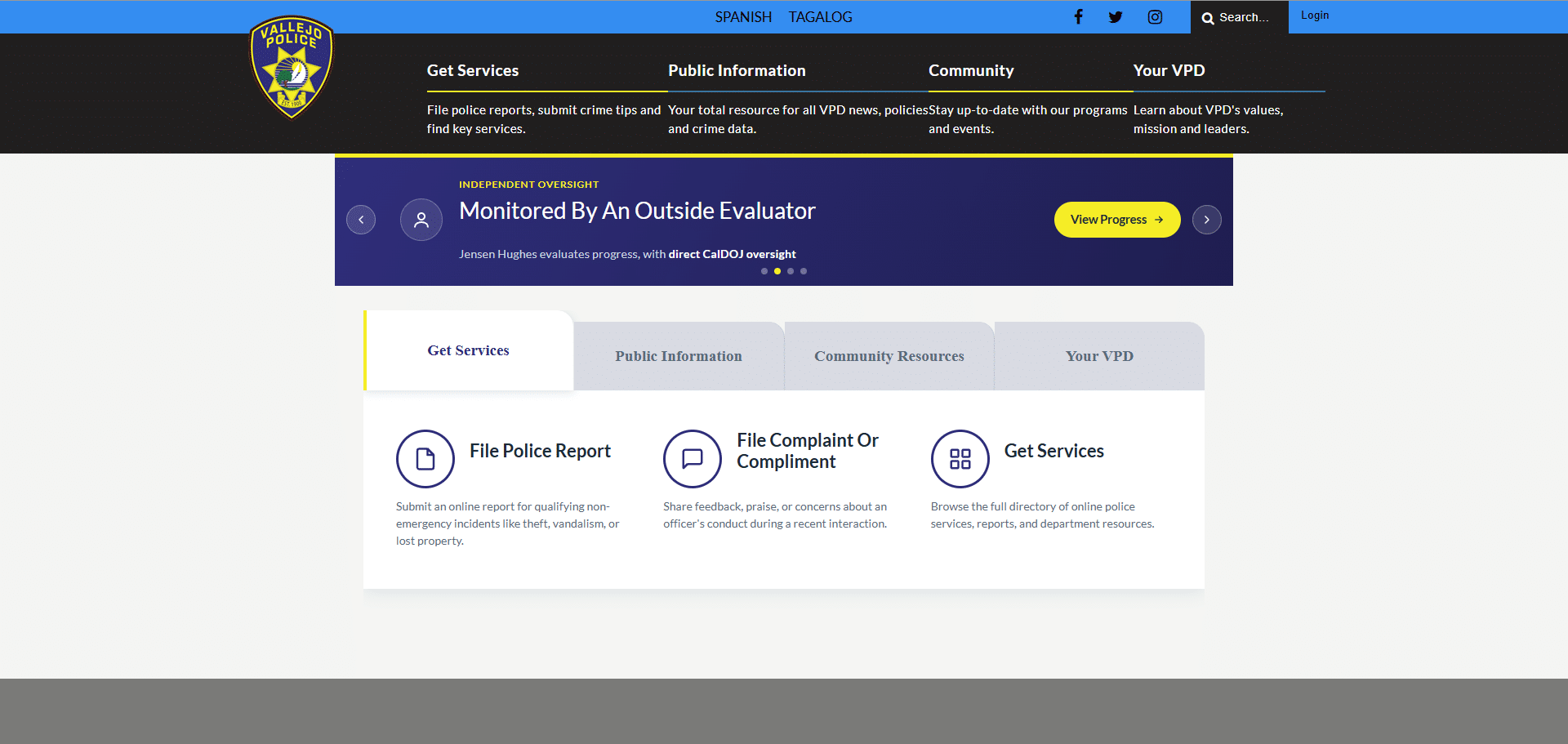
The Vallejo Police Department’s website has one of the deepest public-information architectures in the Bay Area, and its main navigation makes that depth easy to understand. Four top-level sections organize everything: Get Services, Public Information, Community, and Your VPD. Under Get Services, an Online Police Services group covers filing a police report, requesting a copy, submitting crime tips, public records requests, filing a complaint or compliment, and a parking citation payment plan. Public Information is where the site stands out: Police Reform pages cover the department’s settlement agreement and collaborative reform work; Crime Data includes crime mapping, use of force reports, shooting incident pages, hate crime data, a daily incident log, and a beat map; Codes and Policies includes the policy manual, SB 978 materials, and surveillance technology policies; and further sections cover annual reports, AB 481 materials, RIPA data, and technology and innovation. The Community section highlights the CARE Center, the Chief’s Advisory Board, the Surveillance Advisory Board, and Neighborhood Watch, while Your VPD includes training schedules organized by year. Spanish and Tagalog language options are available. For departments under public scrutiny or in active reform, Vallejo’s structure shows how to present a large volume of accountability information without overwhelming visitors.
5. Walnut Creek Police Department
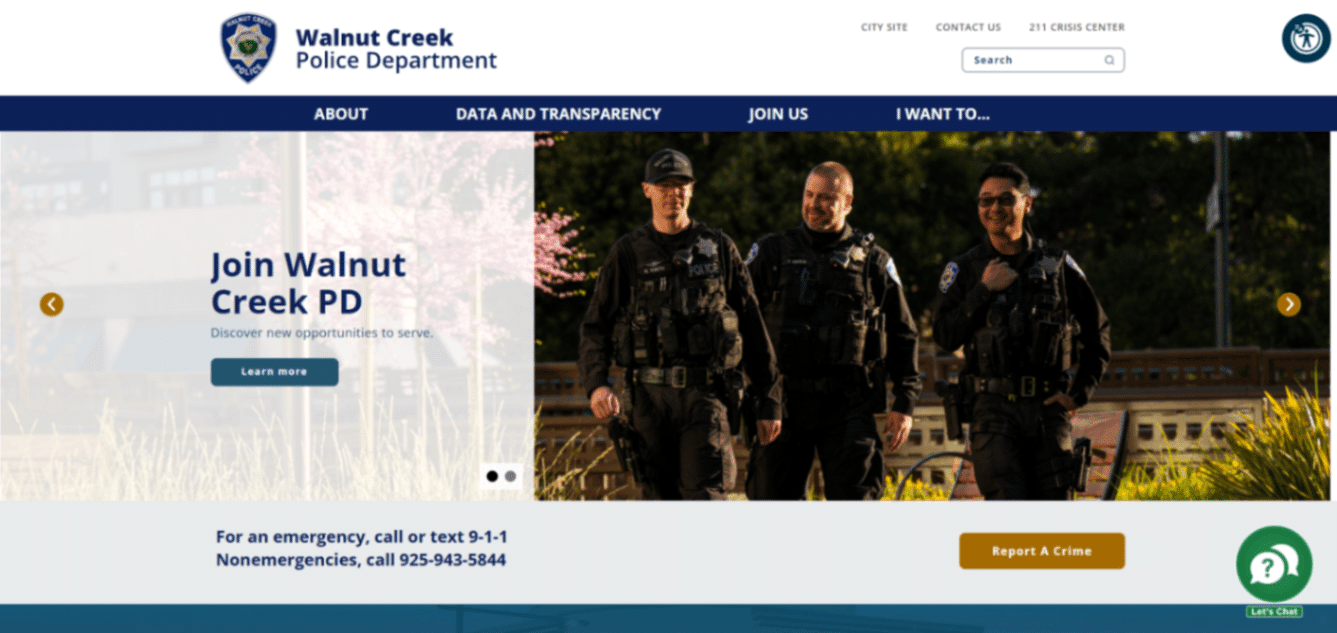
The Walnut Creek Police Department runs its own site, walnutcreekpdca.gov, separate from the City’s main website, and it was launched as part of a coordinated redesign that the City says was shaped by surveys, workshops, and user testing with the community and staff, with simplified navigation, expanded translation options, and new accessibility tools. The result is a site that reads as a mid-sized city department speaking directly to residents. A personal welcome from the Chief explains the department’s mission in plain language, followed by a clear overview of Operations (patrol, traffic, homeless outreach, K-9, bombs and drones, SWAT and crisis negotiation) and Administrative divisions (investigations, dispatch, professional standards, records, property and evidence), plus an annual report summary that tells visitors what it covers: crime statistics, important investigations, staffing, and notable events. An “I Want To” menu groups services by intent: report a crime, car accident, or abandoned vehicle; request a police or accident report, public records, or parking information; and join the department through reserve officer, cadet, and volunteer paths. The Transparency Portal is organized into three clear groups: Data (police response activity, RIPA data, hate crimes), Transparency (annual reports, SB 1421 use of force records, incidents of public interest, military equipment use policy, and the Chief’s Community Advisory Board), and Records (requests for police reports and public records). A dedicated Business Watch page and a complaints page that explains how to file in person, by phone, by mail, or by email round out the experience. For mid-sized city departments, Walnut Creek shows how a standalone site can be organized around intent rather than org chart.
6. Alameda County Sheriff’s Office
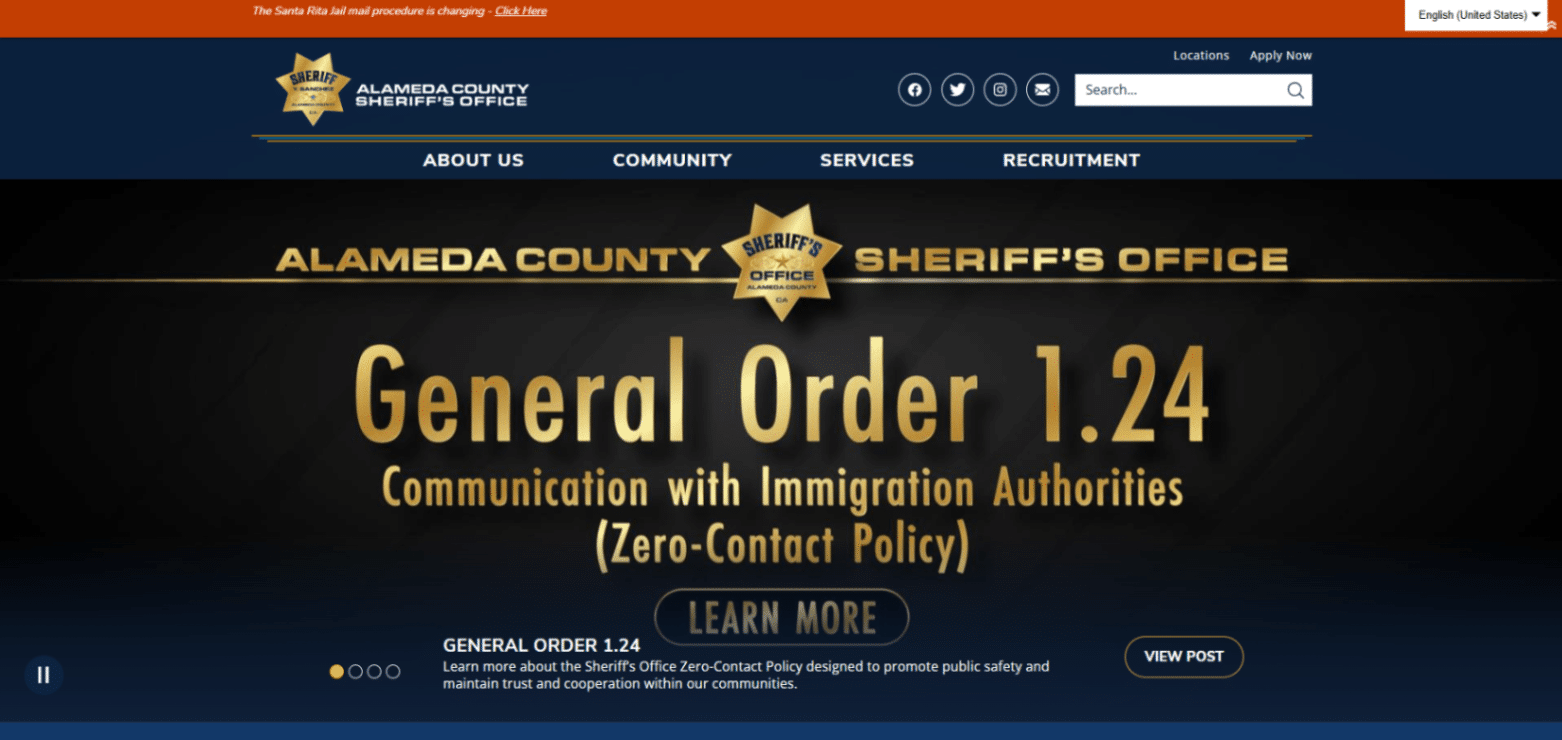
The Alameda County Sheriff’s Office shows what a transparency section looks like for an agency that runs courts security, coroner services, and a major county jail in addition to patrol. Its Public Information Portal opens with a clear statement that transparency and accountability are foundational to the office’s goals, then lists exactly what visitors will find: written directives and policies, mandated posted documents, in-custody death information, the organizational chart, PREA statistics, military equipment disclosures, a transparency page for license plate reader technology, hate crime statistics, internal affairs statistics, Santa Rita Jail statistics, and press releases. The portal is described as an iterative tool that will expand as new data becomes available, and it names a coordinator visitors can contact with questions, which sets honest expectations. The About Us section notes the office’s CALEA accreditation, and a dedicated recruitment site gives candidates a focused experience separate from the public-information content. The agency launched its current website with the stated goal of making it both informative and easy to navigate, and it pairs that site with subscription options so residents can receive updates directly. For sheriff’s offices with many divisions and audiences, this portal-based approach is a practical way to organize complex public data.
7. Marin County Sheriff’s Office
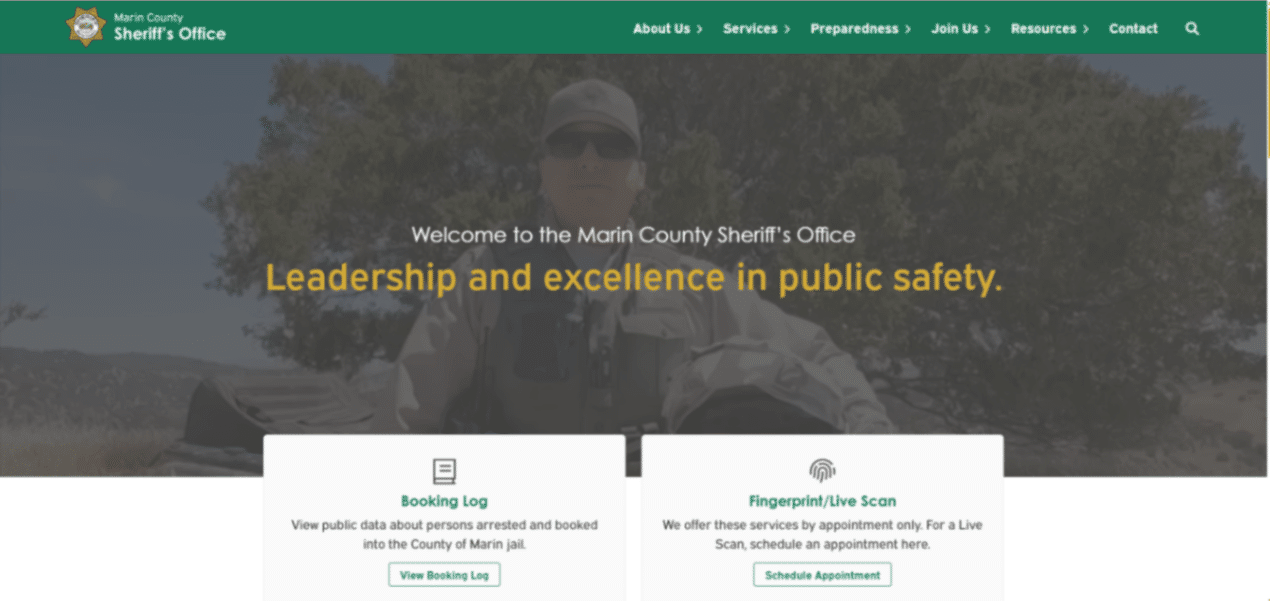
The Marin County Sheriff’s Office has moved to a .gov domain, marinsheriff.gov, and its current website is a clear example of navigation that explains itself. Six top-level sections organize the whole site: About Us, Services, Preparedness, Join Us, Resources, and Contact. Inside each menu, every link carries a one-line description, so a resident can tell what a page does before clicking it. The Services menu covers fifteen practical tasks, from civil services, records, warrants, and missing and wanted persons to fingerprinting and Live Scan, a non-emergency crime report that can be filed and printed for free, vacation house checks, security camera registration, free gun locks, evacuation tags, concealed weapons permits, and bicycle registration. The homepage elevates the most requested tools as large tiles: a public booking log, Live Scan appointment scheduling, a recruitment video, and an FAQ that answers common questions by topic. A dedicated Preparedness section covers emergency alert tools, hazard information, disaster recovery, and current emergency updates, which is especially relevant for a county that faces wildfire and flood risk. The Resources section collects the citizen complaint process, crime data and statistics including RIPA data, training, policies and procedures with the use of force policy, forms, and news. A Transparency block on the homepage links to annual report videos for five consecutive years and to the county’s open data portal. For sheriff’s offices that want their site to work as both a service center and an emergency resource, Marin is an excellent model.
8. Sonoma County Sheriff’s Office
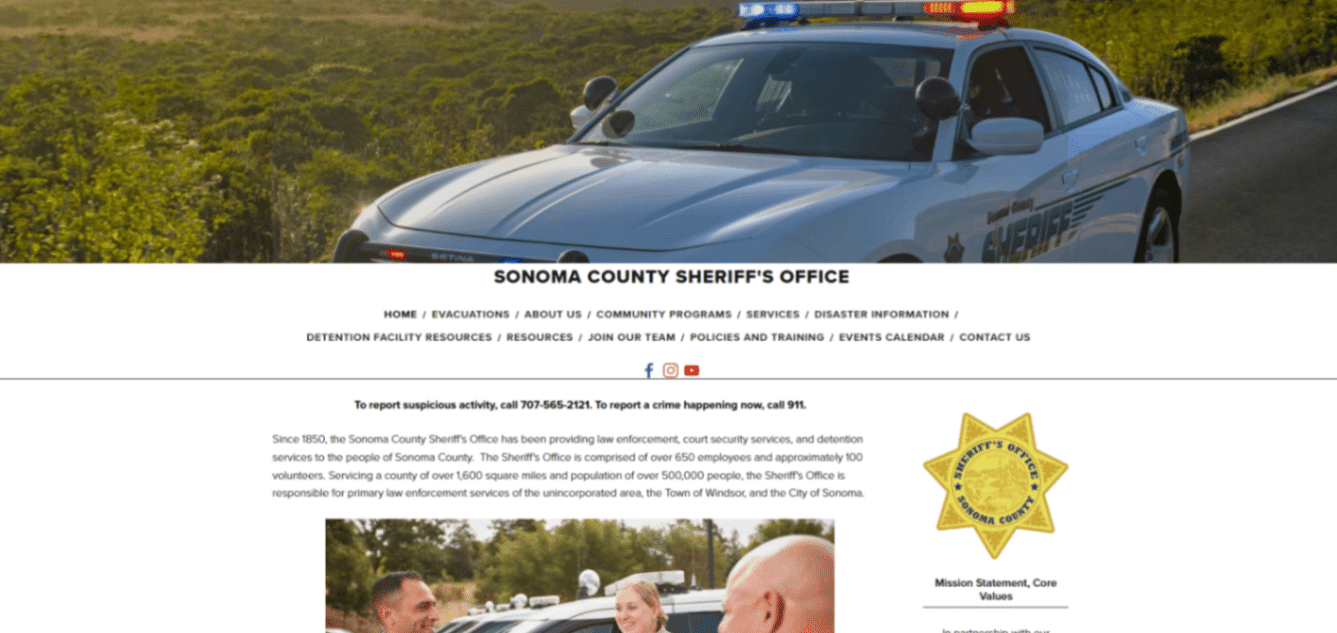
The Sonoma County Sheriff’s Office serves a large, largely rural county, and its website reflects that reality in the way it prioritizes information. The homepage opens with a bold line that separates two situations: call 911 for a crime happening now, or the non-emergency number to report suspicious activity. Evacuations sit in the top-level navigation next to Home and About Us, which is exactly where residents of a wildfire-prone county need them, and a Disaster Information menu adds fire information and evacuation preparedness. An icon grid of quick links puts the most used tools on the homepage: live events, crime map, report a crime, warrant search, inmate search, Silent Witness anonymous tips, concealed weapon permits, civil bureau, and the phone directory. The Services menu includes programs that reflect local needs, such as an Ag Access Program, gate code registration, abandoned vehicle and abandoned boat programs, and a ride-along application. Community programs include a Community Academy that is also offered in Spanish and a Community Roundtable for Equity, Engagement, and Diversity. A full Detention Facility Resources menu covers visitation, commissary, depositing money, PREA information, facility inspections, and incarcerated person search. Policies and Training has its own top-level link, a Resources section includes reports and statistics and SB 272 compliance, and recruitment is handled on a separate careers site. A footer offers alert sign-ups through Nixle and SoCoAlert, a monthly newsletter subscription, and an accessibility contact for documents. For sheriff’s offices that serve rural and disaster-prone communities, Sonoma shows how to put emergency and community-specific services first.
9. Contra Costa County Office of the Sheriff
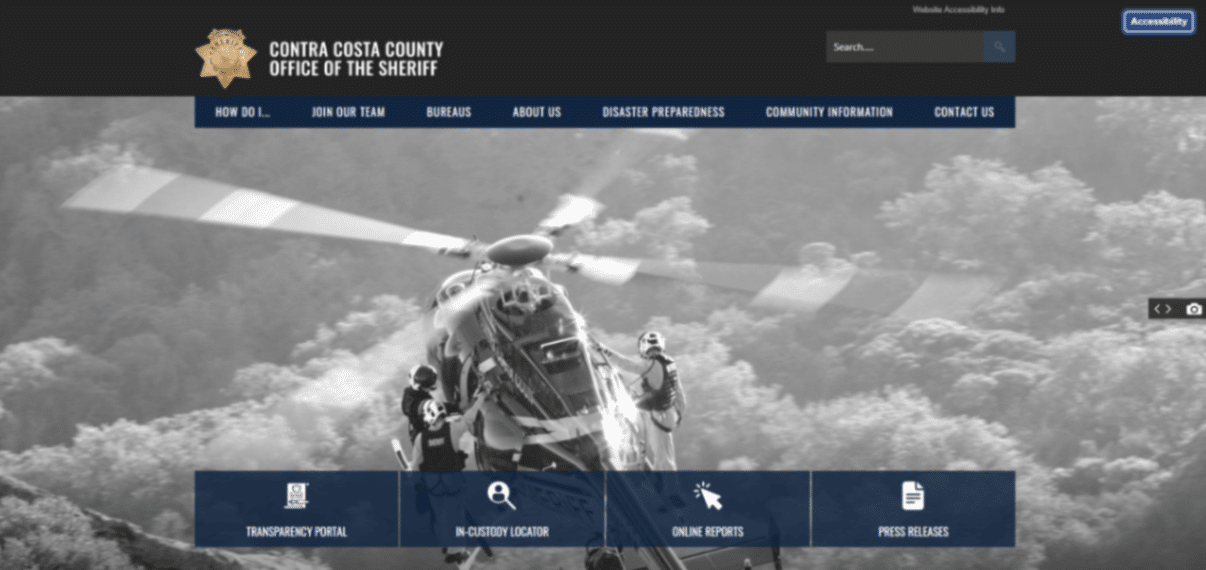
The Contra Costa County Office of the Sheriff runs a site that shows how to turn complicated administrative processes into clear, step-by-step pages. Its Request a Police Report page is the best example: it explains who the Records and ID Unit serves, the office hours and address, the identification required, the ten-day response time, and the accepted payment methods, and then lists the forms by situation, including separate forms for victims, drivers, and registered owners, for insurance companies and third parties acting for them, for lawyers, for juvenile case information, and for petitions to seal arrest records. The page also does something many agencies skip: it tells visitors where to go for things the Sheriff’s Office does not handle, such as the Superior Court for criminal histories and court records, the Investigations Division for case status, the Civil Unit for evictions and service, and the District Attorney for formal charges. The Join Our Team page presents distinct career paths for Deputy Sheriff, Reserve Deputy Sheriff, and Dispatcher, with plain explanations of the academy, lateral pathways, and training process, and no assumption that applicants already know the system. The About Us section includes a bureaus overview, command staff biographies, an office overview with annual statistics, and a history of past sheriffs, while the Administrative Services pages explain the Internal Affairs unit and the complaint procedure. A dedicated citizen complaint form page invites comments, suggestions, and complaints. For sheriff’s offices with large records and civil operations, Contra Costa shows how clear instructions can reduce phone calls and counter visits.
10. University of California Police Department, Berkeley (UCPD)
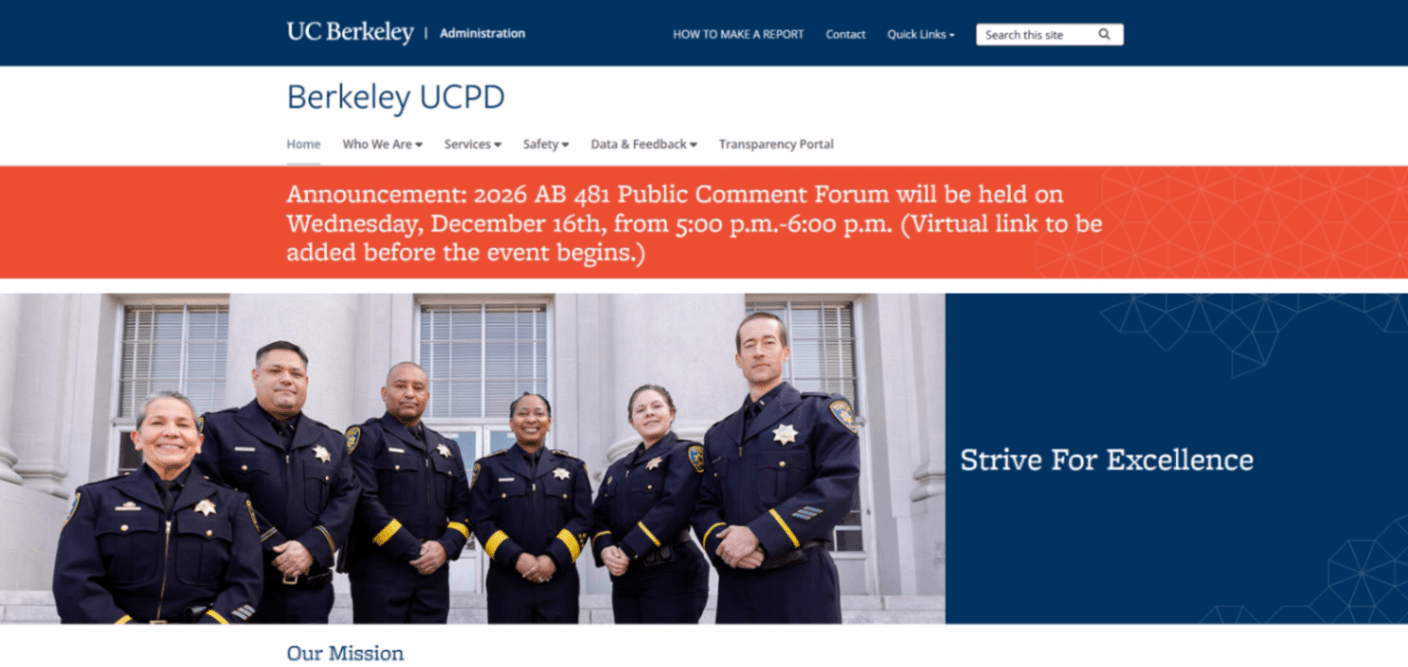
The UC Berkeley Police Department has its own dedicated website, built on the campus web platform, and it demonstrates how a campus agency can serve a very different audience: students, parents, faculty, staff, and visitors. The main navigation is built around five clear areas — Who We Are, Services, Safety, Data and Feedback, and a Transparency Portal — with a secondary bar that keeps How to Make a Report, Contact, and Quick Links available everywhere. Each menu opens with a short explanation of what the section is for, and the Quick Links list puts the most common tasks in one place: report a crime, request a police report, daily crime log, lost and found, crime mapping, a survey, WarnMe alerts, and bicycle registration. The Services section explains how the campus WarnMe alert system works and that all students, faculty, and staff are automatically enrolled. The Safety section covers topics specific to a campus, including residence hall security, game day, targeted violence and active threats, and sexual assault and relationship violence resources. Data and Feedback is unusually complete, with a daily crime log, crime mapping, traffic stop data, use of force data, RIPA and AB 481 pages, calls for service data, complaint data, feedback results, and ways to make a commendation or file a complaint. The Policies page includes plain-language guidance on what to expect during a police stop, plus links to the policy manual, use of force policy, complaint investigation policy, and training plan. A department demographics page shares workforce data in charts, and an accessibility note in the footer provides a phone number for immediate help. For campus and institutional police departments, UCPD Berkeley is a clear model of audience-specific content and open data.
Whether the strongest feature is a task-based menu, a clearly explained online reporting process, a deep transparency portal, a multilingual layout, or a dedicated recruitment experience, every department above succeeds for the same reason: its website starts with what residents, candidates, and the public actually need to do. If your police department or sheriff’s office serves San Francisco, Oakland, San Jose, the East Bay, the Peninsula, or anywhere in the Bay Area, KO Websites builds websites that make services easy to find, organize your public information, and help you recruit with confidence. Contact us today for a free consultation.
What Sets Our Law Enforcement Website Design Apart
Designed Around Resident Tasks
Residents rarely visit a police website to learn about the org chart. They want to file a report, request a record, pay a citation, share a commendation, or find a station. We organize your navigation around those tasks, with clear eligibility rules for online reporting and prominent 9-1-1 and non-emergency messaging, so people reach the right channel on the first try. Our web design process starts with your most requested services and works outward.
Transparency Sections That Stay Organized
SB 978 requires agencies to post policies and training materials, but the Electronic Frontier Foundation’s review of agency pages found little consistency in how that information is published and noted that links changed or disappeared as agencies updated or relaunched their sites. We build document libraries with clear categories, descriptive file names, update dates, and a maintainable structure so your SB 978 materials remain easy to find over time. Your agency and counsel decide what must be posted; we make it clear and durable.
Accessibility and Language Access Built In
Public agency websites need to work for every resident. We build to WCAG 2.1 Level AA, including semantic structure, keyboard navigation, color contrast, accessible forms, and accessible documents, and we design for translation tools and multilingual content. The federal ADA Title II web accessibility rule sets compliance dates in 2027 for larger entities and 2028 for smaller ones, so building accessibly now avoids a costly rebuild later.
Recruitment That Reflects Your Department
Hiring is a daily challenge for law enforcement agencies. The National Institute of Justice has published guidance on optimizing agency websites for effective and inclusive recruitment, and we apply those principles: authentic photography and stories, clear steps from interest to application, multiple ways to reach a recruiter, and a message that matches your department’s real culture. See how we approach government and agency web design across the Bay Area.
Complete Law Enforcement Website Package
SB 978 Transparency Hub
A dedicated, easy-to-navigate section for policies, procedures, training materials, annual reports, and other public-information documents, organized by topic with clear labels and update dates. We can also structure pages for related disclosures your agency chooses to publish, such as equipment and technology policies.
Online Reporting and Records Request Flows
Plain-language pages that explain which incidents can be reported online, link or embed your existing reporting and records systems, and route everything else to the right phone number or station. Eligibility checklists, translation options, and clear emergency messaging reduce misdirected reports.
Recruitment Pages and Microsites
A focused hiring experience with role descriptions, requirements, testing steps, salary and benefits information, events, and contact options for recruiters. Separate paths for lateral officers, recruits, dispatchers, cadets, and professional staff help each candidate find what applies to them.
Community Engagement Tools
Pages and forms for community meetings, beat or district information, crime prevention programs, neighborhood watch, camera registration, commendations, and feedback. These features connect your website to your ongoing website management so content stays current.
Specialized Law Enforcement Digital Solutions
Police Department Websites
Standalone or city-integrated sites for municipal police departments, with clear service navigation, station and contact information, news, and community programs. We design for the full range of audiences: residents, victims, businesses, candidates, and the media.
Sheriff’s Office Websites
Websites that organize the wide range of sheriff’s office functions, from patrol and investigations to court security, detention, and coroner services, into a structure the public can understand, with dedicated sections for each division and its public information.
Crime Data and Dashboards
Pages that present crime statistics, incident logs, annual reports, and other data in understandable formats, with plain-language explanations of what the numbers mean and what they do not.
Public Information and Accountability Pages
Organized sections for use of force reports, policy manuals, complaint and commendation processes, community advisory boards, and other accountability resources, written and structured for clarity rather than legal jargon.
Emergency Alerts and Public Notices
Prominent alert banners, links to emergency notification sign-ups, missing persons pages, and public notices that authorized staff can update quickly when the community needs information.
Multilingual and Accessible Design
Layouts that support translation tools and multilingual content, plain-language writing, accessible forms and documents, and mobile-friendly design for residents who reach your site from a phone, often in a hurry.
Website Redesign and Migration
Content audits and structured migrations for agencies moving from outdated platforms, including redirects and document organization so important links and records are not lost during the transition. Ready to see how this works in practice? Explore our portfolio.
Serving Bay Area Law Enforcement Agencies
From the dense urban neighborhoods of San Francisco and Oakland to the technology corridors of San Jose and Silicon Valley, Bay Area agencies serve communities with very different needs. We work with departments across the East Bay and Tri-Valley, including San Leandro, Castro Valley, Pleasanton, Livermore, and San Ramon. Each community has its own languages, neighborhoods, and priorities, and we shape content and navigation to match.
Beyond Web Design: Complete Digital Communication
A strong department website works best when it is supported by consistent communication. Our SEO strategies help residents find your services when they search for things like police reports, records requests, or careers in your city. Local search optimization keeps your station addresses, hours, and phone numbers accurate across Google Maps and other directories. Social media marketing supports community engagement with consistent messaging, while video production creates recruitment and community-outreach content that shows your department as it really is. Ongoing website management and hosting keeps your site secure, updated, and reliable.
Your Questions About Law Enforcement Web Design Answered
How do you help a department meet SB 978 requirements?
SB 978 requires local law enforcement agencies to conspicuously post their current standards, policies, practices, operating procedures, and training materials on their websites. We build an organized transparency section with clear categories, descriptive file names, and update dates, and we make sure it is easy to find from your main navigation. Your agency and legal counsel remain responsible for deciding which materials must be posted and for reviewing them before publication.
Can you build on our city’s website platform, or do we need a standalone site?
Both approaches are common in the Bay Area. Many departments publish within their city’s website platform, while others, such as SFPD, Fremont PD, and Walnut Creek PD, operate dedicated department sites. We evaluate your city’s IT policies, budget, and goals and recommend the best route: a standalone site, a recruitment microsite, or improved content and design within your city’s system.
How does online crime reporting work on the website?
We link to or embed your existing online reporting and records systems and design the pages around them. That includes clear eligibility checklists, plain-language instructions, translation options, and prominent emergency messaging so residents know when to call 9-1-1, when to use the non-emergency line, and when to file online.
Can the website help us recruit officers, dispatchers, and professional staff?
Yes. We create recruitment pages or microsites with role descriptions, requirements, hiring steps, benefits, events, and recruiter contact options. We follow principles from the National Institute of Justice’s guidance on inclusive recruitment websites, including authentic imagery, a clear application path, and multiple ways to connect with a recruiter.
Will the website be accessible and available in multiple languages?
We design and build to WCAG 2.1 Level AA and plan for translation tools and multilingual content from the beginning. The federal ADA Title II rule on web accessibility sets compliance dates in 2027 for larger public entities and 2028 for smaller ones, so we recommend building accessibly now. Final compliance decisions should be reviewed with your city attorney.
What ongoing support do you provide after launch?
We provide hosting, security updates, backups, and content support so your site stays current, including help organizing new policy documents, annual reports, and recruitment updates. See what our clients say in our testimonials section.
Build a Law Enforcement Website Your Community Can Trust
Your website is often the first and most frequent interaction a resident has with your department. When it is clear, accessible, and transparent, it saves staff time, helps residents get what they need, and strengthens trust in your agency. When it is outdated or hard to navigate, the opposite happens. KO Websites designs law enforcement websites that make services easy to find, organize your public information, and present your department as the professional, community-focused agency it is.