Professional City Government Website Design That Makes Services Easy to Find, Accessible to Everyone, and Ready for .gov Compliance
Custom website strategy, design, and content for Bay Area cities that put residents’ tasks first, meet accessibility standards, and make the move to a .gov domain without losing search visibility
The best city websites do more than look modern. They organize content around what residents are trying to do, write in plain language that translates well, publish accessible documents, keep meeting agendas and permit information easy to find, and plan every domain or platform change so links, search rankings, and bookmarks keep working. We build for all of that.
Best City Government Websites: Bay Area Examples That Put Residents First
Bay Area cities have been rethinking their websites with a common goal: help people finish a task and leave. The ten cities below show different ways to do that, from San Francisco’s single citywide platform to Walnut Creek’s family of four coordinated sites. Each one runs its own full website, and each offers lessons in navigation, accessibility, multilingual access, or the domain and platform changes that every California city will face by 2029.
1. City and County of San Francisco (SF.gov)
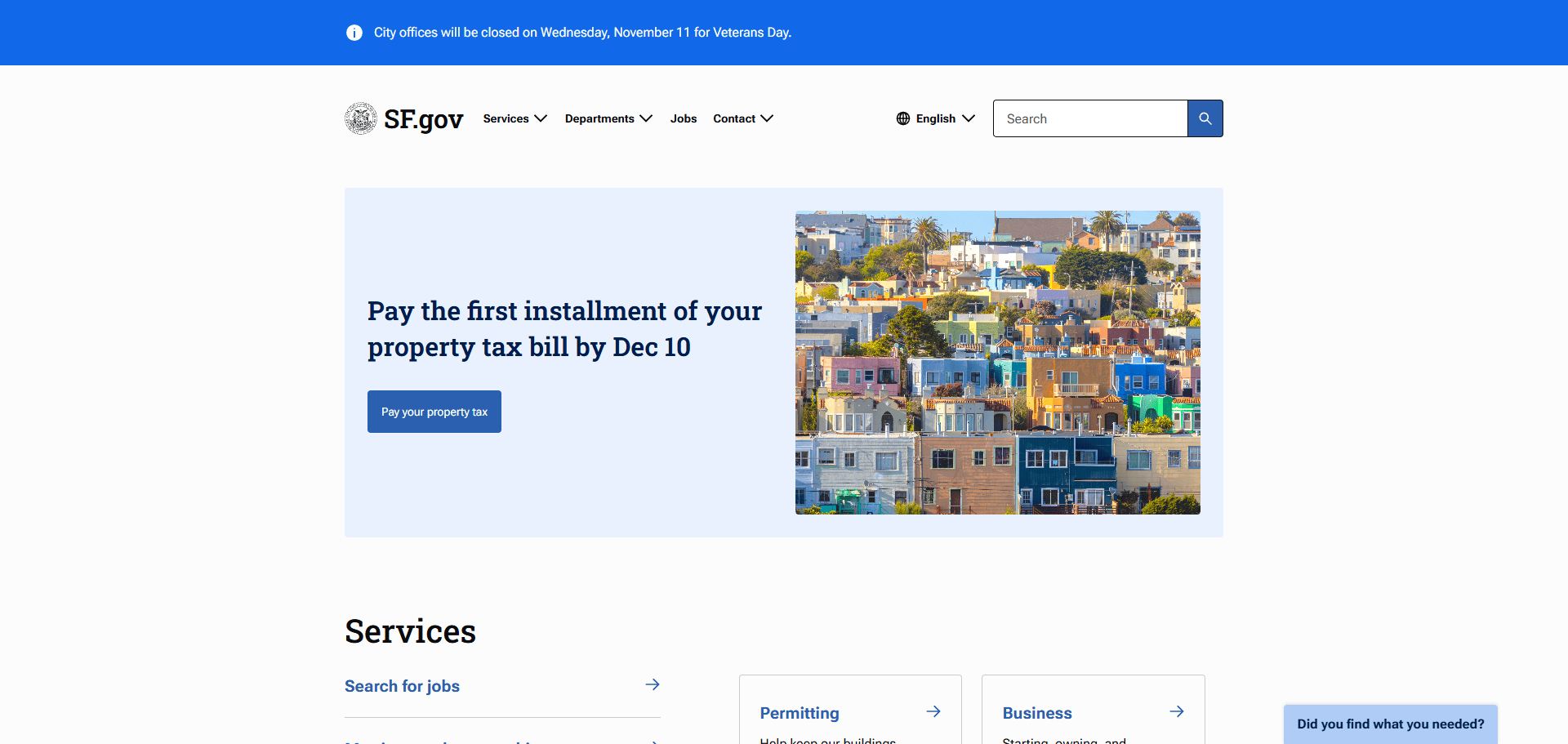
SF.gov is a single, centralized website for the City and County of San Francisco, and it shows what a unified platform can do for residents. In January 2025 the city launched a redesigned, replatformed site built on Wagtail, an open-source CMS, paired with a new design system aimed at accessible, responsive design. The site hosts more than 200 departments, divisions, programs, boards, and commissions, serves about 750,000 unique visits a month, and is maintained by roughly 300 active editors, all working inside one consistent system. The navigation puts tasks before organization charts: the Services menu leads with shortcuts like getting married, getting a birth certificate, finding affordable housing, getting a permit, and reporting a problem, followed by topic categories such as Building, Business, Health, Homelessness, Housing, Parking, and Volunteering. A separate Departments menu and a Contact section that points to 311 round out the structure. The site is available in English, Spanish, Traditional Chinese, Filipino, and Vietnamese, and the city’s digital standard calls for accessibility to WCAG AA+ and content written at a fifth-grade reading level. Its design team also described research into what makes residents trust a website as official and feel it belongs to them, then applied lightweight design changes to give the site a San Francisco identity while preserving its accessibility scores. For any city that wants to consolidate scattered department sites under one standard, SF.gov is the benchmark.
2. City of Oakland (oaklandca.gov)
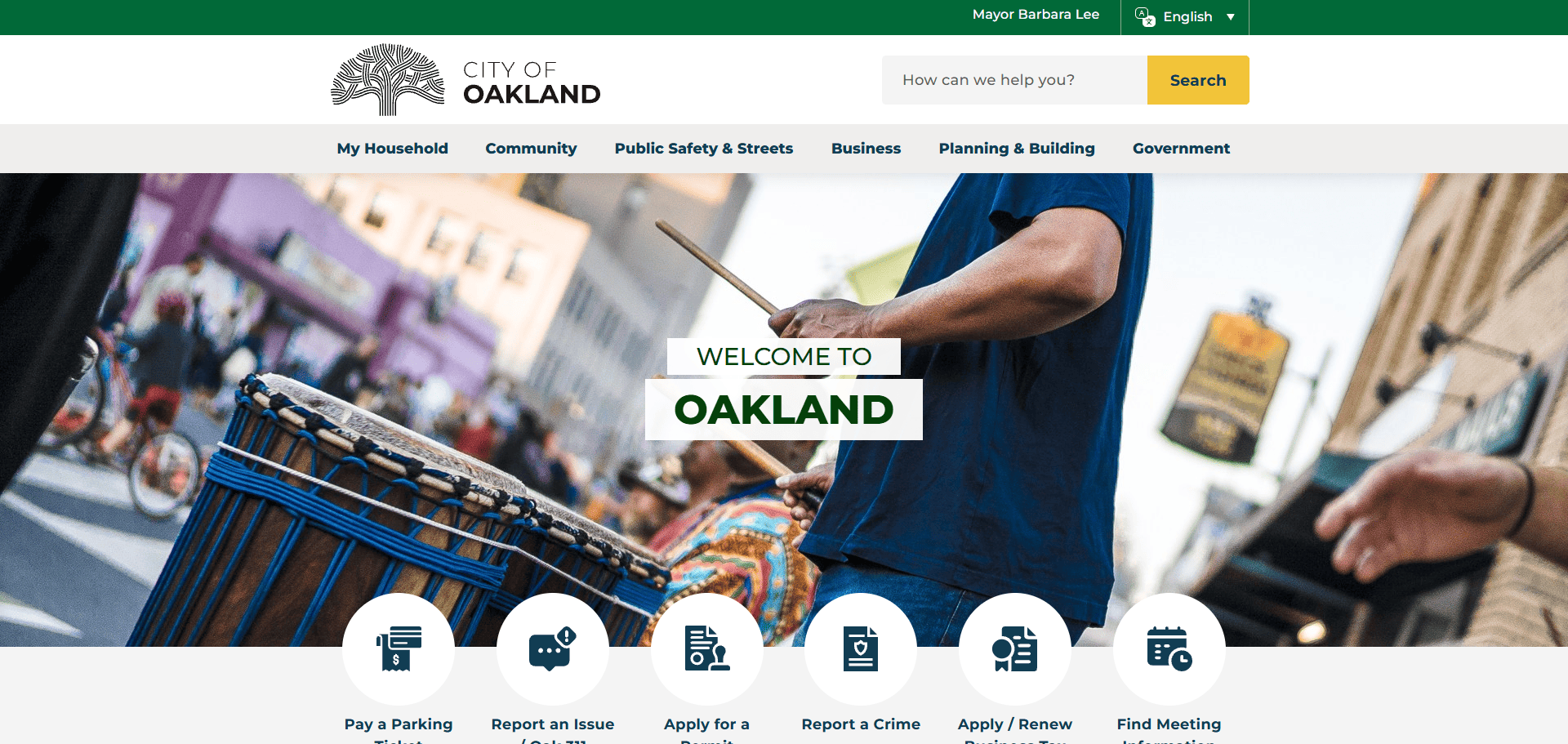
Oakland’s website relaunch in June 2025 is a good example of using data to decide what to change. The city reported that most visitors come from mobile devices and prefer to search rather than click through layers of pages, so it rebuilt the main navigation around its most-used service categories and tuned the search to return more relevant results. The main menu is organized by who is asking and why: My Household, Community, Public Safety and Streets, Business, Planning and Building, and Government. The city also trimmed outdated content and rewrote pages that were written in bureaucratic language, noting that simpler language is easier for automated tools to translate. A language selector offers thirteen options, including Spanish, Vietnamese, Chinese in two forms, Khmer, Hmong, Arabic, and Tagalog. The release describes the new site as launched but not finished, and a feedback link at the bottom of every page invites residents to report broken links and outdated information, which the city said it reviews daily. A dedicated Digital Services section includes an accessibility statement, guidance on writing for the city, and the OakApps portal, and the footer connects visitors to jobs, crime reporting, open data, and maps. Oakland also tested accessibility with community partners, including organizations that serve people who are blind or have low vision, and reported fixing 35 of 58 issues found in an early round. For cities that want to base redesign decisions on how residents actually use the site, Oakland is a strong model.
3. City of San José (sanjoseca.gov)
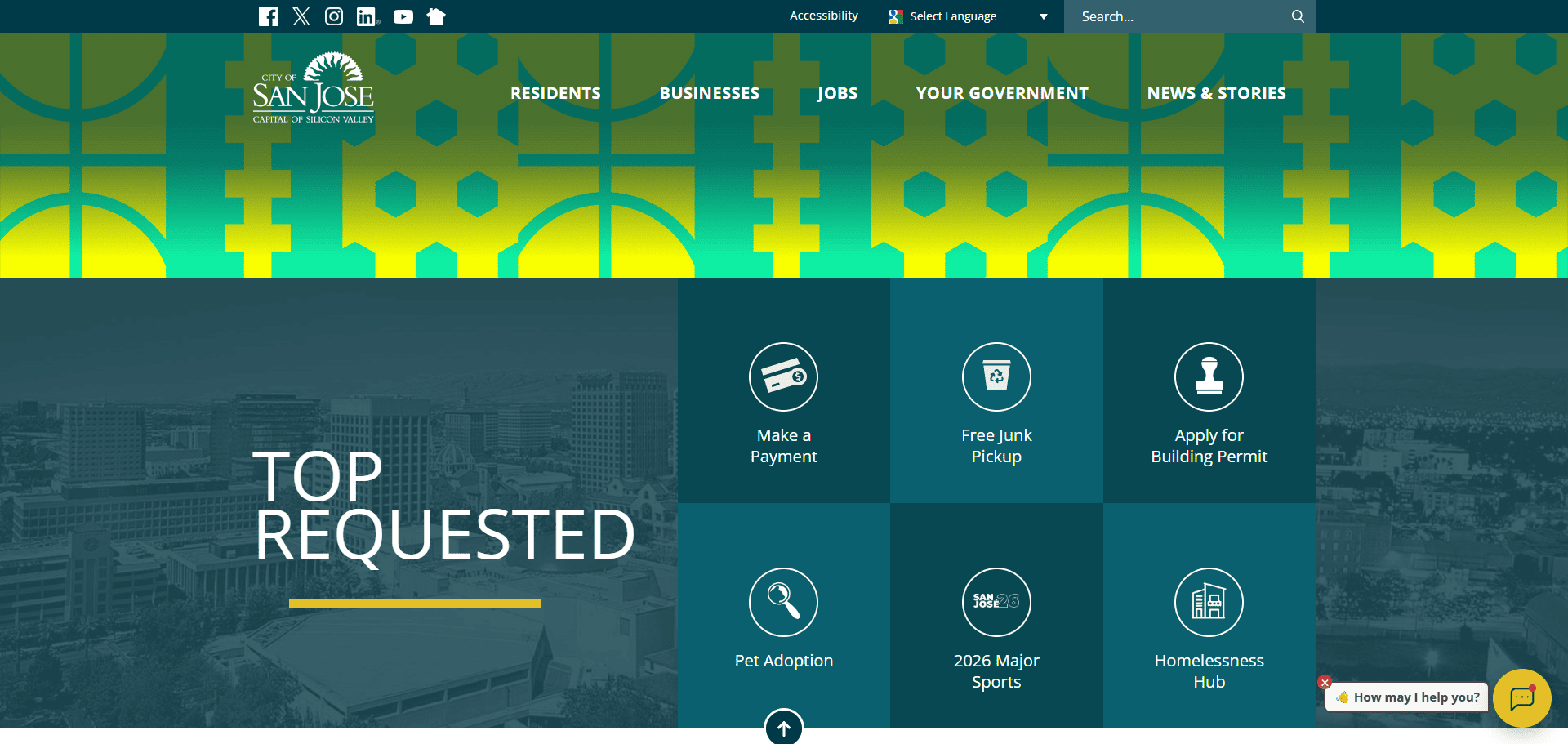
San José manages one of the largest city websites in the Bay Area, and its approach to governance and accessibility is worth studying. The site organizes content under clear top-level paths like Your Government and Departments and Offices, with departments ranging from Housing and Public Works to Planning, Building and Code Enforcement, and it connects to related tools such as the San José 311 service center and a dedicated permits site. Behind the scenes, the city maintains a Website and Digital Services Governance Policy that sets citywide standards for how the site, its subsites, and its transactional applications are managed, and that requires departments, council offices, and programs to use the official sanjoseca.gov domain, with documented exceptions. The city’s Digital Accessibility Statement is unusually specific. It commits to WCAG 2.1 Level AA, names the goal of substantial conformance by April 26, 2027, lists ongoing efforts such as staff training and regular accessibility reviews, describes features like keyboard navigation, text alternatives, proper heading structure, and compatibility with screen readers, and openly acknowledges that older documents and third-party content may not yet conform. It also offers an accessibility feedback form and alternative formats on request. For large cities balancing dozens of departments, San José shows how governance, transparency about gaps, and a clear timeline build trust.
4. City of Berkeley (berkeleyca.gov)
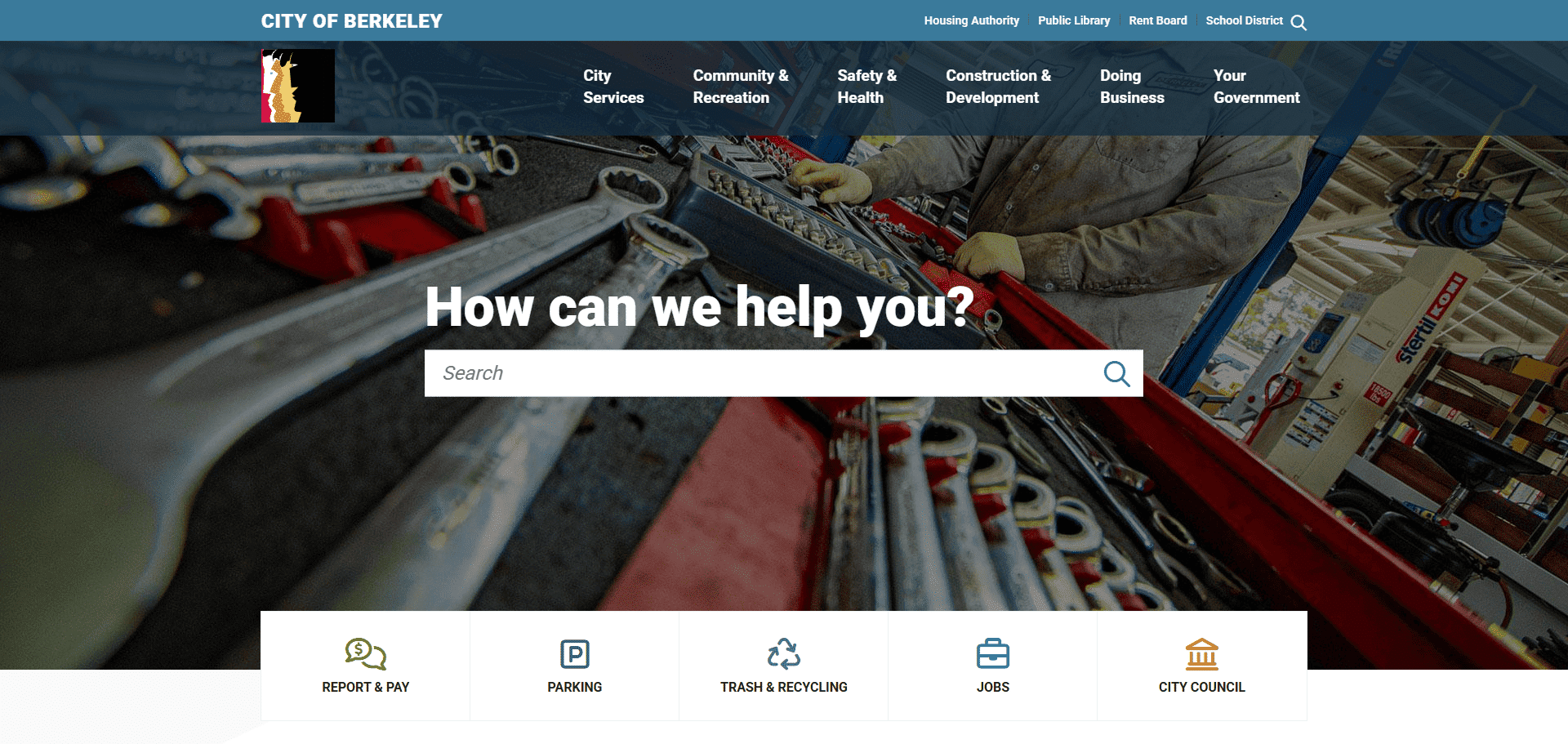
Berkeley treated its 2022 website launch as a ground-up rebuild rather than a visual refresh. The city said residents found its old site cluttered and outdated, so it reworked navigation, created a modern look, designed every page to prioritize key information on any device, and rewrote every page for accuracy, clarity, and efficient web reading. A “report and pay” tool guides visitors to common transactions, such as paying a bill, applying for an event permit, requesting public records, or reporting graffiti, and mobile-friendly forms handle issues like a missed garbage pickup or a pothole. The city’s stated principle is that making information easy to understand and accessible to people of all abilities improves access for everyone. It also planned the transition carefully, explaining that many links from the old site redirect to new pages and that residents can use the new navigation and search for everything else, and it invited feedback by email. Berkeley then showed that a city website is a long-term commitment: in 2024 it upgraded the entire software platform less than two years after launch, with more than 100 editors across the city publishing through the system. For cities that want a clean slate with a plan for ongoing maintenance, Berkeley is a useful example.
5. City of Palo Alto (paloalto.gov)
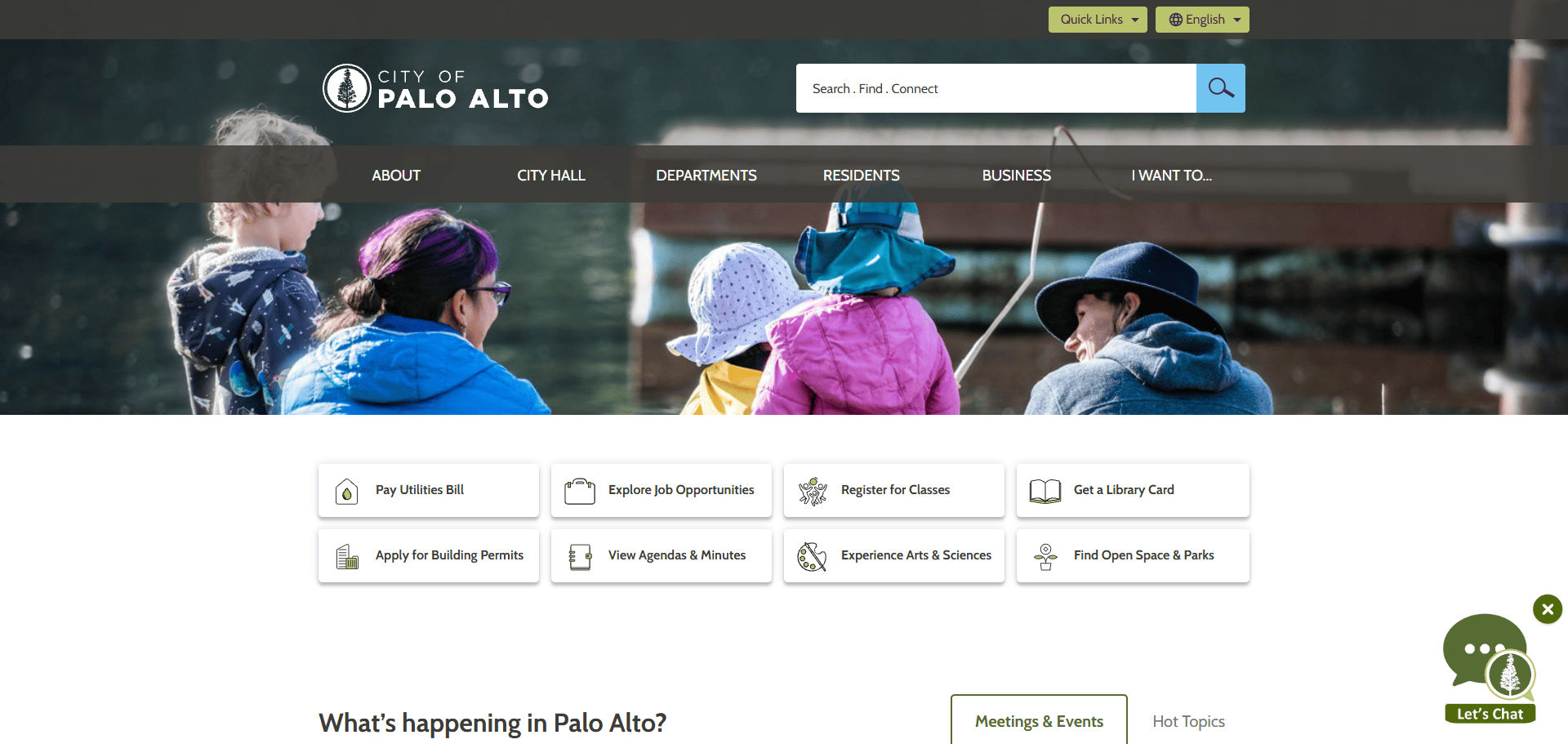
Palo Alto moved from cityofpaloalto.org to paloalto.gov on April 9, 2025, well ahead of the state’s 2029 deadline, and it handled the change as a communications project, not just a technical one. The city published a plain-language announcement with a frequently asked questions section that explained what was happening, why (compliance with AB 1637, stronger security, trust, and better search visibility), and what residents needed to do, which was nothing for the time being. Visitors to the old address were automatically redirected, staff email addresses moved to the new domain at the same time with the old addresses remaining active during a transition period, and the city used a homepage announcement, a web banner starting a week before the change, and social media updates to prepare the public. It also openly noted that search rankings might fluctuate briefly while the new domain was indexed. The site itself is built for tasks: a quick-links bar offers search near me, contact, PA311, subscribe, website feedback, and document search, and an “I Want To…” menu lists dozens of actions, from paying a utilities bill and submitting a service request to locating parking and filing a public records request. A language selector offers a long list of translations, and the footer links to an accessibility statement and a way to report ADA grievances. For any city preparing its .gov transition, Palo Alto is the playbook.
6. City of Mountain View (mountainview.gov)
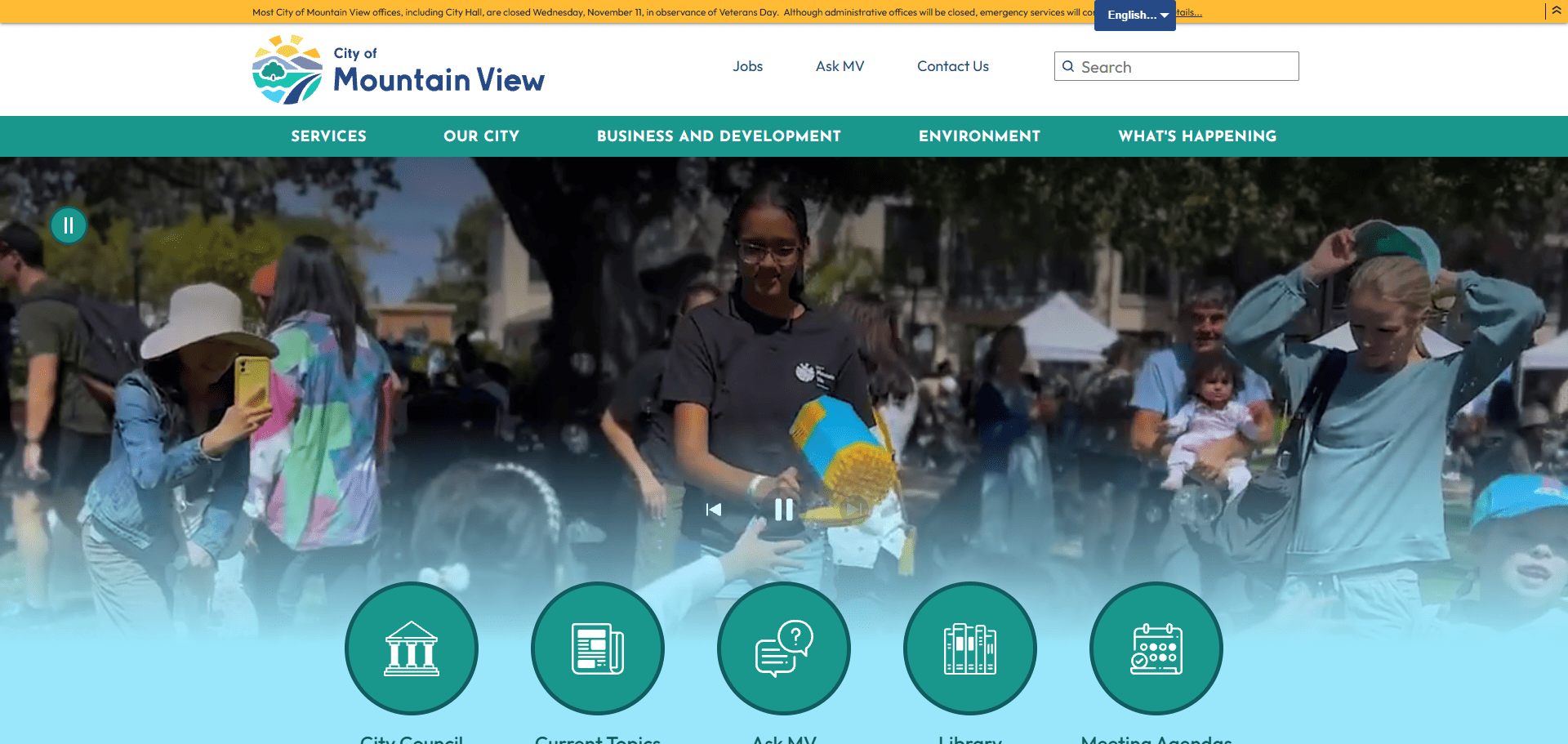
Mountain View replaced an eight-year-old website in May 2023 and used a public beta to improve it before launch. The city invited the community to test-drive a beta site, collected input from hundreds of users, and conducted on-location testing at the public library, senior center, and teen center, then published a release in English, Spanish, Chinese, and Russian. The redesign also created dedicated sites for Economic Development, the Mountain View Public Library, and the Mountain View Center for the Performing Arts, so audiences with distinct needs have focused homes while the main site stays streamlined. The new MountainView.gov aimed for intuitive navigation, improved search, upgraded accessibility, responsive design, and an email notification system that lets residents subscribe by topic to city news, police and fire updates, meeting details, and events in one place. Its transition page set expectations clearly: search engines take weeks to reindex, so visitors may see a few “page not found” errors; bookmarks should be updated; and broken links can be reported from a feedback link on every page. The city followed with a dedicated Development Permits site that provides an online how-to guide to permits and review steps, alongside an online permits platform for submissions and status tracking. For cities that want to pair a main site with specialty sites, Mountain View is a clear model.
7. City of Sunnyvale (sunnyvale.ca.gov)
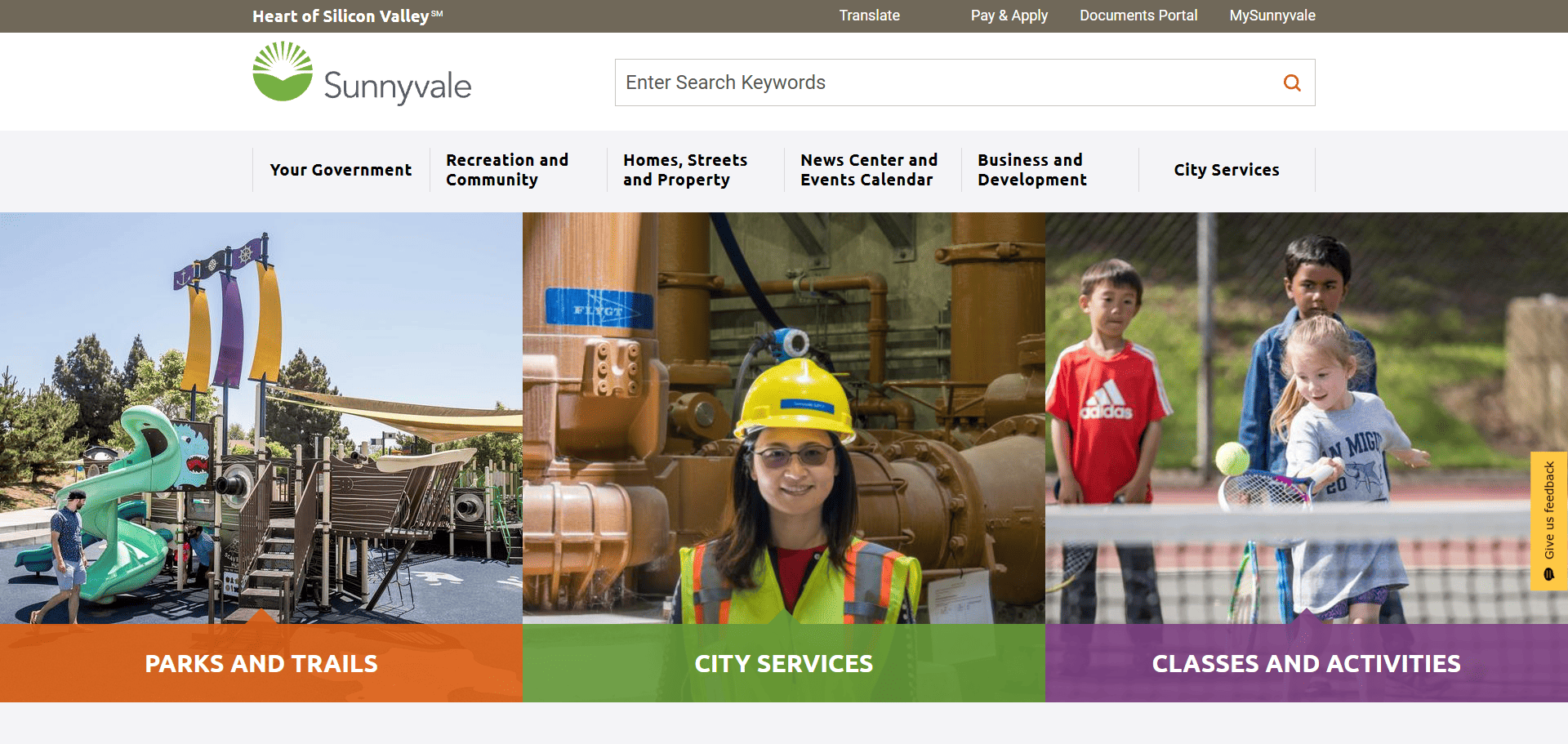
Sunnyvale treats its website as something that is never finished, and the approach earned recognition: the city received a 2023 Digital Government Website of the Year award from its CMS provider, Granicus. After a full redesign in 2017, which changed the platform, navigation, every word of content, and even the city’s branding, the web team moved in 2022 to a more flexible platform with a philosophy of continuous improvement based on data. The site is designed for people who are in a hurry: the homepage offers a task-oriented mobile view with quick access to top services, the search bar is prominent, megamenus and a streamlined homepage highlight popular topics, and city communications sign-ups sit in the footer. Decisions come from several sources, including analytics with heat maps, click maps, and search terms, an on-page feedback module, and quarterly conversations with front-line staff who answer the phones and serve the counters. The web team also uses a governance model with about 20 cross-departmental representatives and runs writing workshops to explain why plain language matters for accessibility. According to the case study, accessibility compliance improved by 17 percent after fixing contrast and template issues, and a redesigned aquatics landing page saw a 12 percent increase in traffic. For cities that want a sustainable improvement model rather than a redesign every decade, Sunnyvale is an excellent example.
8. City of Walnut Creek (walnutcreekca.gov)
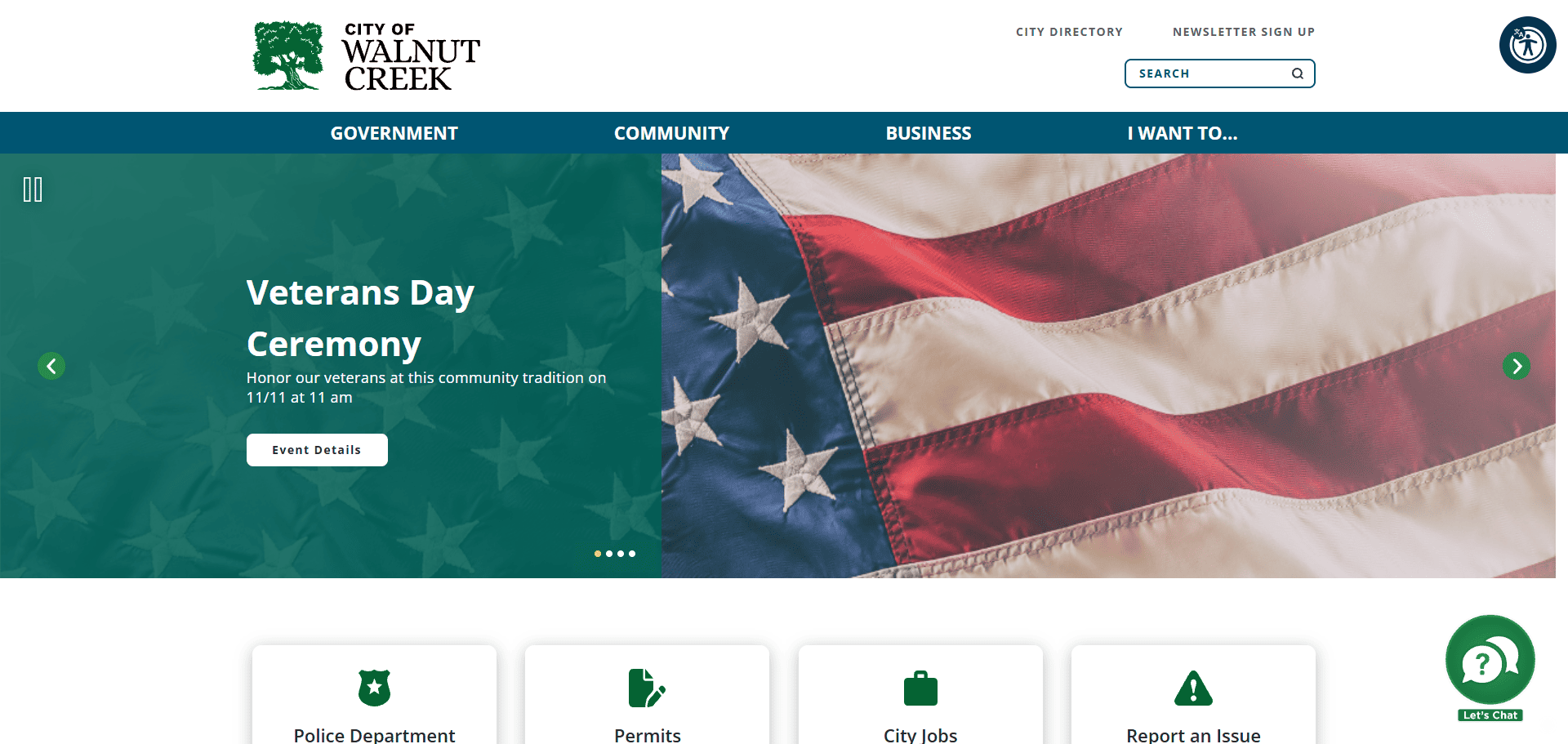
Walnut Creek launched four new websites at once: the main City site, Arts + Recreation, Economic Development, and the Walnut Creek Police Department. The city said the sites were designed alongside the community and staff through a year of surveys, workshops, and user testing, and all four share simplified navigation, user-friendly content, expanded translation options, and new accessibility tools. That coordinated approach is what makes Walnut Creek notable. Residents who come for a recreation class, a business license, or police information land on a site tailored to that task, but the experience feels consistent across all four, with the same design language and tools. The main site uses a walnutcreekca.gov domain that already meets the state’s .gov requirement, and the launch page on the city’s Communications and Outreach section explains the change in a short, plain announcement. For mid-size cities that serve very different audiences, such as families looking for classes, employers considering a move, and residents seeking public safety information, Walnut Creek shows how a connected family of sites can serve each audience without overloading a single homepage.
9. City of Fremont (fremont.gov)
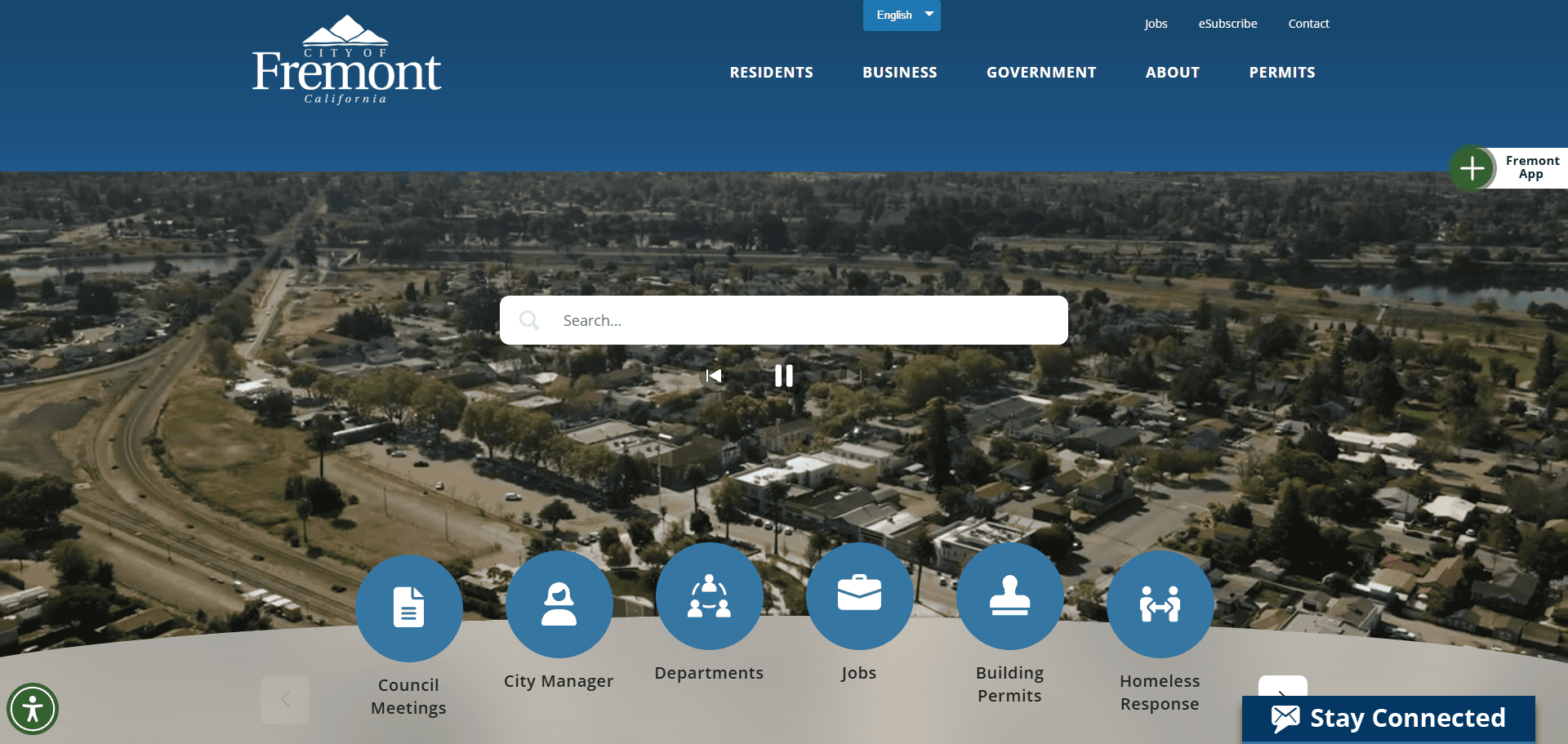
Fremont built its May 2022 redesign on a resident survey and website traffic data. Between October and December 2020 the city surveyed more than 600 people and learned that 54 percent visited mainly to access online city services, 51 percent wanted to find city events and meetings, and 56 percent asked for better search results. The new site responded directly: an “I want to…” box helps visitors register for recreation activities and camps, subscribe to newsletters, and find information on affordable housing and starting a business; a robust Agenda Center combines a calendar for City Council, boards, and commissions with events; and a Permits page in the global navigation gathers all permit information in one place. Streamlined global navigation, an improved Departments page, mobile responsiveness, a customizable translation tool, and an accessibility plugin round out the design. The homepage anchors a button to the Fremont App for reporting issues and features a video that introduces the city’s districts, parks, and businesses. The city was also candid about the downside of any redesign, warning that bookmarks and links in city communications might break because all page addresses changed, and it added a branded short-link domain for important pages going forward. For cities that want to show their website choices are grounded in real resident feedback, Fremont is a clear example.
10. City of Pleasanton (cityofpleasantonca.gov)
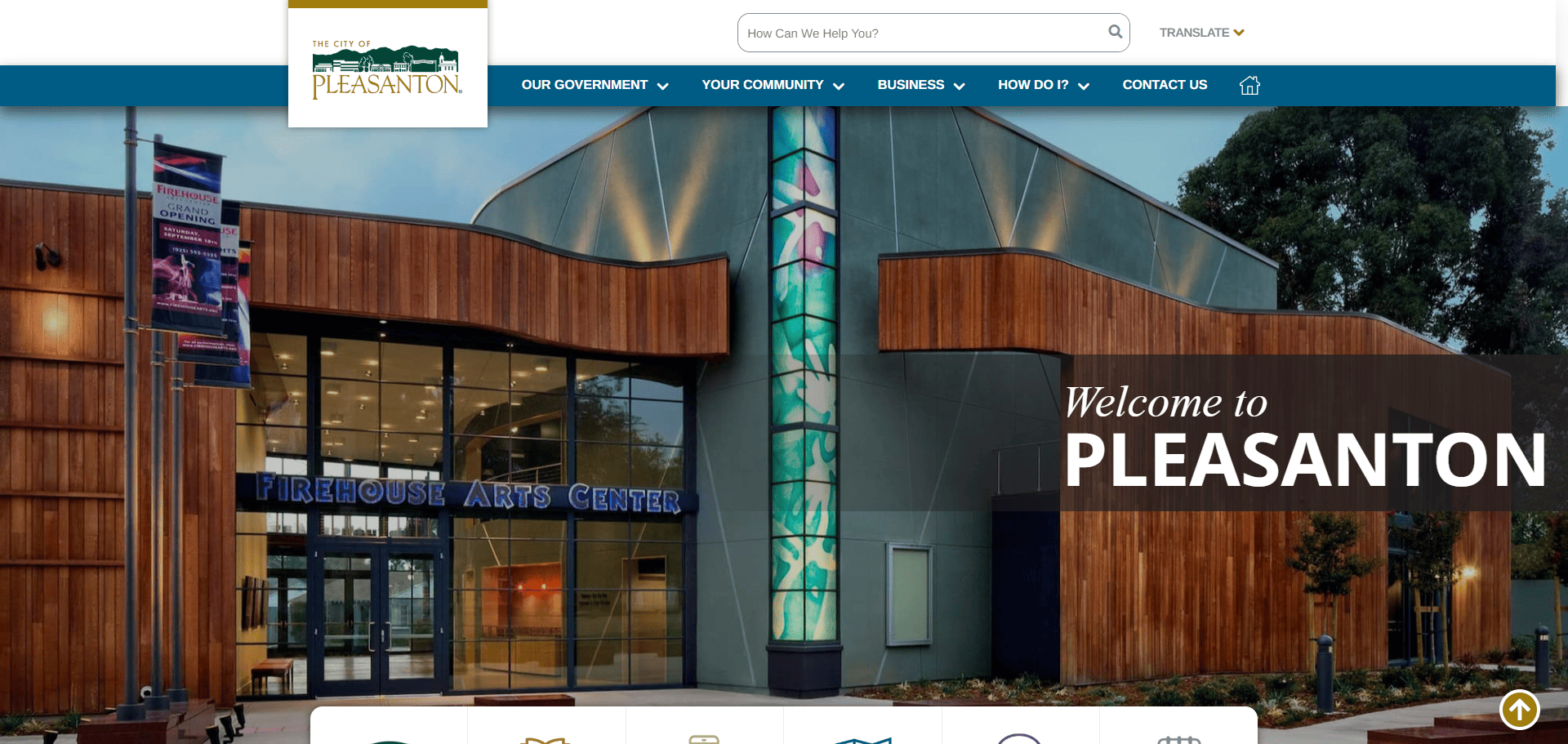
Pleasanton launched its redesigned website in November 2023 as part of its five-year strategic plan, which calls for leveraging technology for efficient and effective use by staff and the public. The city worked with a Pleasanton-based design firm from April through November, which shows that cities of this size often partner with local agencies for strategy, design, and content. The site offers streamlined access to city services and departments, up-to-date news and announcements, interactive maps, a citizen feedback portal, and a search function designed to deliver accurate and comprehensive results. Accessibility and multilingual access are built in: a translation button supports a dozen languages, and the site includes screen-reader and keyboard navigation along with readability features. One of the most useful changes is the way meetings are handled. An integrated agenda management system displays upcoming City Council, commission, and committee agendas and packets in one place from the homepage, while older archived records remain in a separate records center. Because the city uses a cityofpleasantonca.gov address, it already meets the state’s .gov domain requirement. For cities that want clear access to meetings and a local design partner, Pleasanton is a strong model.
Whether a city is consolidating 200 departments onto one platform, moving to a .gov domain, building a family of specialty sites, or simply making its permit information easier to find, the cities above succeed because they start with what residents are trying to do. If your city or public agency serves the Bay Area, KO Websites can help you plan and build a website that is accessible, easy to use, and ready for the 2027 and 2029 deadlines. Contact us today for a free consultation.
What Sets Our City Government Website Design Apart
Task-First Navigation and Search
Residents come to a city website with a job to do, such as paying a bill, reporting a problem, or finding a meeting. We organize navigation around those tasks and audiences, build search that returns the right page, and use analytics to keep improving. Our web design process starts with how people actually use your site.
Accessibility Built In, Not Bolted On
The ADA Title II web rule requires WCAG 2.1 Level AA for state and local government websites and mobile apps. We design templates, color contrast, headings, forms, and documents for accessibility from the start, test with assistive technologies, and help your team write content that stays accessible as it grows.
Plain Language and Multilingual Access
Bay Area cities serve residents who speak dozens of languages. We help you rewrite bureaucratic content into plain language that is easier to read and easier to translate, plan language options that fit your community, and create Spanish-language content that reads naturally, not like machine output.
.gov Migration Without Losing Search Visibility
California cities must use a .gov or .ca.gov domain by January 1, 2029. We plan domain moves with redirect maps, search engine updates, email transition checklists, and public communications so residents find you before, during, and after the switch. See how we approach government and agency web design across the Bay Area.
Complete City Government Website Package
Task-Based Navigation and Search
Top-task shortcuts, an “I want to…” menu, audience-based navigation, megamenus, and tuned site search that help residents finish common tasks quickly on any device.
Accessibility and Plain Language
WCAG 2.1 AA templates, accessible forms and documents, readability standards, and content guidelines so every department publishes pages residents can understand and use.
Multilingual and Spanish-Language Content
Language selectors, translated key pages, Spanish content written for your community, and guidance on which pages to prioritize for the languages your residents speak.
Meetings, Permits, and Service Integration
Clear paths to council and commission agendas, permit information and portals, service request forms, utility payments, and 311 tools, integrated into a consistent experience. These connect to your ongoing website management so content stays current.
Specialized City Government Digital Solutions
City Website Strategy and Redesign
Research, information architecture, content audits, design, and implementation for your city’s main website, informed by surveys, analytics, and testing with residents and staff.
Accessibility Audits and Remediation
WCAG 2.1 AA audits of pages, templates, forms, and documents, with prioritized remediation plans and staff training to help your city prepare for the ADA Title II deadlines.
.gov and .ca.gov Domain Migration
Migration planning, redirect strategy, search console and analytics updates, email transition support, and public communications for the AB 1637 domain requirement.
Department and Specialty Sites
Focused sites for Economic Development, Parks and Recreation, libraries, arts and culture, permits, and public safety that share your city’s design system while serving their own audiences.
Content Strategy and Plain-Language Rewriting
Content inventories, trimming of outdated pages, plain-language rewrites, and writing workshops that help department editors publish clear, consistent, scannable content.
Spanish and Multilingual Content
Spanish-language page development and review, translation planning, and multilingual landing pages for high-priority services so Spanish-speaking residents can complete tasks with confidence.
Training, Governance, and Ongoing Management
Editor training, web governance guidelines, analytics reviews, and ongoing updates so your site keeps improving after launch. Ready to see how this works in practice? Explore our portfolio.
Serving Bay Area Cities and Municipal Agencies
Every Bay Area city has its own residents, languages, and priorities, from dense urban neighborhoods to suburban business districts. We work with cities, departments, and public agencies across San Francisco, Oakland, San Jose, and Silicon Valley, as well as San Leandro, Castro Valley, Pleasanton, Livermore, and San Ramon. We shape content and design to match your community.
Beyond Web Design: Complete Digital Communication
A strong city website works best when it is supported by consistent outreach. Our SEO strategies help residents find permits, services, and meetings through search, which matters even more during a domain change. Local search optimization keeps city hall, library, and facility listings accurate across Google Maps and directories. Social media marketing supports announcements, events, and emergency information, while video production creates welcome videos, how-to guides for services, and community stories. Ongoing website management and hosting keeps your site secure, updated, and reliable.
Your Questions About City Government Web Design Answered
What does California’s AB 1637 require for city websites?
AB 1637 requires California cities and counties to use a “.gov” or “.ca.gov” domain for their public websites and employee email addresses by January 1, 2029. A city that keeps a website on another domain after that date must redirect it to a compliant one. We help plan the migration, redirects, and search engine updates so residents and search engines find the new address. Your city attorney and IT team should confirm the details for your situation.
When do cities need to meet the ADA web accessibility rule?
Under the Department of Justice’s ADA Title II rule, which adopts WCAG 2.1 Level AA, the compliance date was extended to April 26, 2027 for public entities serving 50,000 or more people and April 26, 2028 for smaller entities and special districts. Title II obligations to provide equal access already apply today. We can audit your site, prioritize fixes, and train your staff, but your city attorney should confirm your specific legal obligations.
Do you work with the CMS platform our city already uses?
Yes. Many cities use a vendor-provided CMS, and we can work within the platform your city has selected or help you evaluate options. We focus on what makes the biggest difference for residents: information architecture, content, accessibility, design systems, specialty sites, migrations, and training.
Can you help with our RFP or procurement process?
We can help you define requirements, write content and accessibility criteria, evaluate proposals, and plan the project, and we can respond to qualified requests for proposals. Your city’s purchasing rules and procurement process will determine how projects are awarded.
How do you keep our search rankings and bookmarks working during a redesign?
We map old pages to new ones, set up redirects, update search console and analytics, communicate changes to residents, and monitor for broken links after launch. Cities like Palo Alto, Mountain View, and Fremont have shown that clear public messaging about the change reduces confusion.
Can you create Spanish-language content for our city?
Yes. We write and review Spanish-language pages so they read naturally for your community, and we can help you decide which services to prioritize for translation. As a Spanish-speaking team, we understand how residents search for city services in Spanish.
What ongoing support do you provide after launch?
We provide hosting, security updates, backups, analytics reviews, and editor training so your site keeps improving. See what our clients say in our testimonials section.
Build a City Website That Residents Trust and Can Actually Use
Your residents are trying to pay a bill, find a meeting, or get a permit, often on a phone and sometimes in a second language. A well-planned website makes those tasks simple, supports every resident, and prepares your city for the 2027 and 2029 deadlines. KO Websites helps Bay Area cities do exactly that.