Professional Search and Rescue Website Design That Recruits Volunteers, Builds Trust, and Funds Your Mission
Custom websites for Bay Area search and rescue teams that put “call 911” first, explain how to join with honest expectations, make donating simple, and show your community the work your volunteers do
A good SAR website has to do several jobs at once. It must make emergency guidance unmistakable, because a visitor who thinks the team takes calls directly could lose precious time. It must explain who the team is and how it is activated. It must recruit people who understand the commitment before they apply. And it must make giving easy and transparent for a team that is usually a 501(c)(3) nonprofit working alongside a sheriff’s office. We build for all four.
Best Search and Rescue Websites: Bay Area and California Examples That Recruit, Inform, and Earn Support
Search and rescue teams are not marketing organizations, but the best SAR websites in California communicate with remarkable clarity. They tell visitors what to do in an emergency, describe the work honestly, set realistic expectations for new members, and make it easy to donate. The ten teams below all run their own dedicated websites. Eight are based in or near the Bay Area, including county sheriff’s search and rescue units, a mountain rescue unit, a statewide mutual aid team, and a K9 association headquartered in the East Bay. Two more, from Monterey County and Santa Barbara County, show what strong SAR sites look like elsewhere in the state. Santa Cruz County sits on the southern edge of the Bay Area region and is included because its team works closely with Bay Area units.
1. Bay Area Mountain Rescue Unit (BAMRU)
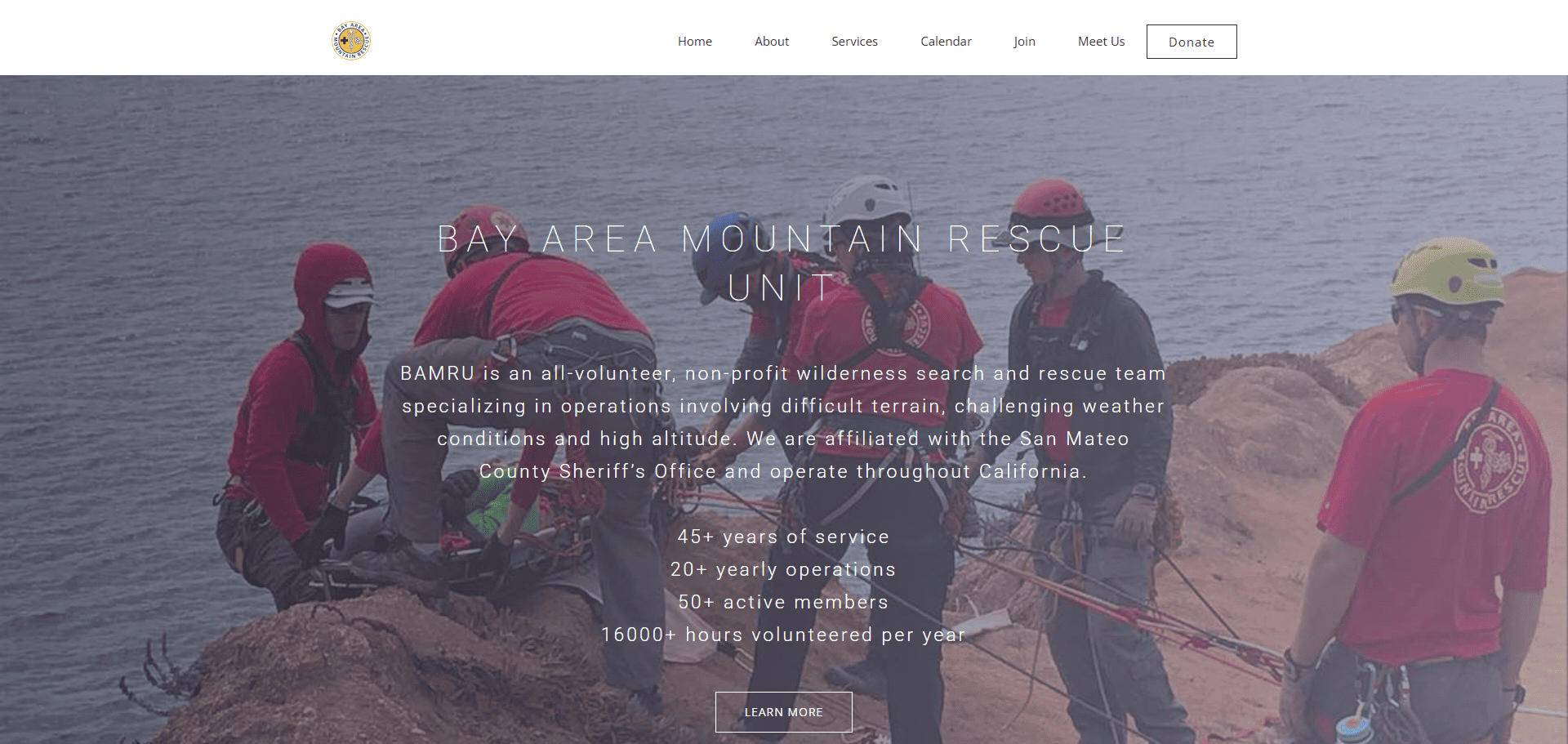
The Bay Area Mountain Rescue Unit’s website is a clean, confident example of how a volunteer wilderness rescue team can present itself. The navigation is short and purposeful — Home, About, Services, Calendar, Join, Meet Us, and Donate — and the homepage opens with a one-paragraph description of the team and four headline numbers: more than 45 years of service, more than 20 operations a year, more than 50 active members, and more than 16,000 volunteer hours a year. A section titled “Anytime, Anywhere, All Conditions” explains what the team can do in plain terms: it can be field deployable for up to 72 hours in all terrain and weather, from missing-person searches in the high Sierra to coastal cliffs and communities affected by wildfires, and it is an accredited Mountain Rescue Association member and a FEMA and California OES Type I resource activated by the San Mateo County Sheriff’s Office. The Join page is refreshingly honest: it says being a member takes support from loved ones and employers, and it tells interested guests to attend general meetings and mock-search trainings first. The Calendar page explains that monthly general meetings are open to the public and that guests must complete a few steps before attending field trainings. The Donate page states that the team has no paid employees and that 100 percent of donations support operating costs, with PayPal and mailing-address options. For teams that want a simple, credible site built around numbers, accreditation, and honest recruiting, BAMRU is a model.
2. Marin County Sheriff’s Search & Rescue (Marin SAR)
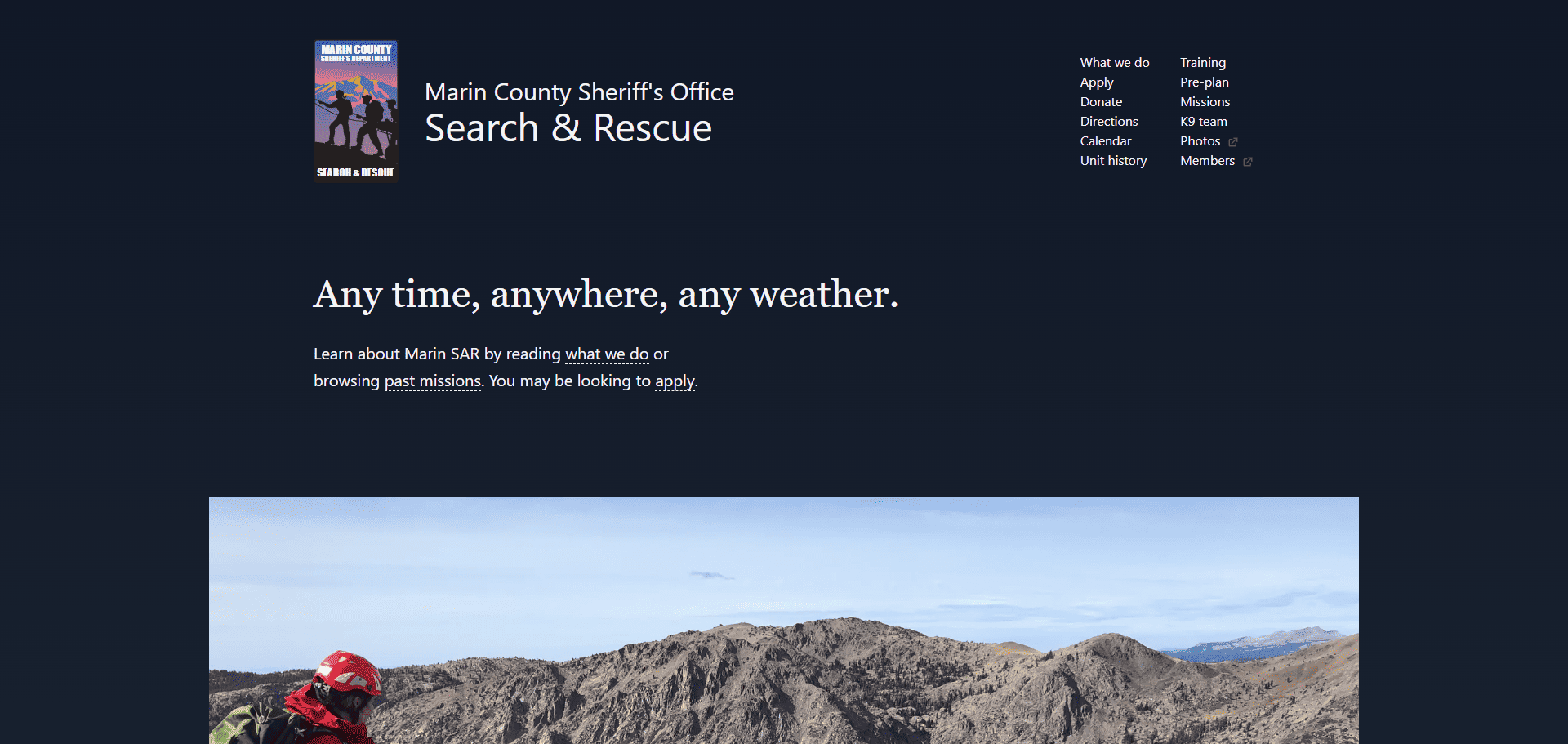
Marin SAR runs a site built around one idea: tell people the truth about the work. The navigation covers What We Do, Apply, Donate, Directions, Calendar, Unit History, Training, Missions, K9 Team, Photos, and a members area. The What We Do page reads like a conversation with a prospective volunteer, describing what members actually do, from getting paged out at 2 a.m. in the rain to attending two general meetings and a full training day each month, and then walking through the resources used on a search: ground units, a mountain rescue team, search dogs, a mounted posse, air patrol, park and open space rangers, local law enforcement, and mutual aid. It even describes a typical wilderness search, such as an overdue hiker on Mount Tam, and how quickly members arrive on scene. The Apply page is one of the most detailed recruitment pages in the region. It explains the annual recruitment cycle, the required orientation meetings and online incident command courses, the two-year minimum commitment, the age rules for youth members, the background review with the Sheriff’s Office, and a fitness test described as a four-mile loop with 1,500 feet of elevation gain carrying a 25-pound pack, with a map and an interactive route so applicants can try it first. It also speaks candidly about the physical and emotional challenges of the work. A Missions section archives numbered mission reports by year. For teams that want to attract committed applicants and filter out mismatched ones, Marin SAR is a standard-setting example.
3. Santa Clara County Sheriff Search and Rescue (SCCSSAR)
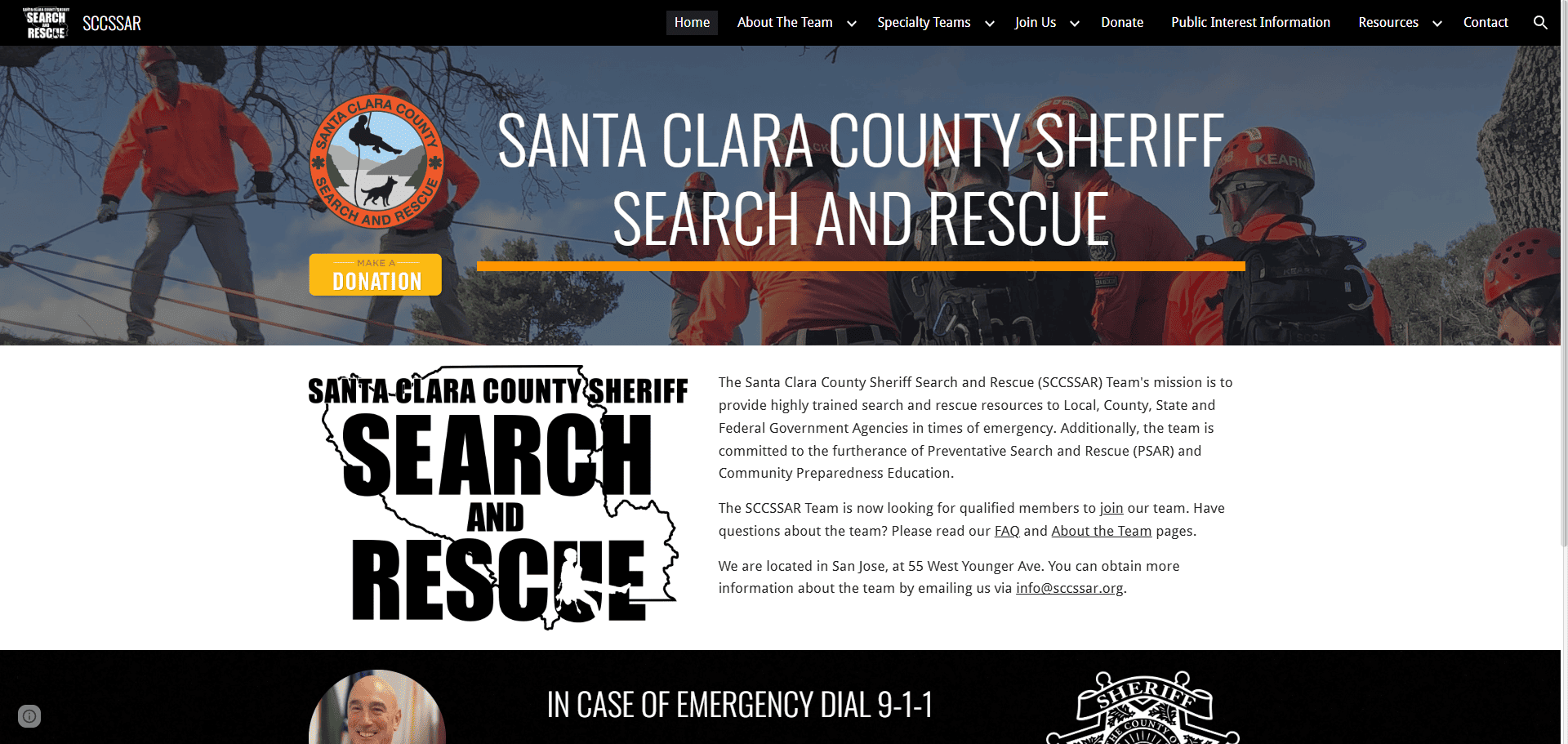
The Santa Clara County Sheriff Search and Rescue team organizes a lot of information into a site that is easy to navigate. The menu is built around the questions a visitor is likely to have: About the Team, with pages on capabilities, training, and equipment; Specialty Teams; Join Us, with a page on the academy; Donate; Public Interest Information; Resources; and Contact. The homepage states the team’s mission, including a commitment to preventative search and rescue and community preparedness education, and it keeps a plain reminder close to the top: in case of emergency, dial 9-1-1. The Specialty Teams section lists ATV, canine, technical rescue, tracking, parabolic microphone, drone, and e-bike teams, which gives prospective members a clear picture of the skills the team uses. The FAQ is especially helpful. It explains who the team serves, what kinds of missions it supports, where it searches, what the time commitment is for out-of-county searches, and whether responding to a callout is mandatory. The Equipment page thanks the Sheriff’s Office for providing the team’s rescue equipment and vehicles and explains that members handle inspections and basic maintenance themselves. A Wilderness Education page supports the team’s prevention mission, and a Donate page links to an online giving platform and a sponsors page that thanks supporters by name. For county teams that want to explain their value to the public, SCCSSAR is a good example of an FAQ-driven site.
4. Alameda County Sheriff’s Search and Rescue (ALCO SAR)
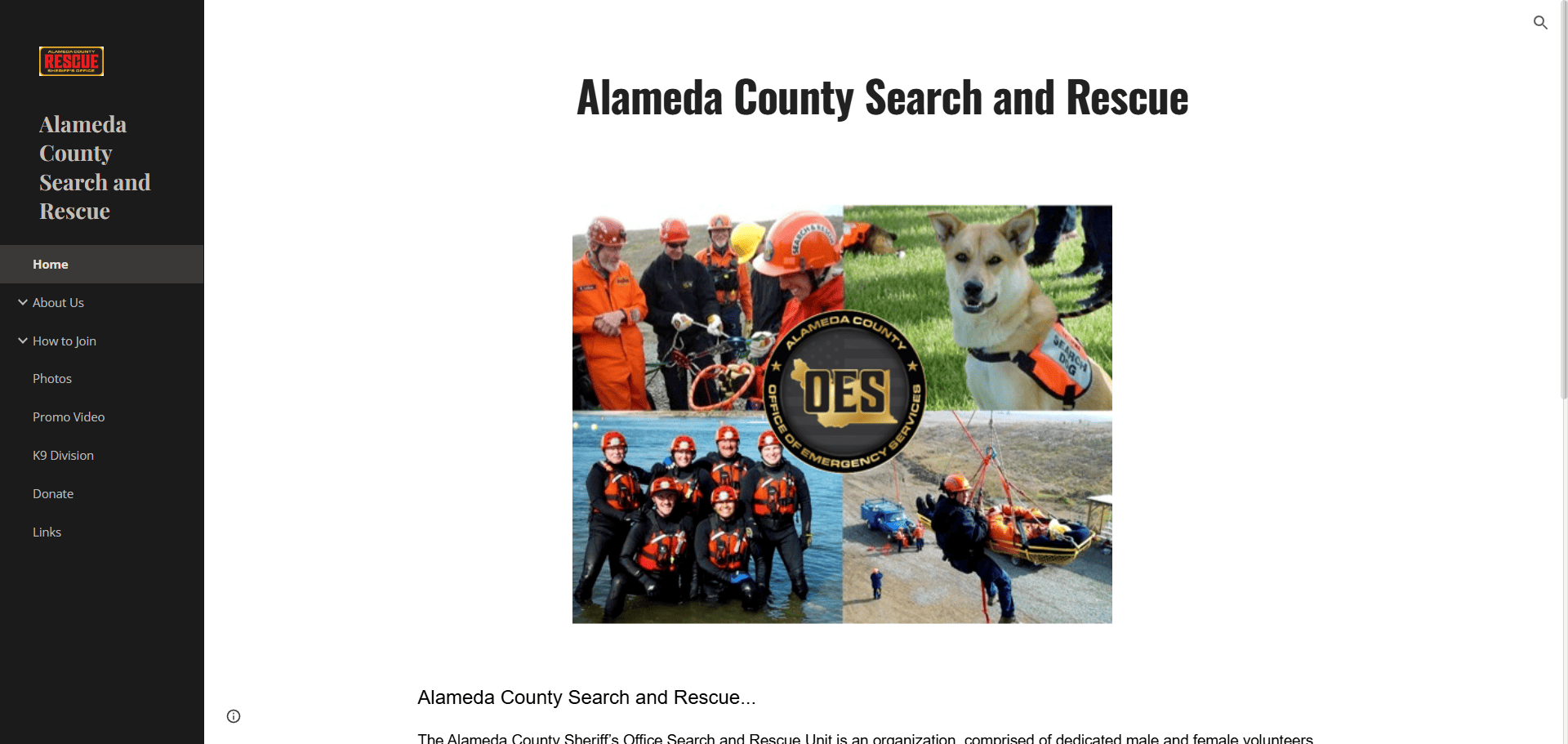
Alameda County Search and Rescue has one of the most complete recruitment pages of any team in the Bay Area. The Application Process page walks a prospective member through each step: minimum requirements (age 18 or older, a valid California driver license, living in Alameda County or a contiguous county, and a background check at the end of the Basic Rescue Class); a 90-minute orientation that is required to receive an application; physical abilities testing and oral board interviews; and the Basic Rescue Class schedule, including Thursday evenings, two Saturdays, and one overnight weekend. It explains that after basic training, members are expected to participate in at least six hours of unit activities each month, lists the skills the class teaches, from land navigation and survival skills to low angle rescue and tracking, and spells out the medical certification required within a year, with local sources for classes. The rest of the site stays simple: a short history page that traces the team’s roots to an early-1950s civil defense unit, a K9 Division page noting that the canine team responds to more than 20 searches a year, a Donate page explaining that the team is a 501(c)(3) that funds training and equipment the Sheriff’s Office does not, and a Links page connecting to the Bay Area Search and Rescue Council, CARDA, CalOES, FEMA, and the Red Cross. For teams that want recruitment to run on clear steps instead of repeated questions, ALCO SAR is a strong model.
5. San Mateo County Search and Rescue (SMCSAR)
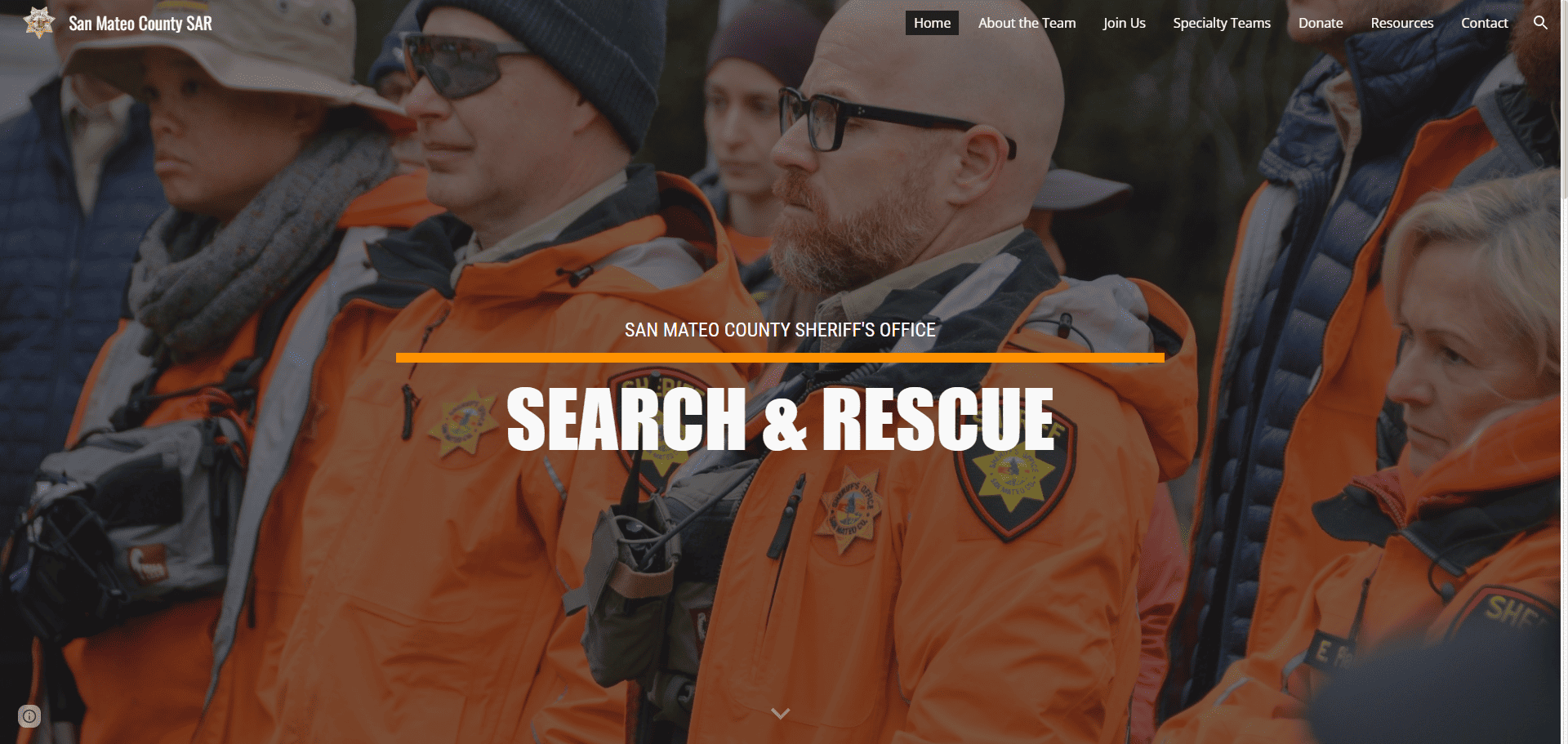
The San Mateo County Search and Rescue team uses its homepage to answer a question many visitors never ask: why does this matter? It opens with the scale of the missing-person problem nationwide and then describes how San Mateo County’s mix of coastal cliffs, redwood forests, and dense urban areas can quickly turn a simple outing into a life-threatening situation, which gives the team’s mission a local and personal frame. The About the Team page presents the unit as a professional, all-volunteer team within the Sheriff’s Office Emergency Services Bureau, with more than 60 operational members, about 20,000 annual service hours, and a 1978 founding year, and it explains that volunteers also support public safety during winter storms, wildfire evacuations, and major community events. The Join Us page is a model of timeline clarity: an annual application window in January, mandatory orientations held beforehand, interviews in early February, a training academy from late February through April with weekly evening sessions and four Saturday field trainings, and a sworn-member background process that takes one to two years. It also explains the monthly time commitment, notes that no prior search and rescue experience is required, and describes what a typical search demands physically. A Donate page makes the case for supporting the team’s nonprofit with the line “every minute matters.” For teams that want to turn a complex recruitment season into a simple calendar, SMCSAR is a great example.
6. California Search & Rescue (CALSAR)
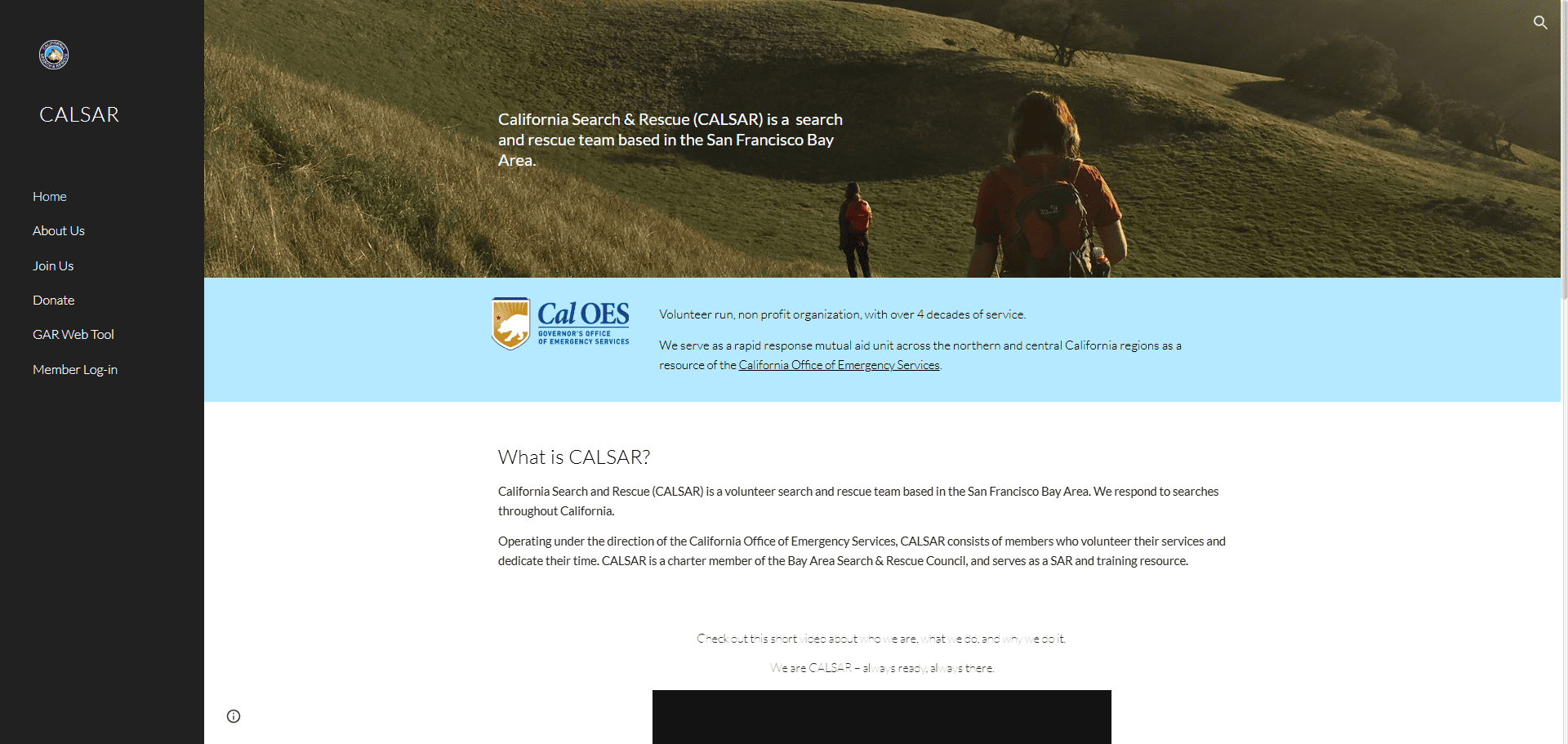
California Search and Rescue, known as CALSAR, is a Bay Area–based team that is not tied to a single county, and its website is built around explaining that difference. The homepage describes a volunteer-run nonprofit with more than four decades of service that serves as a rapid-response mutual aid unit across northern and central California as a resource of the California Office of Emergency Services. A section titled “What makes CALSAR different” explains that the team is deployed to help other counties and SAR organizations throughout the state at the direction of Cal OES, and that it is a charter member of the Bay Area Search and Rescue Council. A short “Who We Are” video lets visitors see and hear the team before reading anything else. The site’s history, which traces the unit back to a Boy Scouts Explorer post chartered in 1969 and its later role as the first Explorer search and rescue unit under Cal OES serving a statewide area, gives the team credibility with agencies and donors. The Support CALSAR section is direct and specific: members provide their own equipment and transportation and take time from work to train and search, and donations help maintain resources and replace obsolete communications, rescue, and medical equipment, with the team’s 501(c)(3) status stated. A navigation item links to a risk-assessment web tool, and a member login serves the team internally. For mutual aid and multi-county teams, CALSAR shows how to explain an unusual structure simply.
7. California Rescue Dog Association (CARDA)
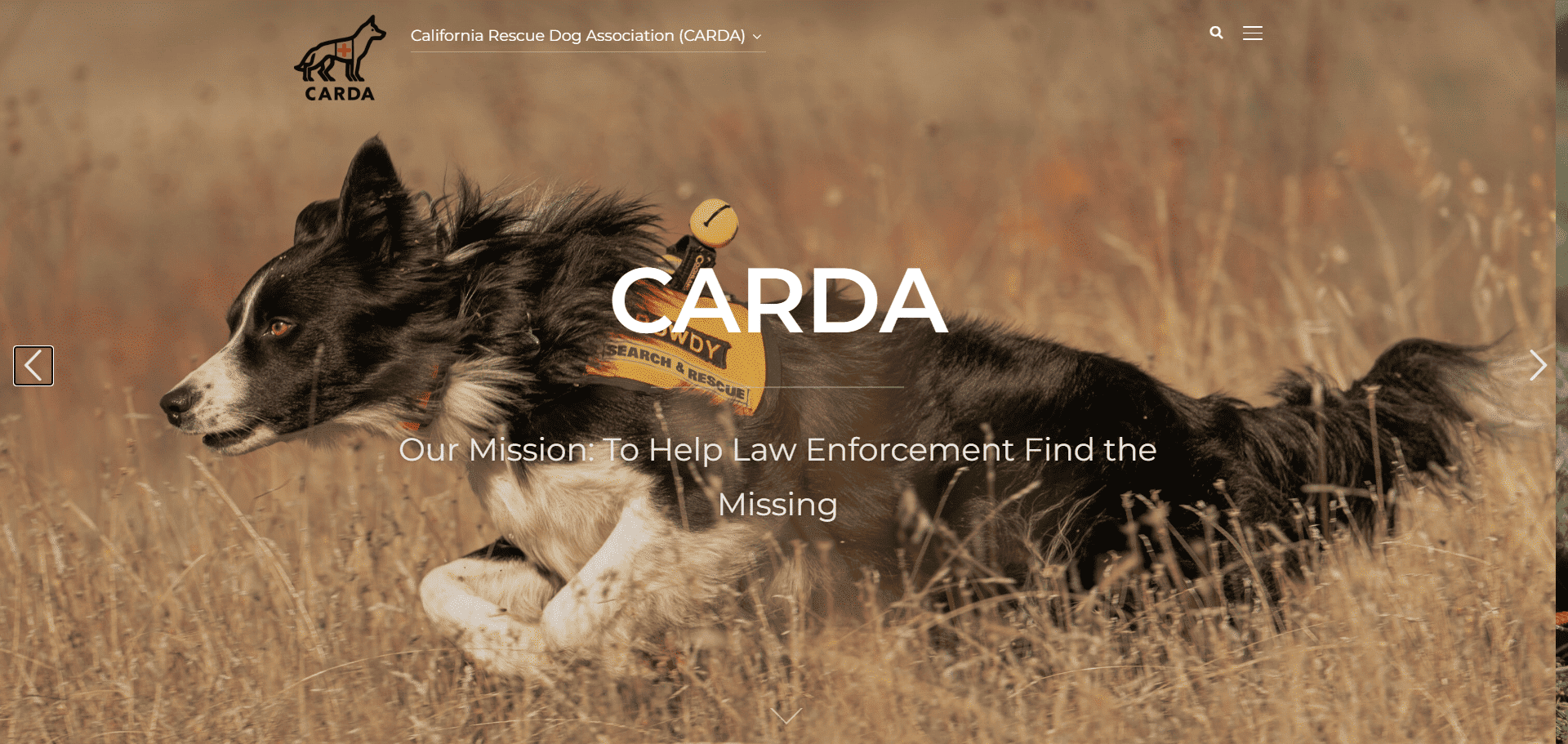
The California Rescue Dog Association is a statewide, volunteer search dog organization with an East Bay address, and its website is a strong example of how to explain a specialized service to two audiences at once: law enforcement agencies that request resources and volunteers who want to join. The navigation separates Law Enforcement Agencies, with pages for Cal OES and county sheriff search and rescue teams, from Support and Volunteer pages, certified teams, and About information including the board, press room, and blog. The Our Mission page opens with a clear headline, “Help Law Enforcement Find The Missing,” and explains the organization’s charter from Cal OES to train, certify, and deploy search dog teams. It states that all services are free to requesting agencies, that members cover their own costs for gas, vehicles, training, equipment, and dog expenses, and that the organization relies on donations. It also describes how teams train, with 25 local training groups across the state, how certification follows Cal OES standards, and how many certified canine teams are available. One line stands out for its clarity: in an emergency, dial 9-1-1, and CARDA cannot respond individually to families or non-law enforcement agencies. The Donate section offers designated funds, such as water recovery search certification and search-related emergency veterinary care, and the site publishes financial information for donors. For specialized volunteer organizations, CARDA shows how to set expectations for agencies, families, and supporters on the same page.
8. Santa Cruz County Search and Rescue
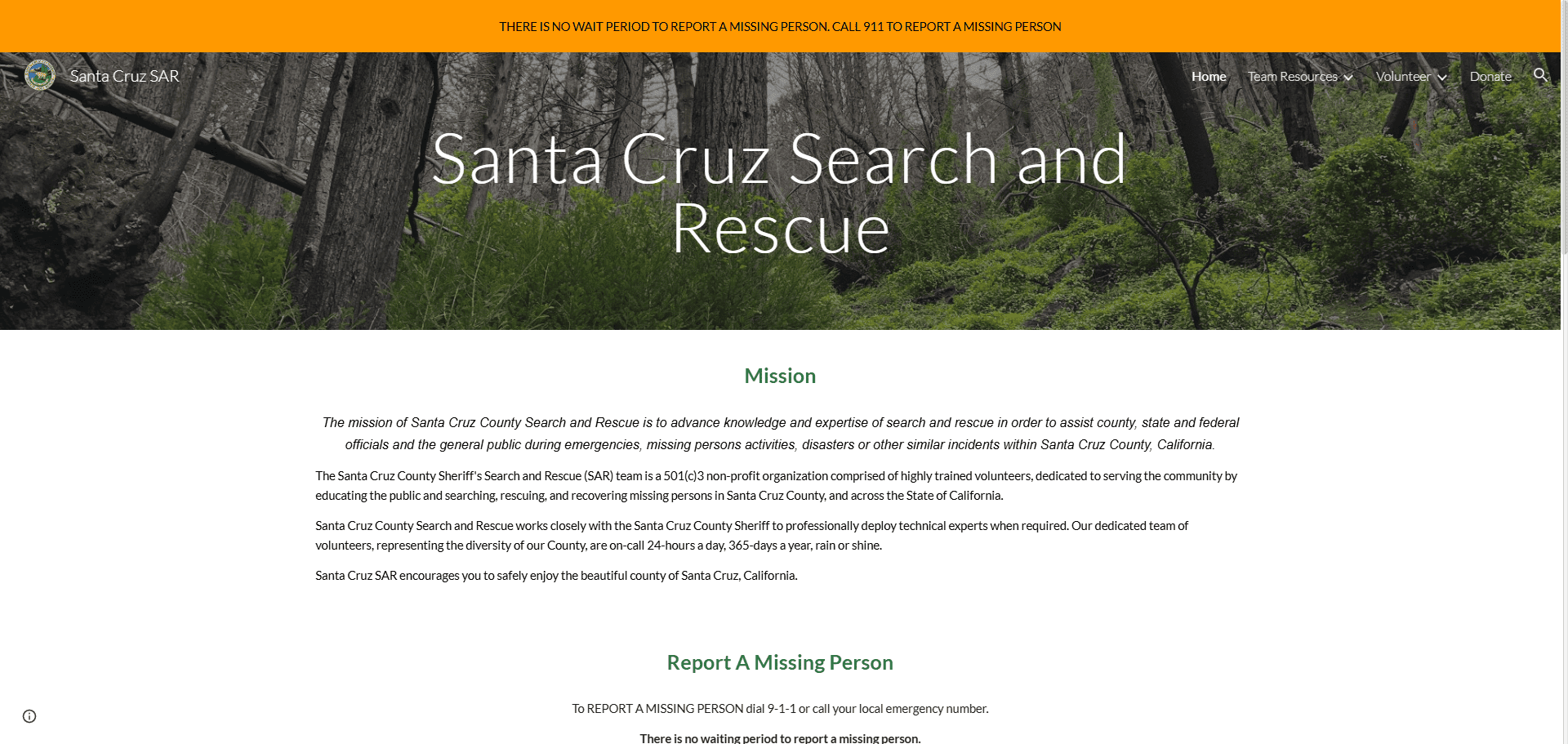
The Santa Cruz County Search and Rescue team puts its most important message in a banner at the top of the site: there is no waiting period to report a missing person, and visitors should call 911. That single line, repeated in a dedicated “Report a Missing Person” section on the homepage and again on the contact page, does the work of preventing delay before anything else on the site is read. The homepage then states the team’s mission, explains that it is a 501(c)(3) nonprofit of trained volunteers who work closely with the Sheriff, and tells the team’s story, from a Boy Scout Explorer post in 1972 to a unit recognized by the state as a mutual aid resource. Simple Donate and Volunteer calls to action appear throughout, and a Volunteer page explains that the team recruits and trains new members on a regular cycle and uses an interest form that states the team’s commitment expectation up front. A Special Teams page describes the specialty groups, including swiftwater and communications, and a Team Resources area serves members. The homepage embeds the team calendar and shows the nonprofit’s tax and corporation identifiers, a small trust signal for donors. For teams that want a simple, focused site with emergency guidance impossible to miss, Santa Cruz SAR is a clear model.
9. Monterey County Sheriff’s Office Search and Rescue
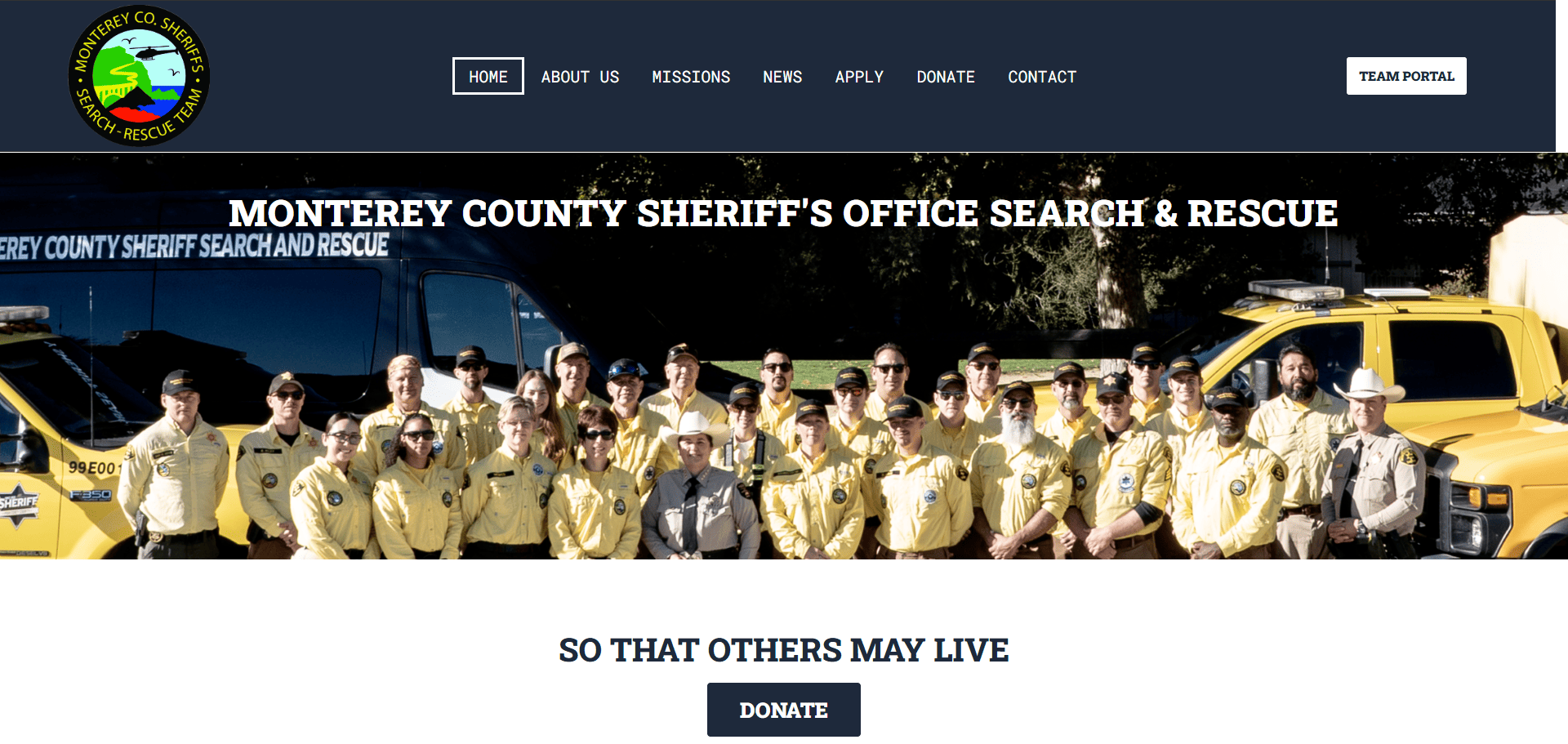
Monterey County Search and Rescue, just south of the Bay Area, shows how a compact, well-organized site can handle recruitment, public information, and fundraising in a few pages. The navigation is short — Home, About Us, Missions, News, Apply, Donate, and Contact — with a highlighted Apply button in the header and a separate Team Portal button for members, so the public site and the internal tools stay clearly apart. The Apply page opens with an invitation to qualified recruits and moves straight into a section titled “Need to Know,” which tells applicants plainly what they are signing up for: a lifestyle that allows monthly training and monthly meetings plus 24/7 availability for missions, excellent mental and physical condition, standards set by the California Office of Emergency Services, a Sheriff’s Office background check, and a minimum two-year commitment. Applicants can download the testing requirements, an open letter to applicants, and a fillable application, then email it to the team. A Training and Certification section lists what new members learn, starting with First Responder medical and CPR training and continuing through map and compass, tracking, rope rescue, incident command, search management, swiftwater rescue, communications, and disaster operations, with the line that member safety through training comes first. The Donate page explains that the Sheriff’s Office provides only a modest annual allowance toward equipment, uniforms, and training, invites supporters to ask about the team’s needs, offers a QR code for giving, and thanks its donors and supporters. For teams that need a clear, no-frills recruitment and giving site, Monterey County SAR is a practical model.
10. Santa Barbara County Search and Rescue (SBCSAR)
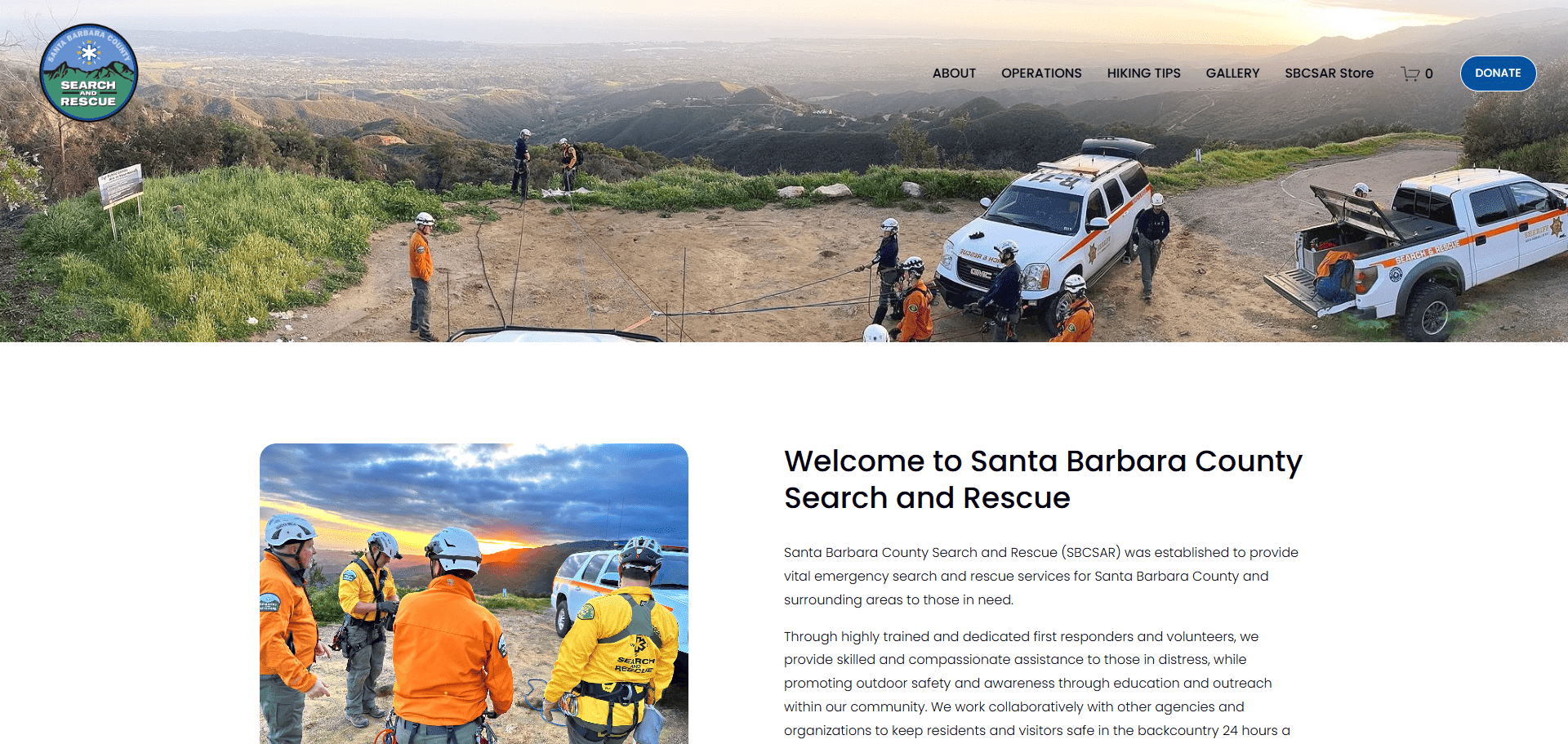
Santa Barbara County Search and Rescue makes the most of visuals and structure to explain a technical team to a general audience. The navigation covers About Us, the SBCSAR Team, Join the Team, History, Affiliations, Contact Info, Operations, Hiking Tips, and a Gallery, plus a Donate button and an online team store with a shopping cart, which gives supporters a way to help beyond a one-time gift. At the bottom of every page, a tap-to-call line reads “In an Emergency, call: 911,” so emergency guidance travels with the visitor no matter where they land. The Mutual Aid page is a clear example of explaining a complicated system simply: it describes how counties request help through the California Office of Emergency Services, how Cal OES contacts available teams in neighboring counties, how the team’s Mountain Rescue Association membership and snow and ice rescue expertise fit in, and how the system works in both directions. The K9 Search Unit page turns a technical topic into something personal, with a profile card for each dog showing its name, discipline (air scent and area, trailing, or human remains detection), status (mission ready, in training, or retired), and handler. It explains that training to the standards of the California Rescue Dog Association and Cal OES can take up to three years before a dog becomes mission ready, which helps donors and prospective volunteers understand the investment behind each team. A Hiking Tips page extends the team’s work into prevention. For teams with specialty units, mutual aid roles, or merchandise to sell, SBCSAR is an inspiring example.
Whether the strongest feature is a headline number bar, a candid recruitment page, an academy timeline, a profile card for each search dog, or a one-line “call 911” banner, every team above succeeds because it respects the visitor’s time and tells the truth about the work. If your search and rescue team serves the Bay Area, KO Websites builds websites that put emergency guidance first, recruit committed volunteers, and make it easy for supporters to give. Contact us today for a free consultation.
What Sets Our Search and Rescue Website Design Apart
Emergency Guidance That Cannot Be Missed
Families and agencies often reach a SAR website while someone is missing. We place clear 911 messaging at the top of every page, explain how your team is activated, and make it obvious what your team can and cannot do directly, so no one loses time looking for the wrong phone number. Our web design process starts with what a stressed visitor needs to see first.
Recruitment That Sets Honest Expectations
SAR is a serious commitment, and the best recruitment pages say so. We build recruitment hubs with orientation sign-ups, application timelines, requirements, academy schedules, fitness and training expectations, and an FAQ, so the people who apply understand the time, cost, and demands, and your team spends less time answering the same questions.
Donations and Nonprofit Transparency
Most SAR teams are volunteer-run 501(c)(3) organizations that fund their own training and equipment. We design donation pages that explain exactly what gifts support, display your nonprofit status, offer online giving and check options, recognize sponsors, and give donors confidence that contributions go to the mission.
Prevention Education and Mission Storytelling
SAR teams save the most time by preventing searches. We create wilderness safety and preparedness pages, mission summaries written with care for families, photo and video galleries, and event calendars that show your community what your volunteers do. See how we approach government and agency web design across the Bay Area.
Complete Search and Rescue Website Package
Emergency and Missing-Person Guidance
A prominent banner and dedicated page explaining when and how to call 911, how searches are requested, and how your team is activated, with clear wording for families, hikers, and partner agencies.
Volunteer Recruitment Hub
Application timelines, orientation registration, requirements and fitness expectations, academy schedules, medical certification guidance, FAQs, and an interest form, designed to attract committed applicants and reduce back-and-forth emails.
Donation and Sponsor Pages
Online giving, check and mailing instructions, designated funds, a clear statement of what donations buy, nonprofit identification details, and sponsor recognition. These connect to your ongoing website management so your content stays current.
Mission Archive and Public Education
Mission summaries, specialty team profiles, training calendars, wilderness safety resources, and event pages that show your community what your team does and how people can stay safe outdoors.
Specialized Search and Rescue Digital Solutions
County Sheriff SAR Team Websites
Websites for sheriff’s office search and rescue units that explain the relationship with the Sheriff, the team’s capabilities, how to join, and how to support the nonprofit that funds equipment and training.
Mountain Rescue and Technical Rescue Teams
Sites for teams with technical rock, snow and ice, swiftwater, or alpine capabilities, with pages for accreditations, disciplines, training standards, and deployment readiness.
K9 and Search Dog Teams
Pages that explain canine disciplines, certification standards, how handlers train, how agencies request teams, and how families and the public can support the work, including profile cards for each dog and handler.
Specialty Units: Mounted, Air, Dive, and Drone
Profiles of mounted posses, air support, dive teams, UAS, e-bike, and other specialty units, with photos, capabilities, and recruitment information for each.
Academy and Training Pages
Clear academy calendars, required courses, expectations for each phase, public training events where allowed, and training videos and resources for members.
Fundraising, Sponsorship, and Team Stores
Donation pages, sponsor walls, fundraiser event pages, gear wish lists, merchandise stores, and corporate partnership information that help your team raise the funds the Sheriff’s Office does not provide.
Member Areas and Website Migration
Secure member-only resources, calendars, and documents, plus migrations from outdated or template-based sites with redirects so your links and donor pages keep working. Ready to see how this works in practice? Explore our portfolio.
Serving Bay Area Search and Rescue Teams
Search and rescue volunteers cover everything from the coastal cliffs and redwood forests of the Peninsula to the hills of the East Bay and the open space of the North Bay. We work with teams and supporters across San Francisco, Oakland, San Jose, and Silicon Valley, as well as San Leandro, Castro Valley, Pleasanton, Livermore, and San Ramon. Every team has its own terrain, partners, and community, and we shape content to match.
Beyond Web Design: Complete Digital Communication
A strong SAR website works best when it is supported by consistent outreach. Our SEO strategies help volunteers and donors find your team when they search for local search and rescue opportunities. Local search optimization keeps your location and contact information accurate across Google Maps and directories. Social media marketing supports recruitment drives, fundraisers, and safety messaging, while video production creates recruitment, training, and “who we are” videos that show your team at its best. Ongoing website management and hosting keeps your site secure, updated, and reliable.
Your Questions About Search and Rescue Web Design Answered
What should a search and rescue website include?
At minimum: clear emergency guidance, a description of your team and how it is activated, capabilities and specialty teams, a recruitment page with requirements and timelines, a donation page with your nonprofit details, a calendar, contact information, and a way for members to log in or find internal resources. Many teams also add a mission archive, wilderness safety education, and a sponsors page.
How do you handle requests for help on the website?
In California, search and rescue is activated through the county Sheriff’s Office, so your website should send families and agencies to 911 and to the proper channel rather than inviting direct requests. We write that guidance with your team and your Sheriff’s Office so visitors know exactly what to do.
Can you build recruitment and orientation registration?
Yes. We build recruitment pages with timelines, requirements, FAQs, and registration links to your existing tools, such as event registration and application forms, so interested applicants can sign up for orientations and understand each step before applying.
How do donations work on the website?
We integrate the giving options your team already uses, such as online donation platforms, PayPal, and mailing instructions for checks, and design a donation page that explains what contributions fund, shows your 501(c)(3) status, and recognizes sponsors. Your team and your tax advisor remain responsible for donation receipts and compliance.
Can we publish mission reports and photos?
Yes, with care. Many teams publish mission summaries and photos to show their work. We can design the section and help you write summaries in a respectful tone, and your team and Sheriff’s Office decide what is appropriate to publish, especially where families or investigations are involved.
Can you build a members-only area?
Yes. We can create a protected area for calendars, training materials, callout information, and internal documents, or connect to the tools your team already uses, while keeping the public site focused on emergency guidance, recruitment, and donations.
What ongoing support do you provide after launch?
We provide hosting, security updates, backups, and content support so your site stays current, including help posting recruitment dates, academy schedules, donation campaigns, and mission updates. See what our clients say in our testimonials section.
Build a Search and Rescue Website That Brings Volunteers and Supporters to Your Team
Your volunteers give their time, their gear, and their nights and weekends to bring people home. Your website should work as hard as they do: it should tell families exactly where to turn, show future members what the work is really like, and make it simple for your community to support your mission. KO Websites designs search and rescue websites that do all three.